



 Chat with AI
Exam 17: Trusts

Exam 1: Taxation-Its Role in Decision Making10 Questions
Exam 2: Fundamentals of Tax Planning10 Questions
Exam 3: Liability for Tax, Income Determination, and Administration of the Income Tax System9 Questions
Exam 4: Income From Employment9 Questions
Exam 5: Income From Business10 Questions
Exam 6: The Acquisition, Use, and Disposal of Depreciable Property10 Questions
Exam 7: Income From Property9 Questions
Exam 8: Gains and Losses on the Disposition of Capital Propertycapital Gains10 Questions
Exam 9: Other Income, Other Deductions, and Special Rules for Completing Net Income for Tax Purposes10 Questions
Exam 10: Individuals: Determination of Taxable Income and Taxes Payable10 Questions
Exam 11: Corporationsan Introduction10 Questions
Exam 12: Organization, Capital Structures, and Income Distributions of Corporations10 Questions
Exam 13: The Canadian-Controlled Private Corporation8 Questions
Exam 14: Multiple Corporations and Their Reorganization8 Questions
Exam 15: Partnerships8 Questions
Exam 16: Limited Partnerships and Joint Ventures8 Questions
Exam 17: Trusts8 Questions
Exam 18: Business Acquisitions and Divestituresassets Versus Shares8 Questions
Exam 19: Business Acquisitions and Divestiturestax-Deferred Sales8 Questions
Exam 20: Domestic and International Business Expansion7 Questions
Exam 21: Tax Aspects of Corporate Financing8 Questions
Exam 22: Gsthst Overview8 Questions
Select questions type


Which of the following accurately describes one of the rules pertaining to inter vivos trusts?

Free
(Multiple Choice)
4.9/5  (84)
(84) Correct Answer: Verified
D
Briefly answer the following questions:
With regard to non-spousal trusts:
A)What is the purpose of the 21-Year Rule?
B)What event occurs on the 21st anniversary of a trust?
C)What types of properties are subject to the 21-Year Rule?
D)How can the consequences of the 21-Year Rule be avoided?
With regard to spousal trusts:
E)What is the exception to the 21-Year Rule for spousal trusts?
Free
(Essay)
4.9/5 (80)
(80) Correct Answer:Verified
VerifiedA)The 21 Year Rule prevents trusts from escaping tax on specific types of property held for long periods of time.
B)The specific properties of the trust are deemed to be sold and reacquired at their market values,realizing tax gains and losses on the deemed disposition.
C)Capital properties (non-depreciable),depreciable properties,land that is inventory,and resource property are subject to the 21 Year Rule.
D)Properties can be transferred to the beneficiaries prior to the 21st anniversary,at their tax cost,thereby deferring the tax effects.
E)Spousal trusts are exempt from realizing a deemed disposition of the properties at the first 21 Year anniversary.
Jasmine is the beneficiary of an inter vivos trust.During 20x4 the trust received the following income:
Capital gains: $16,000
Interest: $12,000
Non-eligible dividends: $8,000
One half of the trust's income from 20x4 was paid to Jasmine,who does not currently have any other sources of income.The remainder of the income remained in the trust.
Required:
a)Determine Jasmine's personal federal tax.
b)Calculate the federal tax for the trust.
(Round all amounts to zero decimal places,and apply tax rates and rules applicable to 2018.)
Free
(Essay)
4.8/5 (79)
(79) Correct Answer:Verified
Verified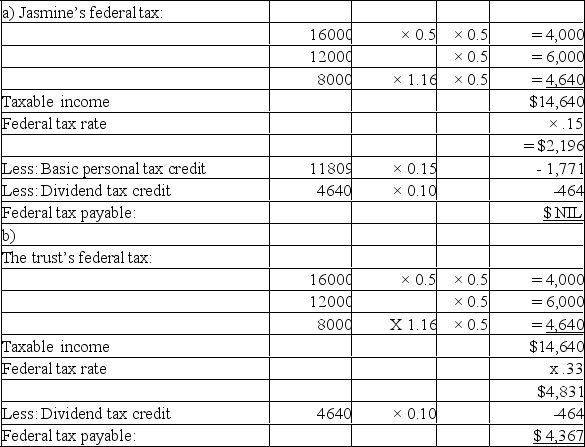
If a trust qualifies as a spousal trust,which of the following is FALSE?
(Multiple Choice)
4.9/5 (85)
(85) Which of the following applies to a testamentary trust that is designated as a graduated rate estate (GRE)?
(Multiple Choice)
4.9/5 (79)
(79) A non-spousal trust account holds two buildings as its assets.Building 1 originally cost $150,000 and Building 2 originally cost $210,000.It is now the 21st anniversary of the trust,and the assets have not been transferred to the beneficiary.The undepreciated capital cost of Building 1 is $85,000 and its market value is $200,000.The undepreciated capital cost of Building 2 is $145,000 and its market value is $190,000.Which costs will be the deemed acquisition values of the buildings for the trust?
(Multiple Choice)
4.8/5 (86)
(86) Which of the following statements is TRUE regarding trusts?
(Multiple Choice)
4.9/5 (103)
(103) Walter passed away this year,leaving a will bequeathing his wife with $80,000 in cash,in addition to his stocks and land,to be held in a spousal trust on her behalf.The trust will pay her the annual income generated by the trust during her lifetime.
Additionally,Walter's 33 year old son,Steven,is to receive a building to be held in a trust until Steven reaches the age of 45.Steven will also receive the assets in his mother's (Walter's wife)trust upon her death.
The assets transferred to Walter's wife consist of land with an ACB of $100,000 and a FMV of $300,000,and stocks valued at $200,000 with a cost base of $150,000.
The building transferred to Steven has an ACB of $200,000,UCC of $180,000,and FMV of $300,000.
Required:
A)What are the immediate tax consequences (identify the income type and amount)to Walter? Show calculations.
B)What are the immediate tax consequences for the assets received by the trust for Walter's wife?
(Essay)
4.8/5 (80)
(80) 
Filters
- Essay(0)
- Multiple Choice(0)
- Short Answer(0)
- True False(0)
- Matching(0)