



 Chat with AI
Exam 12: Organization, Capital Structures, and Income Distributions of Corporations

Exam 1: Taxation-Its Role in Decision Making10 Questions
Exam 2: Fundamentals of Tax Planning10 Questions
Exam 3: Liability for Tax, Income Determination, and Administration of the Income Tax System9 Questions
Exam 4: Income From Employment9 Questions
Exam 5: Income From Business10 Questions
Exam 6: The Acquisition, Use, and Disposal of Depreciable Property10 Questions
Exam 7: Income From Property9 Questions
Exam 8: Gains and Losses on the Disposition of Capital Propertycapital Gains10 Questions
Exam 9: Other Income, Other Deductions, and Special Rules for Completing Net Income for Tax Purposes10 Questions
Exam 10: Individuals: Determination of Taxable Income and Taxes Payable10 Questions
Exam 11: Corporationsan Introduction10 Questions
Exam 12: Organization, Capital Structures, and Income Distributions of Corporations10 Questions
Exam 13: The Canadian-Controlled Private Corporation8 Questions
Exam 14: Multiple Corporations and Their Reorganization8 Questions
Exam 15: Partnerships8 Questions
Exam 16: Limited Partnerships and Joint Ventures8 Questions
Exam 17: Trusts8 Questions
Exam 18: Business Acquisitions and Divestituresassets Versus Shares8 Questions
Exam 19: Business Acquisitions and Divestiturestax-Deferred Sales8 Questions
Exam 20: Domestic and International Business Expansion7 Questions
Exam 21: Tax Aspects of Corporate Financing8 Questions
Exam 22: Gsthst Overview8 Questions
Select questions type


Which of the following scenarios would be appropriate for a section 85 rollover?

Free
(Multiple Choice)
4.8/5  (88)
(88) Correct Answer: Verified
C
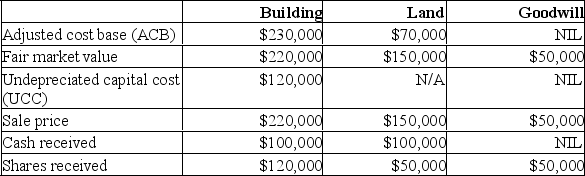
Janko Corp.has transferred the following three assets to Jumbo Corp.,a Canadian controlled private corporation,under section 85 of the Income Tax Act.
 equired:
Determine the following amounts:
A)The minimum amount that Janko may elect to transfer each asset in the rollover based on the information provided
B)Janko's income or loss for tax purposes as a result of the rollover
C)The ACB of the shares received by Janko following the rollover
D)The PUC of the shares received by Janko following the rollover
equired:
Determine the following amounts:
A)The minimum amount that Janko may elect to transfer each asset in the rollover based on the information provided
B)Janko's income or loss for tax purposes as a result of the rollover
C)The ACB of the shares received by Janko following the rollover
D)The PUC of the shares received by Janko following the rolloverFree
(Essay)
4.9/5 (83)
(83) Correct Answer:Verified
VerifiedR

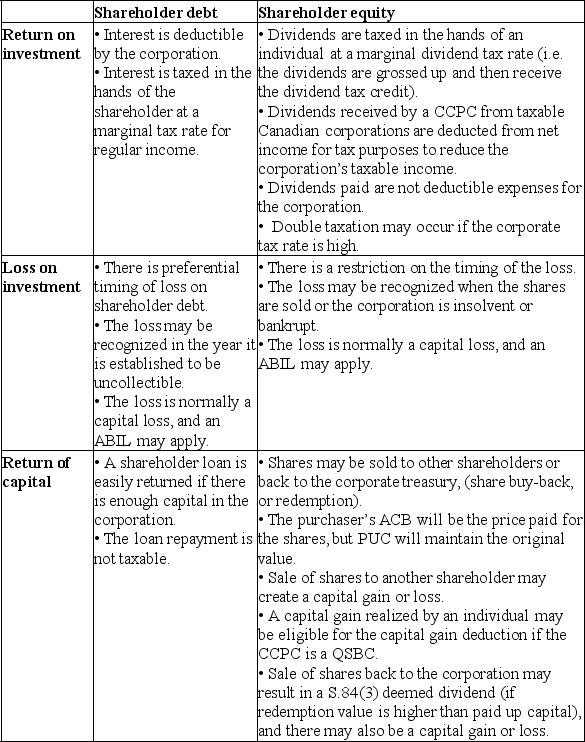
There are significant differences in the tax treatment of shareholder debt and shareholder equity from the perspective of both the CCPC and the shareholders.
Required:
List one tax consequences for each of the following:
1)Return on investment - shareholder debt
2)Loss on investment - shareholder debt
3)Return of capital - shareholder debt
4)Return on investment - shareholder equity
5)Loss on investment - shareholder equity
6)Return of capital - shareholder equity
Free
(Essay)
4.8/5 (81)
(81) Correct Answer:Verified
VerifiedSome of the answers students might include are listed here:
Green Co.transferred a small piece of land to one of its shareholders as a dividend in kind.The land originally cost $50,000 and had a fair market value of $175,000 at the time of the transfer.The corporation will realize ________,and the shareholder will realize ________.
(Multiple Choice)
4.9/5 (76)
(76) Anthony is the sole shareholder of Glass Co.He would like to lend $500,000 to his company by way of a shareholder loan.He is not sure whether to issue an interest free loan or a loan with an interest rate of 10%.Anthony does not pay himself a salary,but rather issues all after-tax profits to himself in the form of a dividend.
Required:
Calculate the total combined tax liability for Anthony and Glass Co.under both alternatives (an interest free loan and a loan with 10% interest).(Assume that CRA's prescribed rate of interest is 2%,Anthony's personal tax rate is 50%,his marginal tax rate on dividends is 43%,and Glass Co.has income of $200,000,subject to a 13% tax rate.)
B)Has double taxation occurred in either scenario?
(Essay)
4.9/5 (89)
(89) Corporation A is a Canadian controlled private corporation and Corporation B is a public Canadian corporation.Both corporations have a paid-up capital balance of $25,000.Which of these statements is TRUE,provided the proper legal steps are followed?
(Multiple Choice)
4.8/5 (85)
(85) Tony Brown sold 5000 of his shares back to ABC Co.for $25,000 during the current fiscal year.He purchased these shares from Carrie White three years ago for $15,000.Carrie had originally purchased the shares from the corporate treasury for $10,000.Which of the following tax consequences will Tony recognize?
(Multiple Choice)
4.9/5 (76)
(76) Robert Smith owns 20% of the shares of Quarks Inc.,a Canadian qualified small business corporation.He purchased the shares from a previous shareholder for $50,000.The stated paid up capital of the shares is $10,000.Two other shareholders own equal portions of the remaining shares of Quarks.
Robert has decided to sell his shares,which have a market value of $120,000.The shares are to be sold either to the two other shareholders,or back to the corporate treasury.All three shareholders used all of their capital gains deductions earlier in the year.
Robert has employment income of $185,000,a capital gain in the amount of $50,000,and property income of $20,000 for the current year.
All three shareholders are in a 50% tax bracket.The marginal rate on dividends is 43%.The corporate tax rate for Quarks is 13%.
Required:
A)Determine the tax cost for Robert is he sells his shares to:
1)the other shareholders.
2)the corporate treasury.
B)Determine the cost of the share purchase for:
1)the other shareholders,assuming that the purchase will be made using dividend income paid to the two shareholders from the corporation.
2)the corporation,assuming that the purchase will be made from business profits.
C)Which option is preferential for 1)Robert and 2)the other shareholders?
D)What is the significance of Robert's $50,000 capital gain received in the year if he were to sell his shares back to the corporate treasury?
(Essay)
4.8/5 (89)
(89) Which of the following statements is TRUE regarding the disposal of shares by a shareholder?
(Multiple Choice)
4.9/5 (77)
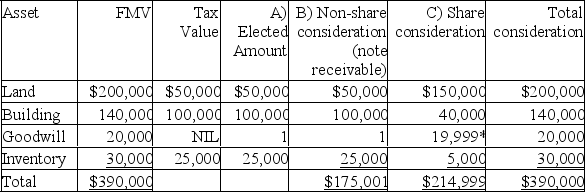
(77) Ben is incorporating his proprietorship and would like to transfer the following capital assets to the new corporation.
 Ben will also transfer his inventory which originally cost $25,000 and has a fair market value of $30,000.
Ben wishes to defer all gains at this time so has elected to use a section 85 rollover.He will receive the maximum note receivable possible and the remainder of the transfer in preferred shares.
Required:
A)What is the elected value for each of the assets transferred under section 85?
B)What is the value of the note receivable that Ben will receive from those assets which benefit from section 85? (Show the amounts for each asset,and the total for all.)
C)What is the value of the preferred shares that Ben must receive in order to defer any income inclusions at this point in time?
Ben will also transfer his inventory which originally cost $25,000 and has a fair market value of $30,000.
Ben wishes to defer all gains at this time so has elected to use a section 85 rollover.He will receive the maximum note receivable possible and the remainder of the transfer in preferred shares.
Required:
A)What is the elected value for each of the assets transferred under section 85?
B)What is the value of the note receivable that Ben will receive from those assets which benefit from section 85? (Show the amounts for each asset,and the total for all.)
C)What is the value of the preferred shares that Ben must receive in order to defer any income inclusions at this point in time?
(Essay)
4.8/5 (70)
(70) 
Filters
- Essay(0)
- Multiple Choice(0)
- Short Answer(0)
- True False(0)
- Matching(0)