



 Chat with AI
Exam 20: Optimum Currency Areas and the European Experience

Exam 1: Introduction39 Questions
Exam 2: World Trade: An Overview25 Questions
Exam 3: Labor Productivity and Comparative Advantage: The Ricardian Model66 Questions
Exam 4: Specific Factors and Income Distribution68 Questions
Exam 5: Resources and Trade: The Heckscher-Ohlin Model63 Questions
Exam 6: The Standard Trade Model43 Questions
Exam 7: External Economies of Scale and the International Location of Production29 Questions
Exam 8: Firms in the Global Economy: Export Decisions, Outsourcing, and Multinational Enterprises64 Questions
Exam 9: The Instruments of Trade Policy62 Questions
Exam 10: The Political Economy of Trade Policy61 Questions
Exam 11: Trade Policy in Developing Countries43 Questions
Exam 12: Controversies in Trade Policy47 Questions
Exam 13: National Income Accounting and the Balance of Payments78 Questions
Exam 14: Exchange Rates and the Foreign Exchange Market: An Asset Approach76 Questions
Exam 15: Money, Interest Rates, and Exchange Rates65 Questions
Exam 16: Price Levels and the Exchange Rate in the Long Run80 Questions
Exam 17: Output and the Exchange Rate in the Short Run111 Questions
Exam 18: Fixed Exchange Rates and Foreign Exchange Intervention80 Questions
Exam 19: International Monetary Systems: An Historical Overview162 Questions
Exam 20: Optimum Currency Areas and the European Experience95 Questions
Exam 21: Financial Globalization: Opportunity and Crisis125 Questions
Exam 22: Developing Countries: Growth, Crisis, and Reform129 Questions
Select questions type


What is one way to offset the economic stability loss due to fixed exchange rates?
(Essay)
4.9/5  (82)
(82) Explain why the European Union's current combination of rapid capital migration with limited labor migration may actually raise the cost of adjusting to product market shocks without exchange rate change?
(Essay)
4.8/5 (68)
(68) The credibility theory of the EMS implies in effect that the political costs of violating international exchange rate agreements
(Multiple Choice)
4.8/5 (75)
(75) The result of the reunification of eastern and western Germany in 1990
(Multiple Choice)
4.7/5 (77)
(77) Explain why even owners of capital that cannot be moved can avoid more of the economic stability loss due to fixed exchange rates when Norway's economy is open to capital flows.
(Essay)
4.8/5 (76)
(76) Draw the graph of the GG and LL schedules and explain the logic behind the slopes of each of the schedules.
(Essay)
4.8/5 (89)
(89) Which one of the following statements is true for Norway, a non-euro country?
(Multiple Choice)
4.9/5 (82)
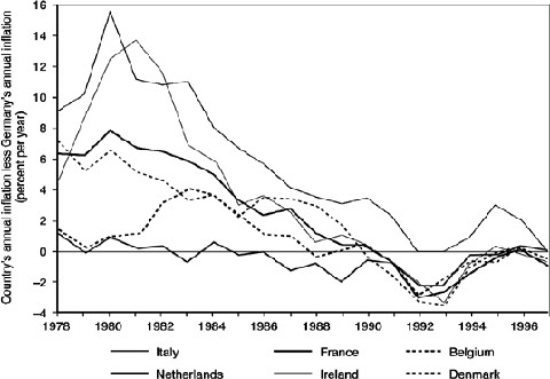
(82) On average, from 1978-1996, the country with the highest rate of annual inflation was
(Multiple Choice)
4.8/5 (80)
(80) 
Describe the effects of the reunification of eastern and western Germany in 1990 on both Germany and its neighboring European countries using the AA-DD framework.
(Essay)
4.8/5 (77)
(77) Explain why it may make sense for the United States, Japan, and Europe to allow their mutual exchange rate to float?
(Essay)
4.9/5 (87)
(87) Discuss the trends and implications of the following graph, especially with respect to the official start of the EMU on January 1, 1999. 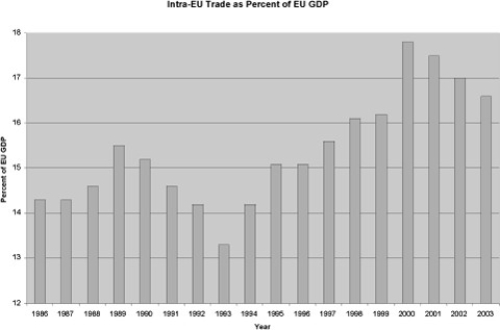
(Essay)
4.8/5 (87)
(87) "Given that labor remains relatively immobile within Europe, the European Union's success in liberalizing its capital flows may have worked perversely to worsen the economic stability loss due to the process of monetary unification." Discuss.
(Essay)
4.9/5 (89)
(89) 
Filters
- Essay(0)
- Multiple Choice(0)
- Short Answer(0)
- True False(0)
- Matching(0)