



 Chat with AI
Exam 14: Exchange Rates and the Foreign Exchange Market: An Asset Approach

Exam 1: Introduction39 Questions
Exam 2: World Trade: An Overview25 Questions
Exam 3: Labor Productivity and Comparative Advantage: The Ricardian Model66 Questions
Exam 4: Specific Factors and Income Distribution68 Questions
Exam 5: Resources and Trade: The Heckscher-Ohlin Model63 Questions
Exam 6: The Standard Trade Model43 Questions
Exam 7: External Economies of Scale and the International Location of Production29 Questions
Exam 8: Firms in the Global Economy: Export Decisions, Outsourcing, and Multinational Enterprises64 Questions
Exam 9: The Instruments of Trade Policy62 Questions
Exam 10: The Political Economy of Trade Policy61 Questions
Exam 11: Trade Policy in Developing Countries43 Questions
Exam 12: Controversies in Trade Policy47 Questions
Exam 13: National Income Accounting and the Balance of Payments78 Questions
Exam 14: Exchange Rates and the Foreign Exchange Market: An Asset Approach76 Questions
Exam 15: Money, Interest Rates, and Exchange Rates65 Questions
Exam 16: Price Levels and the Exchange Rate in the Long Run80 Questions
Exam 17: Output and the Exchange Rate in the Short Run111 Questions
Exam 18: Fixed Exchange Rates and Foreign Exchange Intervention80 Questions
Exam 19: International Monetary Systems: An Historical Overview162 Questions
Exam 20: Optimum Currency Areas and the European Experience95 Questions
Exam 21: Financial Globalization: Opportunity and Crisis125 Questions
Exam 22: Developing Countries: Growth, Crisis, and Reform129 Questions
Select questions type


If the dollar interest rate is 10 percent, the euro interest rate is 12 percent, then
(Multiple Choice)
4.8/5  (68)
(68) Explain the purpose of the following figure 14-2 from the text in the context of the interest rates on the dollar and the Japanese Yen between 1980 and 2010. 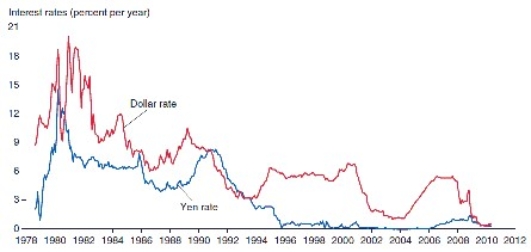
(Essay)
4.9/5 (79)
(79) Suppose that the one-year forward price of euros in terms of dollars is equal to $1.113 per euro. Further, assume that the spot exchange rate is $1.05 per euro, and the interest rate on dollar deposits is 10 percent and on euro it is 4 percent. Under these assumptions,
(Multiple Choice)
4.9/5 (80)
(80) Explain what is a "vehicle currency." Why is the U.S. dollar considered a vehicle currency?
(Essay)
4.9/5 (85)
(85) Explain why (holding interest rates constant), a rise in the expected depreciation in a country's currency leads to depreciation of that currency today.
(Essay)
5.0/5 (82)
(82) The covered interest rate parity condition can be stated as follows: The interest rate on dollar deposits equals the interest rate on euro deposits ________ the forward ________ on dollars against euros.
(Multiple Choice)
4.8/5 (76)
(76) If the dollar interest rate is 4 percent, the euro interest rate is 6 percent, then
(Multiple Choice)
4.9/5 (67)
(67) If the goods' money prices do not change, an appreciation of the dollar against the pound
(Multiple Choice)
4.7/5 (87)
(87) Determine for each, whether the interest parity condition holds or not, if 
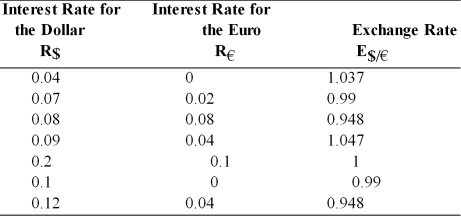
(Essay)
4.8/5 (76)
(76) If the dollar interest rate is 10 percent and the euro interest rate is 6 percent, and the expected return on dollar depreciation against the euro is 8 percent, then
(Multiple Choice)
4.9/5 (67)
(67) How many British pounds would it cost to buy a pair of American designer jeans costing $45 if the exchange rate is 1.50 dollars per British pound?
(Multiple Choice)
4.8/5 (75)
(75) How many dollars would it cost to buy an Edinburgh Woolen Mill sweater costing 50 British pounds if the exchange rate is 1.80 dollars per one British pound?
(Multiple Choice)
4.9/5 (73)
(73) Which one of the following statements is the most accurate?
(Multiple Choice)
4.7/5 (82)
(82) 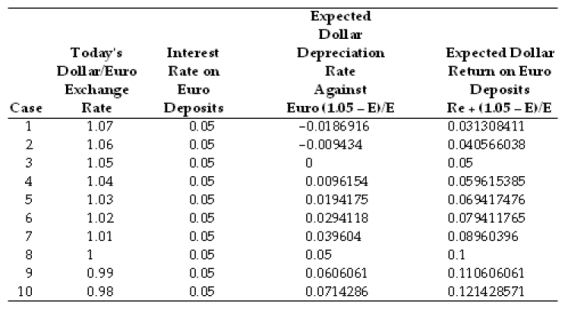 -Using the data in the table above, plot today's dollar/euro exchange rate against the expected dollar return on euro deposits.
 (Essay)
4.9/5 (80)
(80) 
Filters
- Essay(0)
- Multiple Choice(0)
- Short Answer(0)
- True False(0)
- Matching(0)