



 Chat with AI
Exam 12: Controversies in Trade Policy

Exam 1: Introduction39 Questions
Exam 2: World Trade: An Overview25 Questions
Exam 3: Labor Productivity and Comparative Advantage: The Ricardian Model66 Questions
Exam 4: Specific Factors and Income Distribution68 Questions
Exam 5: Resources and Trade: The Heckscher-Ohlin Model63 Questions
Exam 6: The Standard Trade Model43 Questions
Exam 7: External Economies of Scale and the International Location of Production29 Questions
Exam 8: Firms in the Global Economy: Export Decisions, Outsourcing, and Multinational Enterprises64 Questions
Exam 9: The Instruments of Trade Policy62 Questions
Exam 10: The Political Economy of Trade Policy61 Questions
Exam 11: Trade Policy in Developing Countries43 Questions
Exam 12: Controversies in Trade Policy47 Questions
Exam 13: National Income Accounting and the Balance of Payments78 Questions
Exam 14: Exchange Rates and the Foreign Exchange Market: An Asset Approach76 Questions
Exam 15: Money, Interest Rates, and Exchange Rates65 Questions
Exam 16: Price Levels and the Exchange Rate in the Long Run80 Questions
Exam 17: Output and the Exchange Rate in the Short Run111 Questions
Exam 18: Fixed Exchange Rates and Foreign Exchange Intervention80 Questions
Exam 19: International Monetary Systems: An Historical Overview162 Questions
Exam 20: Optimum Currency Areas and the European Experience95 Questions
Exam 21: Financial Globalization: Opportunity and Crisis125 Questions
Exam 22: Developing Countries: Growth, Crisis, and Reform129 Questions
Select questions type


The Ricardian model of comparative advantage lends support to the argument that
(Multiple Choice)
4.7/5  (69)
(69) The Brander-Spencer model identified market failure in certain industries due to
(Multiple Choice)
4.9/5 (84)
(84) It is argued that high-tech industries typically generate new technologies but cannot fully appropriate the commercial benefits associated with their inventions or discoveries. If this is true then in order to maximize a country's real income, the government should
(Multiple Choice)
5.0/5 (86)
(86) Japan's protection of its semiconductor (RAM) producers is today seen as an object lesson in
(Multiple Choice)
5.0/5 (70)
(70) 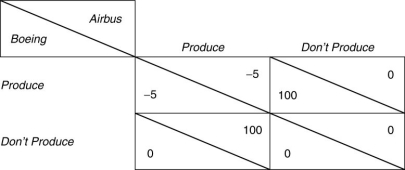 -Refer to the above table. Suppose Airbus is set to produce the aircraft before Boeing. Which company will enter the market?
 (Short Answer)
4.8/5 (91)
(91) When one applies the Heckscher-Ohlin model of trade to the issue of trade-related income redistributions, one must conclude that North South trade, such as U.S.-Mexico trade,
(Multiple Choice)
4.9/5 (77)
(77)
-Refer to the above table. Suppose the U.S. government (but not Europe) offers a $10 million subsidy?
-Refer to the above table. Suppose the U.S. government (but not Europe) offers a $10 million subsidy? (Essay)
4.9/5 (88)
(88)
-Refer to the above table. How could the U.S. government justify its decision to offer a subsidy to a profitable and successful business?
-Refer to the above table. How could the U.S. government justify its decision to offer a subsidy to a profitable and successful business? (Essay)
4.8/5 (74)
(74) The argument that strategic planning is not likely to be practical due to insufficient information means that
(Multiple Choice)
4.9/5 (78)
(78) The fact that clothing sold in Walmart are produced by very poorly paid workers in Honduras, is a fact that if taken into account
(Multiple Choice)
4.9/5 (72)
(72) Spencer and Brander's model highlights the conventional assumption that
(Multiple Choice)
4.7/5 (75)
(75) In today's world markets, poor developing countries tend to rely primarily on exports of
(Multiple Choice)
4.8/5 (92)
(92) It may be argued that Japan's explicit promotion of its microchip industry was an excellent example of successful industrial policy. What criteria would you apply to determine whether such a policy is or is not successful? Judging from your own stated criteria, was Japan's exercise successful? Why or why not? What information would a government require in order to increase the probability that its industrial policy would promote long term self-generated economic growth?
(Essay)
4.9/5 (79)
(79) The proposal that trade agreements should include a system which monitors worker conditions and make the results available to consumers in the rich importing country
(Multiple Choice)
5.0/5 (73)
(73) The Shipbreakers of Alang utilize much labor and little capital, thereby supporting the applicability of the
(Multiple Choice)
4.9/5 (89)
(89) In the Brander-Spencer model the subsidy raises profits by more than the subsidy because of
(Multiple Choice)
4.8/5 (93)
(93) The invocation of beggar-thy-neighbor arguments with respect to industrial policies
(Multiple Choice)
4.8/5 (69)
(69) The WTO seems at times to be interfering in domestic policy since
(Multiple Choice)
4.8/5 (67)
(67) 
Filters
- Essay(0)
- Multiple Choice(0)
- Short Answer(0)
- True False(0)
- Matching(0)