



 Chat with AI
Exam 15: Integrated Production Processes IPP

Exam 1: Introduction to Accounting Information Systems122 Questions
Exam 2: Enterprise Systems141 Questions
Exam 3: Electronic Business E-Business Systems122 Questions
Exam 4: Documenting Information Systems129 Questions
Exam 5: Database Management Systems175 Questions
Exam 6: Relational Databases and SQL103 Questions
Exam 7: Controlling Information Systems: Introduction to Enterprise Risk Management and Internal Control161 Questions
Exam 8: Controlling Information Systems: Introduction to Pervasive Controls159 Questions
Exam 9: Controlling Information Systems: Business Process and Application Controls135 Questions
Exam 10: The Order Entrysales Oes Process134 Questions
Exam 11: The Billingaccounts Receivablecash Receipts Barcr Process134 Questions
Exam 12: The Purchasing Process141 Questions
Exam 13: The Accounts Payablecash Disbursements Apcd Process118 Questions
Exam 14: The Human Resources Process HR Management and Payroll Processes121 Questions
Exam 15: Integrated Production Processes IPP118 Questions
Exam 16: The General Ledger and Business Reporting GLBR Process107 Questions
Exam 17: Acquiring and Implementing Accounting Information Systems206 Questions
Select questions type


The computer technology application that automates the product design process, including but not limited to the functions of geometric modeling, materials stress and strain analysis, drafting, storing product specifications, and mechanical simulation of a product's performance, is called CAD/CAE.
(True/False)
4.8/5  (78)
(78) Which of the following is an ERP add on system that organizes data by product, including designs, manufacturing specifications, quality and warranty performance?
(Multiple Choice)
4.9/5 (71)
(71) The ______________________________ specifies the operations necessary to complete a subassembly or finished good and the sequence of these operations.
(Short Answer)
4.8/5 (87)
(87) ______________________________ is the time it takes from when authorization is made for goods to be produced to when the goods are completed.
(Short Answer)
4.7/5 (88)
(88) The shop floor control process is devoted to monitoring and recording the status of manufacturing orders as they proceed through the factory.
(True/False)
4.8/5 (83)
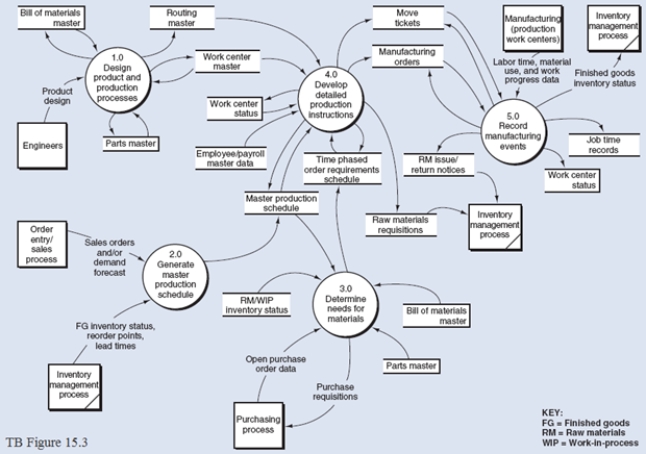
(83) The process within TB Figure 15.3, Bubble 3.0 might be described as follows: After the master production schedule is determined, an important step in completing the production in a timely manner is identifying, ordering, and receiving materials. Materials requirements planning is a process that uses bills of material, raw material and WIP inventory status data, open order data, and the master production schedule to calculate a time-phased order requirements schedule for materials and subassemblies. The schedule shows the time period when a manufacturing order or purchase order should be released so that the subassemblies and raw materials will be available when needed. The process involves working backward from the date production is to begin to determine the timing for manufacturing subassemblies and then moving back further to determine the date that orders for materials must be issued into the purchasing process. In an enterprise system, this process is performed automatically, using a variety of data from the enterprise database including:
*Bills of materials, showing the items and quantites required as developed by engineerng.
*Parts master data, which contains infarmation about part number, description, unit of measure, where used, arder policy. lead tine, and safety stack.
*Raw materials and WIP inventory status data showing the current quantities an hand and quantities already reserved for production for the materials and subassemblies.
*Open purchase order data showring the existing arders for materials. The process begins by exploding the bill of materials to determine the total of each component required to manufacture a given quantity of an upper level assembly or a subassembly specified in the master production schedule. Based on lead time data for producing and ordering materials and subassembly requirements are output in a time-phased order requirements schedule. Based on this schedule, and open PO data, purchase requisitions are generated and sent to purchasing.
Required:
Refer to TB Figure 15.3. Prepare a Level 1 data flow diagram for the materials requirements planning process only.
(Essay)
4.8/5 (68)
(68) The process of ______________________________ involves determining the total of each component required to manufacture a given quantity of an upper-level assembly or subassembly.
(Short Answer)
4.8/5 (81)
(81) Capable to promise planning is the accumulation of the data on current inventories, sales commitments, and planned production to determine whether the production of finished goods will be sufficient to commit to additional sales orders.
(True/False)
4.7/5 (70)
(70) Supply chain management software provides available to promise planning and capable to promise planning.
(True/False)
4.8/5 (76)
(76) ______________________________ is an automated decision support system that generates manufacturing operations instructions and routings based on information about machining requirements and machine capabilities.
(Short Answer)
4.9/5 (80)
(80) Product lifecycle management (PLM) systems are ERP modules or enterprise system add-ons that organize data by product, including designs, manufacturing specifications, quality, and warranty performance.
(True/False)
4.9/5 (64)
(64) Which of the following involves short production runs, continuous flow of operations, cellular manufacturing, reduced floor space, and reduced WIP?
(Multiple Choice)
4.9/5 (80)
(80) The inventory production schedule is a statement of specific production goals developed from forecasts of demand, actual sales orders, or inventory information.
(True/False)
5.0/5 (84)
(84) The computer technology application that automates the product design process, including but not limited to the functions of geometric modeling, materials stress and strain analysis, drafting, storing product specifications, and mechanical simulation of a product's performance, is called ______________________________.
(Short Answer)
4.9/5 (91)
(91) Which of the following is not one of the key drivers of manufacturing competitiveness in a global market defined by uncertainty, change and complexity according to the Deloitte Touche survey?
(Multiple Choice)
4.7/5 (76)
(76) Cost drivers measure the amount of an activity performed to explain activity costs.
(True/False)
4.8/5 (88)
(88) Designing ground-breaking products and getting them to market quickly is an example of:
(Multiple Choice)
4.7/5 (79)
(79) A process costing is a costing approach where detailed costs to perform activities throughout the value chain are computed and can be managed or assigned to cost objects, including products.
(True/False)
4.8/5 (93)
(93) 
Filters
- Essay(0)
- Multiple Choice(0)
- Short Answer(0)
- True False(0)
- Matching(0)