



 Chat with AI
Exam 22: Frontiers of Microeconomics

Exam 1: Ten Principles of Economics439 Questions
Exam 2: Thinking Like an Economist617 Questions
Exam 3: Interdependence and the Gains From Trade527 Questions
Exam 4: The Market Forces of Supply and Demand698 Questions
Exam 5: Elasticity and Its Application595 Questions
Exam 6: Supply, Demand, and Government Policies644 Questions
Exam 7: Consumers, Producers, and the Efficiency of Markets549 Questions
Exam 8: Application: The Costs of Taxation511 Questions
Exam 9: Application: International Trade493 Questions
Exam 10: Externalities524 Questions
Exam 11: Public Goods and Common Resources433 Questions
Exam 12: The Design of the Tax System551 Questions
Exam 13: The Costs of Production420 Questions
Exam 14: Firms in Competitive Markets543 Questions
Exam 15: Monopoly637 Questions
Exam 16: Monopolistic Competition587 Questions
Exam 17: Oligopoly496 Questions
Exam 18: The Markets for the Factors of Production564 Questions
Exam 19: Earnings and Discrimination490 Questions
Exam 20: Income Inequality and Poverty457 Questions
Exam 21: The Theory of Consumer Choice440 Questions
Exam 22: Frontiers of Microeconomics441 Questions
Select questions type


Table 22-18
The following table shows the preferences of four types of voters over four possible alternatives as well as the percentage of the electorate with the given preferences.
 -Refer to Table 22-18. In a majority vote between alternatives X and Y, what percentage of the votes would X receive?
 (Multiple Choice)
4.8/5  (66)
(66) You own an ice cream store and are concerned that an employee may be giving generous scoops to friends and relatives and smaller scoops to some other customers. This may be reducing sales. If you want your employee to stop giving larger scoops to friends and relatives, which of the following is not a good approach?
(Multiple Choice)
4.9/5 (74)
(74) Table 22-11
Five voters must choose from among four options: A, B, C, or D. Each voter's preferences are summarized in the table below. Options higher in the table are more preferred by the voter.
 -Refer to Table 22-11. Which pairwise voting scheme would result in outcome D?
 (Multiple Choice)
4.8/5 (67)
(67) An action taken by an informed party to reveal private information to an uninformed party is called
(Short Answer)
4.7/5 (72)
(72) Table 22-13
A high school Spanish class and their teacher are planning to take a Spring Break trip abroad but they have to decide where to go. They have narrowed the options to: Spain, Mexico, Ecuador, and Costa Rica. The voters' preferences are shown in the table below.
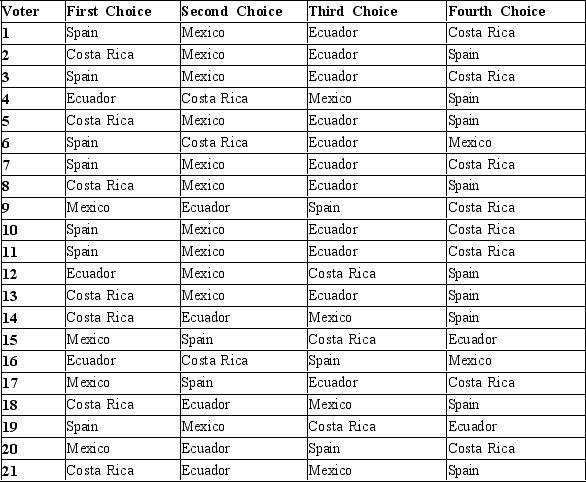 -Refer to Table 22-13. In a pairwise election between Costa Rica and Ecuador and then a second election between the winner and Mexico, which countries are chosen?
 (Multiple Choice)
4.8/5 (89)
(89) People with hidden health problems are more likely to buy health insurance than are other people. This is an example of
(Multiple Choice)
4.9/5 (79)
(79) A travel agency offers a money-back guarantee for vacationers taking their first cruise in case they do not enjoy the experience. This guarantee is an example of
(Short Answer)
4.8/5 (80)
(80) Susan buys automobile insurance from Provident Insurance Company. If Susan avoids having an accident for three years, Provident will reduce the premiums she has to pay for her insurance. Nevertheless, she routinely drives while eating or texting and speeds up to try to make it through yellow lights.
(Multiple Choice)
4.7/5 (88)
(88) Borda count is a voting method often used in polls that rank sports teams.
(True/False)
5.0/5 (85)
(85) When a corporation decides to include its own corporate stock as part of the compensation for its employees, it is trying to solve the
(Multiple Choice)
5.0/5 (77)
(77) According to behavioral economics, participants in a half-marathon are likely to have trained
(Multiple Choice)
4.9/5 (79)
(79) Mankiw argues that a primary difference between taxing products like gasoline and taxing soda and other sugary drinks is that
(Multiple Choice)
4.9/5 (77)
(77) Scenario 22-3
At issue in a particular city vote is how much to spend, per person, on road repair next year. Among the 10,000 voters, 2,900 prefer to spend $500 per person, but no more; 2,200 prefer to spend $600 per person, but no more; 1,900 prefer to spend $800 per person, but no more; 1,600 prefer to spend $1,200 but no more, and 1,400 prefer to spend $1,400 per person, but no more.
-Refer to Scenario 22-3. If there is a vote on whether to spend $800 per person or $1,200 per person, the median voter will vote to spend
(Multiple Choice)
5.0/5 (78)
(78) Rather than always choosing the best course of action, humans make decisions that are merely good enough. In other words, they are
(Short Answer)
4.8/5 (86)
(86) Suppose that in a Borda count election, outcome X is preferred to outcome Y, and outcome Y is preferred to outcome Z, when outcomes X, Y, and Z are all available options. When Y is removed as an option, however, outcome Z is preferred to outcome X. This would violate Arrow's assumption that voting systems should satisfy
(Multiple Choice)
4.9/5 (81)
(81) 
Filters
- Essay(0)
- Multiple Choice(0)
- Short Answer(0)
- True False(0)
- Matching(0)