



 Chat with AI
Exam 19: Earnings and Discrimination

Exam 1: Ten Principles of Economics439 Questions
Exam 2: Thinking Like an Economist617 Questions
Exam 3: Interdependence and the Gains From Trade527 Questions
Exam 4: The Market Forces of Supply and Demand698 Questions
Exam 5: Elasticity and Its Application595 Questions
Exam 6: Supply, Demand, and Government Policies644 Questions
Exam 7: Consumers, Producers, and the Efficiency of Markets549 Questions
Exam 8: Application: The Costs of Taxation511 Questions
Exam 9: Application: International Trade493 Questions
Exam 10: Externalities524 Questions
Exam 11: Public Goods and Common Resources433 Questions
Exam 12: The Design of the Tax System551 Questions
Exam 13: The Costs of Production420 Questions
Exam 14: Firms in Competitive Markets543 Questions
Exam 15: Monopoly637 Questions
Exam 16: Monopolistic Competition587 Questions
Exam 17: Oligopoly496 Questions
Exam 18: The Markets for the Factors of Production564 Questions
Exam 19: Earnings and Discrimination490 Questions
Exam 20: Income Inequality and Poverty457 Questions
Exam 21: The Theory of Consumer Choice440 Questions
Exam 22: Frontiers of Microeconomics441 Questions
Select questions type


Figure 19-2  -Refer to Figure 19-2. This figure depicts labor demand and supply in a nonunionized labor market. The original equilibrium is at $10. If a labor union subsequently establishes a union shop and negotiates an hourly wage of $12.50, then employment is
 (Multiple Choice)
4.7/5  (82)
(82) Among female workers over age 25, about what percent has a college degree? What is this percentage for black female workers over age 25?
(Short Answer)
5.0/5 (80)
(80) Above-equilibrium wages caused by efficiency wages will most likely result in
(Multiple Choice)
4.9/5 (81)
(81) The National Collegiate Athletic Association (NCAA) has long argued that nationally-prominent college athletes are compensated with an investment in human capital that far exceeds the monetary reward of playing professional sports. Examine this argument in light of your knowledge of human capital theory and the economic theory of labor markets.
(Essay)
4.9/5 (82)
(82) Suppose that a company hires recent college graduates for two types of jobs, sales people and credit analysts. The hours worked and skill levels are the same for both positions. The sales people must "cold call," which many people find to be unpleasant. When comparing the salaries of the two positions, it is likely that the company pays the
(Multiple Choice)
4.9/5 (74)
(74) If an employer pays a man a higher wage than a woman, the employer
(Multiple Choice)
4.9/5 (70)
(70) First grade teachers who work in Lynn, Massachusetts's (a large, low income city north of Boston) public schools earn more than first grade teachers who work in private schools in more affluent communities north of Boston. Lynn teachers belong to a teachers' union. Which statement best explains the scenario described above?
(Multiple Choice)
4.8/5 (72)
(72) Figure 19-3
The manufacturing labor market. 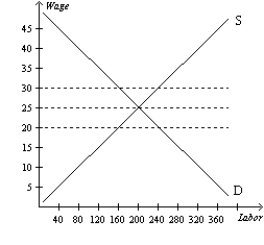 -Refer to Figure 19-3. Suppose the manufacturing labor market, which is non-unionized, is in equilibrium at a wage equal to $25. Suppose now that the AFL-CIO (a labor organization) organizes the workers in the manufacturing market and negotiates a wage of $30 per hour. Because of the union,
 (Multiple Choice)
4.9/5 (91)
(91) Suppose that a college student receives an offer for a summer internship with a stock brokerage firm. Unfortunately for the student, the internship is unpaid. Is it ever economically beneficial to accept an unpaid job?
(Multiple Choice)
4.9/5 (75)
(75) Daryn and Nick work for two different companies, but each performs the same job working on a loading dock.
Daryn, however, earns a higher salary than his friend Nick The difference in salary could illustrate union wages if
Daryn's annual salary is covered by a collective bargaining agreement and Nick's is not.
(True/False)
4.8/5 (73)
(73) Profit-maximizing, competitive firms will not discriminate in the hiring of workers unless consumers exercise a preference for discrimination in product markets or governments mandate discrimination.
(True/False)
4.9/5 (79)
(79) Other things equal, when the supply of workers is low, one would predict that market wages would be
(Multiple Choice)
4.8/5 (87)
(87) A compensating differential refers to a difference in wages that arises from nonmonetary characteristics.
(True/False)
4.8/5 (87)
(87) As a result of their experiment economists Muriel Niederle and Lise Vesterlund found that
(Multiple Choice)
4.9/5 (78)
(78) That some schools direct females away from science and math courses is evidence of
(Multiple Choice)
4.8/5 (84)
(84) Figure 19-6  -Refer to Figure 19-6. Given demand, D1, and supply, S1, what is the quantity of labor demanded if a minimum wage of $8 per hour is imposed on this market?
 (Short Answer)
4.8/5 (83)
(83) Which term do economists use to refer to a difference in wages that arises from nonmonetary characteristics of different jobs?
(Multiple Choice)
4.9/5 (82)
(82) 
Filters
- Essay(0)
- Multiple Choice(0)
- Short Answer(0)
- True False(0)
- Matching(0)