



 Chat with AI
Exam 11: Public Goods and Common Resources

Exam 1: Ten Principles of Economics439 Questions
Exam 2: Thinking Like an Economist617 Questions
Exam 3: Interdependence and the Gains From Trade527 Questions
Exam 4: The Market Forces of Supply and Demand698 Questions
Exam 5: Elasticity and Its Application595 Questions
Exam 6: Supply, Demand, and Government Policies644 Questions
Exam 7: Consumers, Producers, and the Efficiency of Markets549 Questions
Exam 8: Application: The Costs of Taxation511 Questions
Exam 9: Application: International Trade493 Questions
Exam 10: Externalities524 Questions
Exam 11: Public Goods and Common Resources433 Questions
Exam 12: The Design of the Tax System551 Questions
Exam 13: The Costs of Production420 Questions
Exam 14: Firms in Competitive Markets543 Questions
Exam 15: Monopoly637 Questions
Exam 16: Monopolistic Competition587 Questions
Exam 17: Oligopoly496 Questions
Exam 18: The Markets for the Factors of Production564 Questions
Exam 19: Earnings and Discrimination490 Questions
Exam 20: Income Inequality and Poverty457 Questions
Exam 21: The Theory of Consumer Choice440 Questions
Exam 22: Frontiers of Microeconomics441 Questions
Select questions type


Table 11-1
Consider the town of Springfield with only three residents, Sophia, Amber, and Cedric. The three residents are trying to determine how large, in acres, they should build the public park. The table below shows each resident's willingness to pay for each acre of the park.
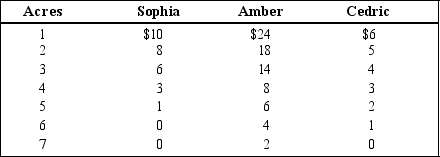 -Refer to Table 11-1. Suppose the cost to build the park is $24 per acre and that the residents have agreed to split the cost of building the park equally. If the residents decide to build a park with size equal to the number of acres that maximizes total surplus from the park, how much total surplus will Sophia receive?
 (Multiple Choice)
4.7/5  (70)
(70) Which of the following is a disadvantage of government provision of a public good?
(Multiple Choice)
4.9/5 (74)
(74) Three business people meet for lunch at an Indian restaurant. They decide that each person will order an item off the menu, and they will share all dishes. They will split the cost of the final bill evenly among each of the people at the table. When the food is delivered to the table, each person faces incentives similar to the
(Multiple Choice)
4.9/5 (73)
(73) Why do wild salmon populations face the threat of extinction while goldfish populations are in no such danger?
(Essay)
5.0/5 (63)
(63) Private markets usually fail to provide lighthouses because
(Multiple Choice)
4.8/5 (87)
(87) When good X is produced, some people benefit. A free-rider problem arises when
(Multiple Choice)
4.9/5 (80)
(80) Too few resources are devoted to the creation of knowledge because profit-seeking firms
(Multiple Choice)
4.8/5 (60)
(60) Seymour owns 3 acres of beautiful waterfront property on a large inland lake. In his will, Seymour donates the land to the state with the understanding that the land will be used as a state beach. Seymour wants an efficient way to prevent overcrowding at the beach, so he should require
(Multiple Choice)
4.8/5 (80)
(80) Is a tornado siren excludable? Is it rival in consumption? How do we classify a tornado siren in terms of the four types of goods?
(Essay)
4.9/5 (72)
(72) Table 11-5
A small island off the coast of Cape Cod contains two restaurants and two retail stores. Tourists need to take a ferry boat to reach the island, but with a recent slowdown in the economy, tourists are less willing to pay for the boat ride to visit the island. The owners of the restaurants and stores on the island - Restaurants 1 and 2, and Stores A and B - think that if tourists could ride the ferry for free, they would be happy to visit the island, eat and shop. The business owners are considering contributing to a pool of money that will be used to pay for roundtrip ferry service each day. The table represents their willingness to pay, that is, the maximum amount that each business owner is willing to contribute, per day, to pay for each ferry trip.
 -Refer to Table 11-5. Suppose the cost to run the ferry for each roundtrip is $750. How many ferry trips should there be to maximize the total surplus of the four business owners?
 (Multiple Choice)
4.8/5 (87)
(87) In what sense is it meaningful to say that fighting poverty is a public good?
(Essay)
4.9/5 (78)
(78) When Rick uses a common resource and diminishes other people's enjoyment of it, he creates
(Multiple Choice)
4.9/5 (79)
(79) Is basic research excludable? Is it rival in consumption? How do we classify basic research in terms of the four types of goods?
(Essay)
4.7/5 (87)
(87) Which of the following pairs of goods includes a good that is excludable and rival in consumption as well as a good that is excludable and not rival in consumption?
(Multiple Choice)
4.9/5 (81)
(81) 
Filters
- Essay(0)
- Multiple Choice(0)
- Short Answer(0)
- True False(0)
- Matching(0)