



 Chat with AI
Exam 6: Supply, Demand, and Government Policies

Exam 1: Ten Principles of Economics439 Questions
Exam 2: Thinking Like an Economist617 Questions
Exam 3: Interdependence and the Gains From Trade527 Questions
Exam 4: The Market Forces of Supply and Demand698 Questions
Exam 5: Elasticity and Its Application595 Questions
Exam 6: Supply, Demand, and Government Policies644 Questions
Exam 7: Consumers, Producers, and the Efficiency of Markets549 Questions
Exam 8: Application: The Costs of Taxation511 Questions
Exam 9: Application: International Trade493 Questions
Exam 10: Externalities524 Questions
Exam 11: Public Goods and Common Resources433 Questions
Exam 12: The Design of the Tax System551 Questions
Exam 13: The Costs of Production420 Questions
Exam 14: Firms in Competitive Markets543 Questions
Exam 15: Monopoly637 Questions
Exam 16: Monopolistic Competition587 Questions
Exam 17: Oligopoly496 Questions
Exam 18: The Markets for the Factors of Production564 Questions
Exam 19: Earnings and Discrimination490 Questions
Exam 20: Income Inequality and Poverty457 Questions
Exam 21: The Theory of Consumer Choice440 Questions
Exam 22: Frontiers of Microeconomics441 Questions
Select questions type


Suppose that the demand for picture frames is highly inelastic, and the supply of picture frames is highly elastic. A tax of $1 per frame levied on picture frames will increase the price paid by buyers of picture frames by
(Multiple Choice)
4.9/5  (64)
(64) Figure 6-18
The vertical distance between points A and B represents the tax in the market.  -Refer to Figure 6-18. The per-unit burden of the tax on sellers is
 (Multiple Choice)
4.9/5 (71)
(71) Figure 6-31  -Refer to Figure 6-31. If the government set a price floor at $15, would there be a shortage or surplus, and how large would be the shortage/surplus?
 (Essay)
4.9/5 (82)
(82) The demand for salt is inelastic, and the supply of salt is elastic. The demand for caviar is elastic, and the supply of caviar is inelastic. Suppose that a tax of $1 per pound is levied on the sellers of salt, and a tax of $1 per pound is levied on the buyers of caviar. We would expect that most of the burden of these taxes will fall on
(Multiple Choice)
4.8/5 (82)
(82) Figure 6-25  -Refer to Figure 6-25. Suppose the same supply and demand curves apply, and a tax of the same amount per unit as shown here is imposed. Now, however, the sellers of the good, rather than the buyers, are required to pay the tax to the government. After the sellers are required to pay the tax, relative to the case depicted in the graph, the burden on buyers will be
 (Multiple Choice)
4.8/5 (92)
(92) Figure 6-32  -Refer to Figure 6-32. If the government set a price ceiling at $40, would there be a shortage or surplus, and how large would be the shortage/surplus?
 (Short Answer)
4.9/5 (88)
(88) Figure 6-16  -Refer to Figure 6-16. In this market, a minimum wage of $2.75 creates a labor
 (Multiple Choice)
5.0/5 (92)
(92) A tax on the sellers of coffee will increase the price of coffee paid by buyers,
(Multiple Choice)
4.8/5 (89)
(89) A tax of $1 on sellers shifts the supply curve upward by exactly $1.
(True/False)
4.9/5 (73)
(73) When a tax is placed on the sellers of a product, buyers pay
(Multiple Choice)
4.8/5 (71)
(71) 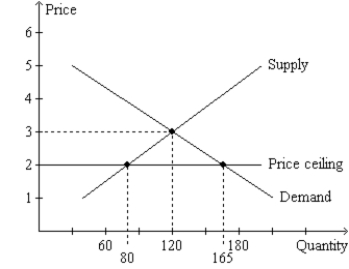 -Refer to Figure 6-2. The price ceiling
Who bears the majority of a tax burden depends on the relative elasticity of supply and demand.
(True/False)
4.9/5 (88)
(88) Figure 6-36  -Refer to Figure 6-36. If the government places a $2 tax in the market, the seller receives $6.
 (True/False)
4.9/5 (86)
(86) 
Filters
- Essay(0)
- Multiple Choice(0)
- Short Answer(0)
- True False(0)
- Matching(0)