



 Chat with AI
Exam 3: Interdependence and the Gains From Trade

Exam 1: Ten Principles of Economics439 Questions
Exam 2: Thinking Like an Economist617 Questions
Exam 3: Interdependence and the Gains From Trade527 Questions
Exam 4: The Market Forces of Supply and Demand698 Questions
Exam 5: Elasticity and Its Application595 Questions
Exam 6: Supply, Demand, and Government Policies644 Questions
Exam 7: Consumers, Producers, and the Efficiency of Markets549 Questions
Exam 8: Application: The Costs of Taxation511 Questions
Exam 9: Application: International Trade493 Questions
Exam 10: Externalities524 Questions
Exam 11: Public Goods and Common Resources433 Questions
Exam 12: The Design of the Tax System551 Questions
Exam 13: The Costs of Production420 Questions
Exam 14: Firms in Competitive Markets543 Questions
Exam 15: Monopoly637 Questions
Exam 16: Monopolistic Competition587 Questions
Exam 17: Oligopoly496 Questions
Exam 18: The Markets for the Factors of Production564 Questions
Exam 19: Earnings and Discrimination490 Questions
Exam 20: Income Inequality and Poverty457 Questions
Exam 21: The Theory of Consumer Choice440 Questions
Exam 22: Frontiers of Microeconomics441 Questions
Select questions type


Figure 3-3
Arturo's Production Possibilities Frontier Dina's Production Possibilities Frontier
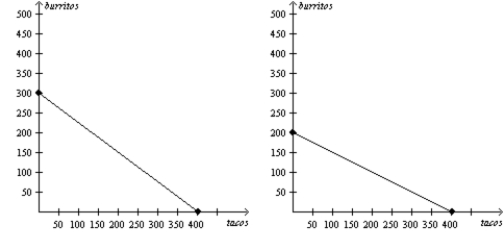 -Refer to Figure 3-3. If the production possibilities frontier shown for Arturo is for 100 hours of production, then how long does it take Arturo to make one burrito?
 (Multiple Choice)
4.7/5  (73)
(73) Table 3-22
Assume that Zimbabwe and Portugal can switch between producing toothbrushes and producing hairbrushes at a constant rate.
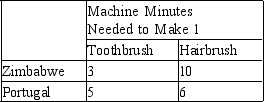 -Refer to Table 3-22. Portugal has an absolute advantage in the production of
 (Multiple Choice)
4.9/5 (74)
(74) Figure 3-2
Brazil's Production Possibilities Frontier 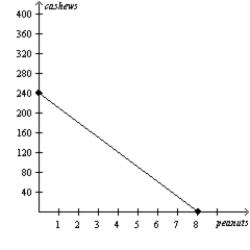 -Refer to Figure 3-2. The fact that the line slopes downward reflects the fact that
 (Multiple Choice)
4.8/5 (65)
(65) Table 3-25
Assume that Maya and Miguel can switch between producing mixers and producing toasters at a constant rate.
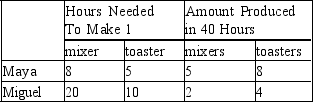 -Refer to Table 3-25. Maya should specialize in the production of
 (Multiple Choice)
5.0/5 (77)
(77) For a country producing two goods, the opportunity cost of one good will be the inverse of the opportunity cost of the other good.
(True/False)
4.9/5 (92)
(92) Ken and Traci are two woodworkers who both make tables and chairs. In one month, Ken can make 3 tables or 18 chairs, whereas Traci can make 8 tables or 24 chairs. Given this, we know that the opportunity cost of 1 chair is
(Multiple Choice)
4.8/5 (85)
(85) Figure 3-14
Arturo's Production Possibilities Frontier Dina's Production Possibilities Frontier
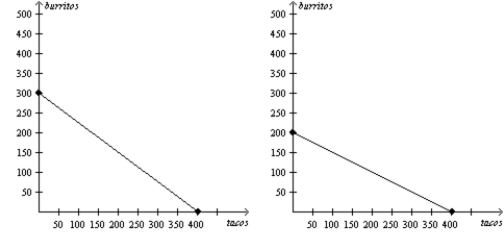 -Refer to Figure 3-14. Arturo has an absolute advantage in the production of
 (Multiple Choice)
4.9/5 (88)
(88) Table 3-31
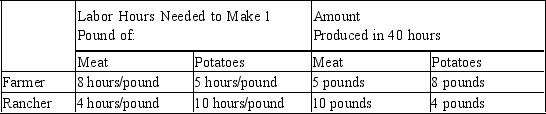 -Refer to Table 3-31. Relative to the rancher, the farmer has a comparative advantage in the production of
 (Multiple Choice)
4.9/5 (81)
(81) Figure 3-21
Uzbekistan's Production Possibilities Frontier Azerbaijan's Production Possibilities Frontier 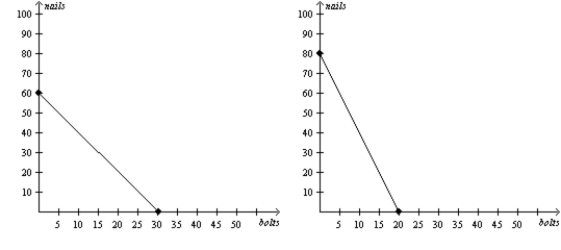 -Refer to Figure 3-21. Suppose Azerbaijan is willing to trade 3 nails to Uzbekistan for every bolt that Uzbekistan makes and sends to Azerbaijan. Which of the following combinations of bolts and nails could Azerbaijan then consume, assuming Uzbekistan specializes in making bolts and Azerbaijan specializes in making nails?
 (Multiple Choice)
4.9/5 (71)
(71) Suppose the U.S. and Japan both produce airplanes and televisions and the U.S. has a comparative advantage in the production of airplanes while Japan has a comparative advantage in the production of televisions. If the U.S. exports airplanes to Japan and imports televisions from Japan,
(Multiple Choice)
4.9/5 (80)
(80) Table 3-27
Assume that Huang and Min can switch between producing parasols and producing porcelain plates at a constant rate.
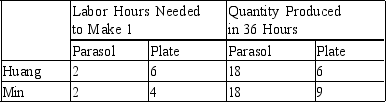 -Refer to Table 3-27. The opportunity cost of 1 plate for Huang is
 (Multiple Choice)
4.9/5 (81)
(81) Suppose that Venezuela produces beef and oil and it can switch production between each at a constant rate. If the most beef it can produce is 300 million pounds and the most oil it can produce is 50 million barrels, then what is the opportunity cost of a pound of beef and what is the opportunity cost of a barrel of oil?
(Essay)
5.0/5 (82)
(82) Table 3-20
Assume that Brad and Theresa can switch between producing wheat and producing beef at a constant rate.
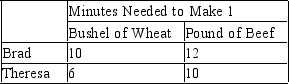 -Refer to Table 3-20. What is Brad's opportunity cost of producing one bushel of wheat?
 (Multiple Choice)
4.8/5 (78)
(78) Table 3-31
-Refer to Table 3-31. Relative to the rancher, the farmer has
-Refer to Table 3-31. Relative to the rancher, the farmer has (Multiple Choice)
4.8/5 (74)
(74) Figure 3-6
Maxine's Production Possibilities Frontier Daisy's Production Possibilities Frontier
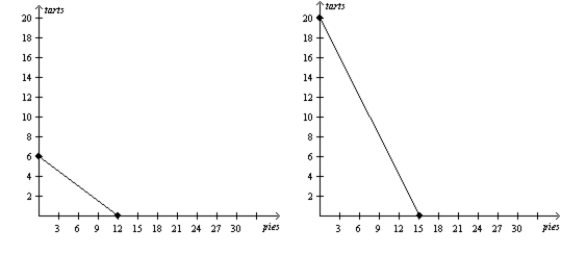 -Refer to Figure 3-6. If Daisy must work 2.5 hours to make each pie, then her production possibilities frontier is based on how many hours of work?
 (Multiple Choice)
4.7/5 (73)
(73) For two individuals who engage in the same two productive activities, it is impossible for one of the two individuals to
(Multiple Choice)
4.9/5 (68)
(68) Julia can fix a meal in 1 hour, and her opportunity cost of one hour is $50. Jacque can fix the same kind of meal in 2 hours, and his opportunity cost of one hour is $20. Will both Julia and Jacque be better off if she pays him $45 per meal to fix her meals? Explain.
(Essay)
4.8/5 (82)
(82) 
Filters
- Essay(0)
- Multiple Choice(0)
- Short Answer(0)
- True False(0)
- Matching(0)