



 Chat with AI
Exam 22: Developing Countries: Growth, Crisis, and Reform

Exam 1: Introduction41 Questions
Exam 2: World Trade: An Overview25 Questions
Exam 3: Labor Productivity and Comparative Advantage: The Ricardian Model70 Questions
Exam 4: Specific Factors and Income Distribution70 Questions
Exam 5: Resources and Trade: the Heckscher-Ohlin Model66 Questions
Exam 6: The Standard Trade Model48 Questions
Exam 7: External Economies of Scale and the International Location of Production37 Questions
Exam 8: Firms in the Global Economy: Export Decisions, Outsourcing, and Multinational Enterprises69 Questions
Exam 9: The Instruments of Trade Policy74 Questions
Exam 10: The Political Economy of Trade Policy63 Questions
Exam 11: Trade Policy in Developing Countries43 Questions
Exam 12: Controversies in Trade Policy47 Questions
Exam 13: National Income Accounting and the Balance of Payments78 Questions
Exam 14: Exchange Rates and the Foreign Exchange Market: An Asset Approach76 Questions
Exam 15: Money,Interest Rates, and Exchange Rates65 Questions
Exam 16: Price Levels and the Exchange Rate in the Long Run80 Questions
Exam 17: Output and the Exchange Rate in the Short Run116 Questions
Exam 18: Fixed Exchange Rates and Foreign Exchange Intervention81 Questions
Exam 19: International Monetary Systems: An Historical Overview171 Questions
Exam 20: Financial Globalization: Opportunity and Crisis131 Questions
Exam 21: Optimum Currency Areas and the Euro104 Questions
Exam 22: Developing Countries: Growth, Crisis, and Reform116 Questions
Select questions type


In the instances where a loan has been issued under certain terms and has to be repaid,what happens when the borrower does not uphold these stipulations?
(Multiple Choice)
4.8/5  (73)
(73) Describe some of the features hindering developing countries from growing faster.
(Essay)
4.9/5 (69)
(69) In 1981-1983,the world economy suffered a steep recession.Naturally,the fall in industrial countries' aggregate demand had a direct negative impact on the developing countries.What other mechanism was an even more important contributor to this event?
(Multiple Choice)
4.8/5 (72)
(72) Since 1960,countries in Africa have grown at rates ________ those of the main industrial countries.
(Multiple Choice)
4.9/5 (96)
(96) In the early 1960s South Korea was an extremely poor country.However,in 1963,the country began a remarkable economic ascent.What was a direct cause of this?
(Multiple Choice)
4.8/5 (85)
(85) When a government defaults on its obligations,the event is called a
(Multiple Choice)
4.9/5 (93)
(93) The $50 billion emergency loan orchestrated by the U.S.Treasury and the IMF to Mexico in 1994
(Multiple Choice)
4.7/5 (78)
(78) Over the period 1960-2010,the United States economy grew at roughly
(Multiple Choice)
4.8/5 (83)
(83) The world's economies can be divided into four main categories according to their annual per-capita income levels.Which one of the following is NOT one of the categories?
(Multiple Choice)
4.9/5 (84)
(84) Over the period 1960-2000,France grew ________ than the United States economy
(Multiple Choice)
4.7/5 (73)
(73) What are the three main lessons on crisis learned from early developing countries in Latin America?
(Multiple Choice)
5.0/5 (68)
(68) Please consider Table 22-2 below. 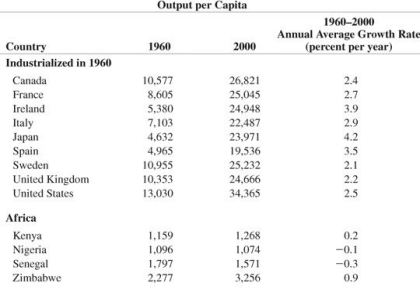
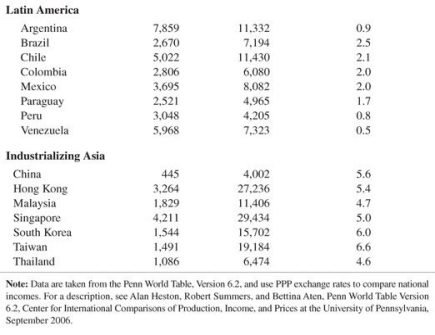 Assuming constant Annual Average Growth Rate in the future,calculate the output per capita for the United States and South Korea for the year 2040.
 (Essay)
4.9/5 (79)
(79) Compare the macroeconomic performances in the 1990s of the following countries under the following exchange-rate regimes: floating exchange rates,Mexico and Brazil;capital control,China and Malaysia;and currency boards,Estonia and Hong Kong;dollarization,Argentina.
(Essay)
4.9/5 (78)
(78) Since foreign credit dries up in crises when it is most needed,developing countries can protect themselves from default by
(Multiple Choice)
5.0/5 (80)
(80) 
Filters
- Essay(0)
- Multiple Choice(0)
- Short Answer(0)
- True False(0)
- Matching(0)