



 Chat with AI
Exam 22: Developing Countries: Growth, Crisis, and Reform

Exam 1: Introduction41 Questions
Exam 2: World Trade: An Overview25 Questions
Exam 3: Labor Productivity and Comparative Advantage: The Ricardian Model70 Questions
Exam 4: Specific Factors and Income Distribution70 Questions
Exam 5: Resources and Trade: the Heckscher-Ohlin Model66 Questions
Exam 6: The Standard Trade Model48 Questions
Exam 7: External Economies of Scale and the International Location of Production37 Questions
Exam 8: Firms in the Global Economy: Export Decisions, Outsourcing, and Multinational Enterprises69 Questions
Exam 9: The Instruments of Trade Policy74 Questions
Exam 10: The Political Economy of Trade Policy63 Questions
Exam 11: Trade Policy in Developing Countries43 Questions
Exam 12: Controversies in Trade Policy47 Questions
Exam 13: National Income Accounting and the Balance of Payments78 Questions
Exam 14: Exchange Rates and the Foreign Exchange Market: An Asset Approach76 Questions
Exam 15: Money,Interest Rates, and Exchange Rates65 Questions
Exam 16: Price Levels and the Exchange Rate in the Long Run80 Questions
Exam 17: Output and the Exchange Rate in the Short Run116 Questions
Exam 18: Fixed Exchange Rates and Foreign Exchange Intervention81 Questions
Exam 19: International Monetary Systems: An Historical Overview171 Questions
Exam 20: Financial Globalization: Opportunity and Crisis131 Questions
Exam 21: Optimum Currency Areas and the Euro104 Questions
Exam 22: Developing Countries: Growth, Crisis, and Reform116 Questions
Select questions type


In general,one would expect that life expectancies reflect international differences in income levels.Do the data support such a claim?
(Multiple Choice)
4.9/5  (78)
(78) Explain how Brazil was able to reduce the rate of inflation from 2,669 percent in 1994 to less than 10 percent in 1997?
(Essay)
5.0/5 (85)
(85) Explain why East Asian countries have done so well relative to South American countries.
(Essay)
4.8/5 (70)
(70) In general,the development of underground economic activity ________ economic efficiency
(Multiple Choice)
4.8/5 (69)
(69) The relationship between annual real per-capita GDP and corruption across countries has been found to be
(Multiple Choice)
4.9/5 (76)
(76) Which of the following are characteristic of a developing country?
(Multiple Choice)
4.8/5 (74)
(74) Please consider Table 22-2 below. 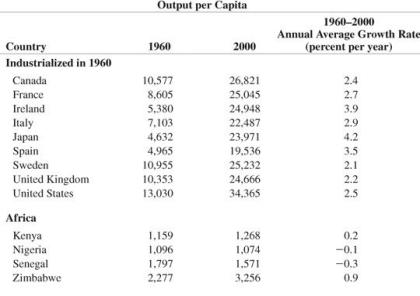
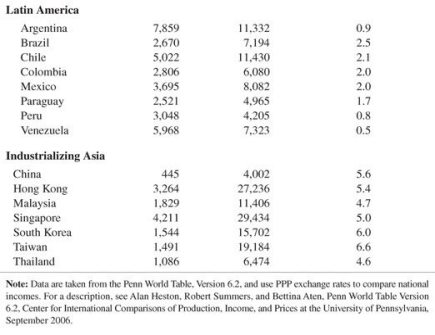 Assuming constant Annual Average Growth Rate in the future,determine the year in which the United States will have the same output per capita as South Korea?
 (Essay)
4.8/5 (87)
(87) Does it appear that currency boards make low-inflation policies credible?
(Essay)
4.8/5 (89)
(89) Since 1960,South Korea and Singapore enjoyed an average per-capita growth rates ________ the average industrialized world.
(Multiple Choice)
4.8/5 (84)
(84) In 1991,Argentina established a radical institutional reform after experiencing a decade marked by financial instability.This program was called the new Convertibility Law.What did this law do?
(Multiple Choice)
4.8/5 (72)
(72) There are many ways developing countries finance their external deficits EXCEPT
(Multiple Choice)
5.0/5 (75)
(75) The main factors that discourage investment in capital and skills in developing countries are
(Multiple Choice)
4.8/5 (84)
(84) Explain why the distinction between debt and equity finance is useful in analyzing the response of developing countries to unforeseen events such as recession or terms of trade change?
(Essay)
4.9/5 (79)
(79) Write an essay on the importance of a sound banking system in developing countries.
(Essay)
4.9/5 (77)
(77) Which Latin American country defaulted on loans in 2005 and paid off their creditors at only 1/3 value?
(Multiple Choice)
4.9/5 (83)
(83) "Developing countries should delay opening the capital account until the domestic financial system is strong enough to withstand the sometimes violent ebb and flow of world capital." Discuss.
(Essay)
4.8/5 (93)
(93) Explain the theory behind convergence and why it is a "deceptively simple" theory.
(Essay)
4.7/5 (80)
(80) 
Filters
- Essay(0)
- Multiple Choice(0)
- Short Answer(0)
- True False(0)
- Matching(0)