



 Chat with AI
Exam 15: Money,Interest Rates, and Exchange Rates

Exam 1: Introduction41 Questions
Exam 2: World Trade: An Overview25 Questions
Exam 3: Labor Productivity and Comparative Advantage: The Ricardian Model70 Questions
Exam 4: Specific Factors and Income Distribution70 Questions
Exam 5: Resources and Trade: the Heckscher-Ohlin Model66 Questions
Exam 6: The Standard Trade Model48 Questions
Exam 7: External Economies of Scale and the International Location of Production37 Questions
Exam 8: Firms in the Global Economy: Export Decisions, Outsourcing, and Multinational Enterprises69 Questions
Exam 9: The Instruments of Trade Policy74 Questions
Exam 10: The Political Economy of Trade Policy63 Questions
Exam 11: Trade Policy in Developing Countries43 Questions
Exam 12: Controversies in Trade Policy47 Questions
Exam 13: National Income Accounting and the Balance of Payments78 Questions
Exam 14: Exchange Rates and the Foreign Exchange Market: An Asset Approach76 Questions
Exam 15: Money,Interest Rates, and Exchange Rates65 Questions
Exam 16: Price Levels and the Exchange Rate in the Long Run80 Questions
Exam 17: Output and the Exchange Rate in the Short Run116 Questions
Exam 18: Fixed Exchange Rates and Foreign Exchange Intervention81 Questions
Exam 19: International Monetary Systems: An Historical Overview171 Questions
Exam 20: Financial Globalization: Opportunity and Crisis131 Questions
Exam 21: Optimum Currency Areas and the Euro104 Questions
Exam 22: Developing Countries: Growth, Crisis, and Reform116 Questions
Select questions type


A change in the money supply creates demand and cost pressures that lead to future increases in the price level from which main sources? I.Excess demand for output and labor
II.Inflationary expectations
III.Raw materials prices

Free
(Multiple Choice)
4.8/5  (71)
(71) Correct Answer: Verified
E
Changes in the money supply growth rate
Free
(Multiple Choice)
4.8/5 (74)
(74) Correct Answer:Verified
VerifiedD
Using a figure describing both the U.S.money market and the foreign exchange market,analyze the effects of a temporary increase in the European money supply on the dollar/euro exchange rate.
Free
(Essay)
4.8/5 (70)
(70) Correct Answer:Verified
VerifiedAn increase in the European money supply will reduce the interest rate on the euro and thus will cause the schedule of the expected euro return expresses in dollars to shift down,causing a reduction in the dollar/euro exchange rate,i.e. ,an appreciation of the U.S.Dollar.The euro depreciates against the dollar.The U.S.money demand and money supply are not going to be affected,and thus the interest rate in the U.S.will remain the same. 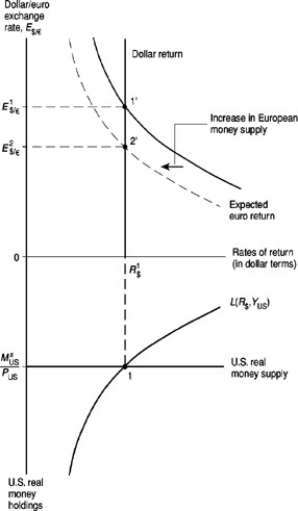
Which of the following can help to explain why higher inflation may lead to currency appreciations?
(Multiple Choice)
4.8/5 (82)
(82) Michael Woodford says the following is an advantage of interest-rate instruments for central banks.
(Multiple Choice)
4.7/5 (78)
(78) Which one of the following statements is the MOST accurate?
(Multiple Choice)
5.0/5 (71)
(71) In Zimbabwe,the government stopped the country's hyperinflation by
(Multiple Choice)
4.8/5 (75)
(75) Which one of the following statements is the MOST accurate?
(Multiple Choice)
4.8/5 (70)
(70) Explain the effects of a permanent increase in the U.S.money supply in the short run and in the long run.Assume that the U.S.real national income is constant.
(Essay)
4.9/5 (70)
(70) A family's summer house on Cape Cod pays a return in the form of
(Multiple Choice)
4.9/5 (92)
(92) 
Filters
- Essay(0)
- Multiple Choice(0)
- Short Answer(0)
- True False(0)
- Matching(0)