



 Chat with AI
Exam 19: International Monetary Systems: An Historical Overview

Exam 1: Introduction41 Questions
Exam 2: World Trade: An Overview25 Questions
Exam 3: Labor Productivity and Comparative Advantage: The Ricardian Model70 Questions
Exam 4: Specific Factors and Income Distribution70 Questions
Exam 5: Resources and Trade: the Heckscher-Ohlin Model66 Questions
Exam 6: The Standard Trade Model48 Questions
Exam 7: External Economies of Scale and the International Location of Production37 Questions
Exam 8: Firms in the Global Economy: Export Decisions, Outsourcing, and Multinational Enterprises69 Questions
Exam 9: The Instruments of Trade Policy74 Questions
Exam 10: The Political Economy of Trade Policy63 Questions
Exam 11: Trade Policy in Developing Countries43 Questions
Exam 12: Controversies in Trade Policy47 Questions
Exam 13: National Income Accounting and the Balance of Payments78 Questions
Exam 14: Exchange Rates and the Foreign Exchange Market: An Asset Approach76 Questions
Exam 15: Money,Interest Rates, and Exchange Rates65 Questions
Exam 16: Price Levels and the Exchange Rate in the Long Run80 Questions
Exam 17: Output and the Exchange Rate in the Short Run116 Questions
Exam 18: Fixed Exchange Rates and Foreign Exchange Intervention81 Questions
Exam 19: International Monetary Systems: An Historical Overview171 Questions
Exam 20: Financial Globalization: Opportunity and Crisis131 Questions
Exam 21: Optimum Currency Areas and the Euro104 Questions
Exam 22: Developing Countries: Growth, Crisis, and Reform116 Questions
Select questions type


Advocates of flexible exchange rates claim that under flexible exchange rates
(Multiple Choice)
4.8/5  (69)
(69) The case of New Zealand,described in the text,concludes that a country's current account deficits are not sustainable if a country's
(Multiple Choice)
4.9/5 (86)
(86) How did the international monetary system influence macroeconomic policy-making and performance during the post-World War II years during which exchange rates were fixed under the Bretton Woods agreement (1946-1973)?
(Essay)
4.8/5 (72)
(72) Which of the following is NOT a result of a temporary fall in foreign demand on one country's exports under floating exchange rate?
(Multiple Choice)
4.8/5 (80)
(80) Advocates of flexible exchange rates claim that under flexible exchange rates
(Multiple Choice)
4.9/5 (72)
(72) In order to bring about a real depreciation of the dollar,the U.S.can hope for
(Multiple Choice)
4.8/5 (83)
(83) A country is said to be in balance of payments equilibrium,when the sum of its current and its
(Multiple Choice)
4.8/5 (71)
(71) An attempt by a central bank to alter the money supply by buying or selling domestic assets
(Multiple Choice)
4.9/5 (89)
(89) Advocates of flexible exchange rates claim that under flexible exchange rates
(Multiple Choice)
4.9/5 (71)
(71) The case of New Zealand,described in the text,draws what technical conclusion regarding the country's international debt position?
(Essay)
4.8/5 (78)
(78) Economic experience since 1973 indicate that,under floating exchange rates
(Multiple Choice)
4.7/5 (77)
(77) Advocates of floating rate suggested it is favorable for economies for all of the following reasons EXCEPT
(Multiple Choice)
4.8/5 (67)
(67) Economic experience since 1973 indicate that,under floating exchange rates,symmetry
(Multiple Choice)
4.9/5 (81)
(81) Using an equation,explain why governments prefer to avoid excessive current account surpluses?
(Essay)
4.8/5 (77)
(77) Explain how a country with a current account deficit is a ripe candidate for currency devaluation.
(Essay)
4.8/5 (69)
(69)  -Refer to the above figure.Use the DD-AA model to examine and compare the response of an economy under fixed and floating exchange rate to a temporary fall in foreign demand for its exports.
 (Essay)
4.7/5 (84)
(84) A person holding dollar deposits during the devaluation of the dollar would
(Multiple Choice)
4.9/5 (83)
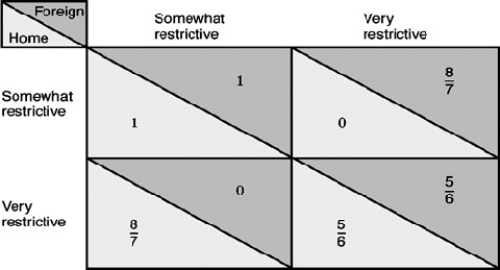
(83) 
Filters
- Essay(0)
- Multiple Choice(0)
- Short Answer(0)
- True False(0)
- Matching(0)