



 Chat with AI
Exam 19: International Monetary Systems: An Historical Overview

Exam 1: Introduction41 Questions
Exam 2: World Trade: An Overview25 Questions
Exam 3: Labor Productivity and Comparative Advantage: The Ricardian Model70 Questions
Exam 4: Specific Factors and Income Distribution70 Questions
Exam 5: Resources and Trade: the Heckscher-Ohlin Model66 Questions
Exam 6: The Standard Trade Model48 Questions
Exam 7: External Economies of Scale and the International Location of Production37 Questions
Exam 8: Firms in the Global Economy: Export Decisions, Outsourcing, and Multinational Enterprises69 Questions
Exam 9: The Instruments of Trade Policy74 Questions
Exam 10: The Political Economy of Trade Policy63 Questions
Exam 11: Trade Policy in Developing Countries43 Questions
Exam 12: Controversies in Trade Policy47 Questions
Exam 13: National Income Accounting and the Balance of Payments78 Questions
Exam 14: Exchange Rates and the Foreign Exchange Market: An Asset Approach76 Questions
Exam 15: Money,Interest Rates, and Exchange Rates65 Questions
Exam 16: Price Levels and the Exchange Rate in the Long Run80 Questions
Exam 17: Output and the Exchange Rate in the Short Run116 Questions
Exam 18: Fixed Exchange Rates and Foreign Exchange Intervention81 Questions
Exam 19: International Monetary Systems: An Historical Overview171 Questions
Exam 20: Financial Globalization: Opportunity and Crisis131 Questions
Exam 21: Optimum Currency Areas and the Euro104 Questions
Exam 22: Developing Countries: Growth, Crisis, and Reform116 Questions
Select questions type


Explain why the United States dollar became the postwar world's key currency.
(Essay)
4.9/5  (72)
(72) Advocates of flexible exchange rates claim that under flexible exchange rates,a currency
(Multiple Choice)
4.9/5 (86)
(86) (a)Assume that R denotes the domestic interest rate and R  denotes the foreign interest rate.Under a fixed exchange rate what is the relation between R and R
 (b)Assume E denotes the domestic currency price of the dollar for a country which is not the United States.If one wants to analyze only the short run effects of a policy,what does one assume about the Home and Foreign price levels,P and P
 ,respectively.
(c)Assume that there is no ongoing balance of payment crisis.What is this assumption really assume?
(d)Assume a fixed exchange rate system.What does this tell you about E?
(e)Under the above assumptions what are the conditions for internal balance?
(f)How is your answer to Part D above would change if P
 is unstable due to foreign inflation.
(g)Given the definitions above,how one defines the real exchange rate?
(h)Write the condition for internal balance.
(i)Define the variable not defined before in Part G above.
(j)Using the equation for internal balance derived above,given our assumptions analyze the effects of a fiscal expansion.
(k)What would happen if the government of that country,which is not the United States under Bretton Woods,decides to devaluate its currency?
(l)What would happen if the government of that country,which is not the United States under Bretton Woods,decides to use monetary policy rather than fiscal policy?
(m)Given all of the above,what is the relation between the exchange rate,E,and fiscal ease,i.e. ,an increase in G or a reduction in T?
(n)Assume that the economy is at internal balance.What will happen if G goes up for a given level of E?
(o)Assume that the economy is at internal balance.What will happen if G goes down for a given level of E?
denotes the foreign interest rate.Under a fixed exchange rate what is the relation between R and R (b)Assume E denotes the domestic currency price of the dollar for a country which is not the United States.If one wants to analyze only the short run effects of a policy,what does one assume about the Home and Foreign price levels,P and P ,respectively.
(c)Assume that there is no ongoing balance of payment crisis.What is this assumption really assume?
(d)Assume a fixed exchange rate system.What does this tell you about E?
(e)Under the above assumptions what are the conditions for internal balance?
(f)How is your answer to Part D above would change if P is unstable due to foreign inflation.
(g)Given the definitions above,how one defines the real exchange rate?
(h)Write the condition for internal balance.
(i)Define the variable not defined before in Part G above.
(j)Using the equation for internal balance derived above,given our assumptions analyze the effects of a fiscal expansion.
(k)What would happen if the government of that country,which is not the United States under Bretton Woods,decides to devaluate its currency?
(l)What would happen if the government of that country,which is not the United States under Bretton Woods,decides to use monetary policy rather than fiscal policy?
(m)Given all of the above,what is the relation between the exchange rate,E,and fiscal ease,i.e. ,an increase in G or a reduction in T?
(n)Assume that the economy is at internal balance.What will happen if G goes up for a given level of E?
(o)Assume that the economy is at internal balance.What will happen if G goes down for a given level of E? (Essay)
4.8/5 (88)
(88) Advocates of flexible exchange rates claim that under flexible exchange rates
(Multiple Choice)
4.7/5 (85)
(85) It is claimed that L.Frank Baum's classic 1900 children's book,The Wonderful Wizard of Oz,is an allegorical rendition of the U.S.political struggle over gold.
(Essay)
4.8/5 (87)
(87) Some claim that the long and agonizing periods of speculation preceding exchange rate realignments would
(Multiple Choice)
4.7/5 (86)
(86) The following figure introduces the relationship between industrial production and wholesale price index changes between the years 1929-1935.What is the purpose of the following figure? 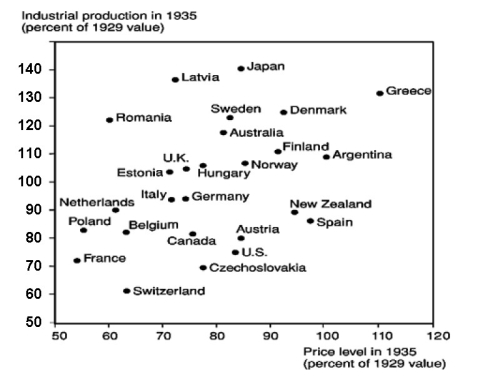
(Essay)
4.9/5 (92)
(92) A convertible currency is a currency that may be freely exchanged for
(Multiple Choice)
4.8/5 (85)
(85) Supporters of a floating exchange rate cited all of the following as advantages over the Bretton Woods system EXCEPT
(Multiple Choice)
4.8/5 (85)
(85) Describe the effects of the Smoot-Hawley tariff imposed by the United States in 1930.
(Essay)
4.7/5 (82)
(82) Imagine a world with two large countries,Home and Foreign.Evaluate how Home's macroeconomic policies affect Foreign.Compare the small and the large country cases;consider both permanent monetary and fiscal policies.
(Essay)
4.8/5 (64)
(64) The case of New Zealand,described in the text,is concerned with the country's
(Multiple Choice)
4.8/5 (78)
(78) Federal Reserve Chairman Volcker's policy to fight inflation
(Multiple Choice)
4.8/5 (86)
(86) 
Filters
- Essay(0)
- Multiple Choice(0)
- Short Answer(0)
- True False(0)
- Matching(0)