



 Chat with AI
Exam 7: Risk and Return

Exam 1: Introduction44 Questions
Exam 2: Consumption, Investment and the Capital Market56 Questions
Exam 3: The Time Value of Money: An Introduction to Financial Mathematics62 Questions
Exam 4: Applying the Time Value of Money to Security Valuation62 Questions
Exam 5: Project Evaluation: Principles and Methods65 Questions
Exam 6: The Application of Project Evaluation Methods64 Questions
Exam 7: Risk and Return76 Questions
Exam 8: The Capital Market64 Questions
Exam 9: Sources of Finance: Equity51 Questions
Exam 10: Sources of Finance: Debt87 Questions
Exam 11: Payout Policy53 Questions
Exam 12: Principles of Capital Structure57 Questions
Exam 13: Capital Structure Decisions51 Questions
Exam 14: The Cost of Capital and Taxation Issues in Project Evaluation47 Questions
Exam 15: Leasing and Other Equipment Finance49 Questions
Exam 16: Capital Market Efficiency55 Questions
Exam 17: Futures Contracts66 Questions
Exam 18: Options and Contingent Claims59 Questions
Exam 19: Analysis of Takeovers55 Questions
Exam 20: International Financial Management58 Questions
Exam 21: Management of Short-Term Assets: Inventory52 Questions
Exam 22: Management of Short-Term Assets: Liquid Assets and Accounts Receivable28 Questions
Select questions type


Which distribution can be fully described by its expected value and standard deviation?
(Multiple Choice)
4.9/5  (86)
(86) Which distribution is a list of the possible dollar returns from the investment together with the probability of each return?
(Multiple Choice)
4.9/5 (95)
(95) Which of the following two investments would a risk seeker choose: Investment A with an expected outcome of $1000 and standard deviation of $500,or Investment B with an expected outcome of $1000 and standard deviation of $200?
(Multiple Choice)
4.8/5 (78)
(78) Assume two securities A and B.The correlation coefficient between these two securities can be written as:
(Multiple Choice)
4.9/5 (92)
(92) The benefit of diversification to an investor is the reduction of:
(Multiple Choice)
4.8/5 (70)
(70) Suppose that the returns on an investment are normally distributed with an expected return of 8% and standard deviation of 4%.What is the likelihood of making a negative return? (Hint: the area under a curve for 1 std dev is 34.13%,2 std dev is 47.73% and 3 std dev is 49.87%).
(Multiple Choice)
4.8/5 (77)
(77) The relationship between the required rate of return for a security and market risk is:
(Multiple Choice)
4.9/5 (78)
(78) Which of the following is not an example of unsystematic risk?
(Multiple Choice)
4.8/5 (82)
(82) The _____________________ plots the relationship between the expected return and beta of a security.
(Short Answer)
4.8/5 (75)
(75) After adjusting for risk,the returns to a portfolio can differ from the benchmark portfolio as a result of:
(Multiple Choice)
4.8/5 (84)
(84) Portfolio theory,as initially developed by Markowitz (1952),assumes that the returns from investments are normally distributed.
(True/False)
4.9/5 (83)
(83) Which type of risk is unique to a firm and may be eliminated by diversification?
(Multiple Choice)
4.9/5 (75)
(75) Examine the following probability distribution: 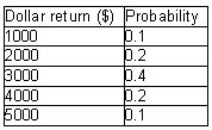 The range and standard deviation of the distribution are:
 (Multiple Choice)
4.9/5 (80)
(80) Which of the following is typically used in empirical studies as a proxy for the market portfolio?
(Multiple Choice)
4.8/5 (69)
(69) Examine the following probability distribution: 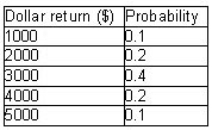 The expected value from this is:
 (Multiple Choice)
5.0/5 (77)
(77) Which investor attaches decreasing utility to each increment in wealth?
(Multiple Choice)
4.9/5 (75)
(75) Standard deviation is measured as the _______________ of variance.
(Short Answer)
4.9/5 (83)
(83) 
Filters
- Essay(0)
- Multiple Choice(0)
- Short Answer(0)
- True False(0)
- Matching(0)