



 Chat with AI
Exam 20: International Financial Management

Exam 1: Introduction44 Questions
Exam 2: Consumption, Investment and the Capital Market56 Questions
Exam 3: The Time Value of Money: An Introduction to Financial Mathematics62 Questions
Exam 4: Applying the Time Value of Money to Security Valuation62 Questions
Exam 5: Project Evaluation: Principles and Methods65 Questions
Exam 6: The Application of Project Evaluation Methods64 Questions
Exam 7: Risk and Return76 Questions
Exam 8: The Capital Market64 Questions
Exam 9: Sources of Finance: Equity51 Questions
Exam 10: Sources of Finance: Debt87 Questions
Exam 11: Payout Policy53 Questions
Exam 12: Principles of Capital Structure57 Questions
Exam 13: Capital Structure Decisions51 Questions
Exam 14: The Cost of Capital and Taxation Issues in Project Evaluation47 Questions
Exam 15: Leasing and Other Equipment Finance49 Questions
Exam 16: Capital Market Efficiency55 Questions
Exam 17: Futures Contracts66 Questions
Exam 18: Options and Contingent Claims59 Questions
Exam 19: Analysis of Takeovers55 Questions
Exam 20: International Financial Management58 Questions
Exam 21: Management of Short-Term Assets: Inventory52 Questions
Exam 22: Management of Short-Term Assets: Liquid Assets and Accounts Receivable28 Questions
Select questions type


Suppose that the spot rate is A$1 = 0.3325 pounds.If the inflation rate next year is expected to be 9 per cent in Australia and 4 per cent in the UK what is next year's spot rate expected to be?

Free
(Multiple Choice)
4.8/5  (83)
(83) Correct Answer: Verified
C
Unbiased forward theory states that the forward rate is an unbiased predictor of the _____________________.
Free
(Short Answer)
4.7/5 (83)
(83) Correct Answer:Verified
Verifiedfuture spot rate
Potential disadvantages of international diversification include adverse taxation implications,increased transaction costs and political risks.
Free
(True/False)
5.0/5 (77)
(77) Correct Answer:Verified
VerifiedTrue
Which of the following transactions minimises exchange rate risk for an importer that buys computer equipment from the US?
(Multiple Choice)
4.9/5 (78)
(78) Foreign currency ___________ are a suitable way to undertake contingent hedging.
(Short Answer)
4.8/5 (83)
(83) Exchange rate between two currencies derived from the exchange rates between the currencies and a third currency is known as:
(Multiple Choice)
4.9/5 (63)
(63) A _____________ loan is debt that is raised in a country other than the currency of the country in which the loan was raised.
(Short Answer)
4.8/5 (87)
(87) In which of the following events will an Australian borrower benefit from borrowing Swiss francs?
(Multiple Choice)
4.8/5 (82)
(82) You observe the following spot exchange rates:
A$1 = £0.4
A$1 = US$0.85
£1 = US$2.125
Assuming no transaction costs,an arbitrage opportunity is possible in this instance.
(True/False)
4.7/5 (70)
(70) The difference between the spot rate and the forward rate is referred to as the:
(Multiple Choice)
4.9/5 (79)
(79) A difference between the 'buy' and 'sell' rates of foreign currency occurs because of:
(Multiple Choice)
4.7/5 (73)
(73) The difference between spot and forwards rates is called the ______________.
(Short Answer)
4.9/5 (82)
(82) The highest figure that the daily market turnover in foreign currency in Australia frequently exceeds is:
(Multiple Choice)
4.8/5 (74)
(74) Which of the following companies is more likely to benefit from exchange rate hedging?
(Multiple Choice)
4.8/5 (91)
(91) The current exchange rates between Australian dollars and US dollars is AUD 1 = USD 0.7500.Interest rates for one year are 5 per cent in Australia and 8 per cent in the US.What is the expected spot exchange rate?
(Multiple Choice)
4.8/5 (81)
(81) The current spot exchange rate between Australian dollars and UK pounds is A$1 = 0.400 pounds.Interest rates for one year are 5 per cent for pounds and 15 per cent for dollars.What is the expected spot exchange rate in one year's time?
(Multiple Choice)
4.9/5 (95)
(95) Calculate how much risk-free profit,in Australian dollars,can be obtained for a dealer with A$10 000 if the following exchange rates apply: 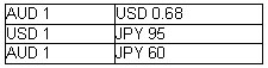
(Multiple Choice)
4.9/5 (85)
(85) Which of the following represents an appropriate hedge for an Australian exporter expecting payment of US$100 000 in three months' time?
(Multiple Choice)
4.7/5 (83)
(83) Companies who are only entering into foreign currency markets for a one-off transaction have no need to hedge against exchange risk.
(True/False)
4.7/5 (87)
(87) 
Filters
- Essay(0)
- Multiple Choice(0)
- Short Answer(0)
- True False(0)
- Matching(0)