



 Chat with AI
Exam 28: International Trade

Exam 1: The Role and Method of Economics198 Questions
Exam 2: Economics: Eight Powerful Ideas197 Questions
Exam 3: Scarcity, Trade-Offs, and Production Possibilities189 Questions
Exam 4: Demand, Supply, and Market Equilibrium240 Questions
Exam 5: Markets in Motion and Price Controls228 Questions
Exam 6: Elasticities206 Questions
Exam 7: Market Efficiency and Welfare136 Questions
Exam 8: Market Failure215 Questions
Exam 9: Public Finance and Public Choice64 Questions
Exam 10: Consumer Choice Theory149 Questions
Exam 11: The Firm: Production and Costs198 Questions
Exam 12: Firms in Perfectly Competitive Markets207 Questions
Exam 13: Monopoly and Antitrust189 Questions
Exam 14: Monopolistic Competition and Product Differentiation159 Questions
Exam 15: Oligopoly and Strategic Behavior146 Questions
Exam 16: The Markets for Labor, Capital, and Land177 Questions
Exam 17: Income, Poverty, and Health Care138 Questions
Exam 18: Introduction to Macroeconomics: Unemployment, Inflation, and Economic Fluctuations171 Questions
Exam 19: Measuring Economic Performance147 Questions
Exam 20: Economic Growth in the Global Economy127 Questions
Exam 21: Financial Markets, Saving, and Investment65 Questions
Exam 22: Aggregate Demand and Aggregate Supply163 Questions
Exam 23: The Aggregate Expenditure Model69 Questions
Exam 25: Monetary Institutions182 Questions
Exam 26: The Federal Reserve System and Monetary Policy147 Questions
Exam 27: Issues in Macroeconomic Theory and Policy130 Questions
Exam 28: International Trade182 Questions
Exam 29: International Finance138 Questions
Select questions type


Restrictions on the importation of tomatoes reduce the supply available to the U.S.domestic market.Studies indicate that the demand for tomatoes is elastic.Compared to a free-trade situation,the import restrictions cause
(Multiple Choice)
4.8/5  (92)
(92) Assume that one day's labor in England can produce either 20 units of cloth or 2 units of wine,while in Portugal,one day's labor can produce either 24 units of cloth or 12 units of wine.If England transfers 2 units of labor from wine to cloth and Portugal transfers 1 unit of labor from cloth to wine,the increase in combined output by those two workers will be
(Multiple Choice)
4.9/5 (82)
(82) After the United States introduces a tariff in the market for widgets,the price of widgets in the United States will:
(Multiple Choice)
4.8/5 (83)
(83) Which of the following is not a result of a U.S.tariff on foreign autos?
(Multiple Choice)
4.8/5 (90)
(90) Exhibit 28-7 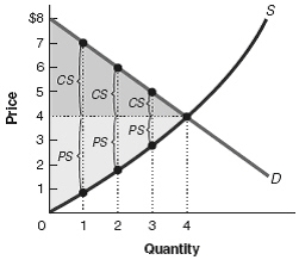 Refer to Exhibit 28-7: The maximum price the consumer is willing to pay for the first unit and minimum price the producer would demand is:
 (Multiple Choice)
4.7/5 (82)
(82) Mutually beneficial trade will occur whenever the exchange rate between the goods involved is set at a level where:
(Multiple Choice)
4.8/5 (87)
(87) If an exporter's supply curve of a commodity is upward sloping,and if a change in import demands in other countries leads them to increase their exports,other things equal,we would expect
(Multiple Choice)
4.8/5 (73)
(73) The central reason why there are gains from international trade is because
(Multiple Choice)
4.9/5 (87)
(87) Exhibit 28-7 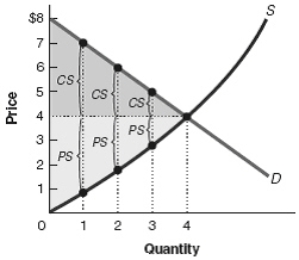 Refer to Exhibit 28-7.For the first unit,the consumer surplus is:
 (Multiple Choice)
4.9/5 (77)
(77) If opening up international trade resulted in the U.S.becoming a wheat exporter,relative to the prior no-trade situation,the U.S.domestic price of wheat:
(Multiple Choice)
4.8/5 (85)
(85) Exhibit 28-2 Karl can produce either 10 tons of oranges or 5 tons of apples in a year,while Adam can produce either 5 tons of oranges or 10 tons of apples.
Refer to Exhibit 28-2.If the exchange rate between apples and oranges in international markets is 1 ton of apples per 3 tons of oranges:
(Multiple Choice)
5.0/5 (76)
(76) In the mid 1990s countries of the world exported $6.5 trillion dollars worth of goods and services.How large were total world imports of goods and services during this period? Explain your answer.
(Essay)
4.9/5 (67)
(67) 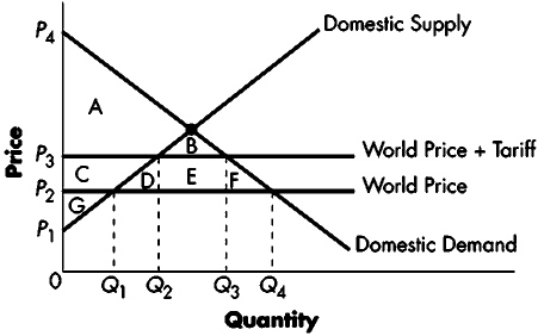 Refer to Exhibit 28-6.A tariff
A new U.S.import quota on imported steel would be likely to:
(Multiple Choice)
4.8/5 (82)
(82) Exhibit 28-3 Alternate Outputs from One Day's Labor Input:
United States: 12 bushels of wheat or 3 yards of textiles.
Great Britain: 3 bushels of wheat or 12 yards of textiles.
Refer to Exhibit 28-3.The opportunity cost of one bushel of wheat in Great Britain is
(Multiple Choice)
4.9/5 (84)
(84) If two countries produce both wheat and sugar and one country has the comparative advantage in producing wheat then the other country must have the comparative advantage producing sugar.
(True/False)
4.9/5 (84)
(84) Exhibit 28-2 Karl can produce either 10 tons of oranges or 5 tons of apples in a year,while Adam can produce either 5 tons of oranges or 10 tons of apples.
Refer to Exhibit 28-2.Which of the following is true?
(Multiple Choice)
4.8/5 (72)
(72) Exhibit 28-2 Karl can produce either 10 tons of oranges or 5 tons of apples in a year,while Adam can produce either 5 tons of oranges or 10 tons of apples.
Refer to Exhibit 28-2.Which of the following would be mutually beneficial terms of trade between Karl and Adam?
(Multiple Choice)
4.7/5 (78)
(78) 
Filters
- Essay(0)
- Multiple Choice(0)
- Short Answer(0)
- True False(0)
- Matching(0)