



 Chat with AI
Exam 28: International Trade

Exam 1: The Role and Method of Economics198 Questions
Exam 2: Economics: Eight Powerful Ideas197 Questions
Exam 3: Scarcity, Trade-Offs, and Production Possibilities189 Questions
Exam 4: Demand, Supply, and Market Equilibrium240 Questions
Exam 5: Markets in Motion and Price Controls228 Questions
Exam 6: Elasticities206 Questions
Exam 7: Market Efficiency and Welfare136 Questions
Exam 8: Market Failure215 Questions
Exam 9: Public Finance and Public Choice64 Questions
Exam 10: Consumer Choice Theory149 Questions
Exam 11: The Firm: Production and Costs198 Questions
Exam 12: Firms in Perfectly Competitive Markets207 Questions
Exam 13: Monopoly and Antitrust189 Questions
Exam 14: Monopolistic Competition and Product Differentiation159 Questions
Exam 15: Oligopoly and Strategic Behavior146 Questions
Exam 16: The Markets for Labor, Capital, and Land177 Questions
Exam 17: Income, Poverty, and Health Care138 Questions
Exam 18: Introduction to Macroeconomics: Unemployment, Inflation, and Economic Fluctuations171 Questions
Exam 19: Measuring Economic Performance147 Questions
Exam 20: Economic Growth in the Global Economy127 Questions
Exam 21: Financial Markets, Saving, and Investment65 Questions
Exam 22: Aggregate Demand and Aggregate Supply163 Questions
Exam 23: The Aggregate Expenditure Model69 Questions
Exam 25: Monetary Institutions182 Questions
Exam 26: The Federal Reserve System and Monetary Policy147 Questions
Exam 27: Issues in Macroeconomic Theory and Policy130 Questions
Exam 28: International Trade182 Questions
Exam 29: International Finance138 Questions
Select questions type


Which of the following is not a major trading partner of the U.S.?
(Multiple Choice)
4.8/5  (72)
(72) The change in the total gain to a nation from international trade is the:
(Multiple Choice)
4.9/5 (85)
(85) Exhibit 28-3 Alternate Outputs from One Day's Labor Input:
United States: 12 bushels of wheat or 3 yards of textiles.
Great Britain: 3 bushels of wheat or 12 yards of textiles.
Refer to Exhibit 28-3.From the data above,the United States
(Multiple Choice)
4.7/5 (76)
(76) When a country allows trade and becomes an exporter of goods,producers gain more than consumers lose.
(True/False)
4.7/5 (81)
(81) Iceland can produce 32 units of food per person per year or 16 units of clothing per person per year,but Lavaland can produce 16 units of food per year or 8 units of clothing.Which of the following is true?
(Multiple Choice)
4.8/5 (87)
(87) The world price of a commodity will settle at the level where
(Multiple Choice)
4.9/5 (77)
(77) In Artland the opportunity cost of producing 1 ton of wheat is 2 tons of corn,while in Scienceland,the opportunity cost of producing 2 tons of wheat is 3 tons of corn.Both countries would be better off if:
(Multiple Choice)
4.8/5 (83)
(83) Exhibit 28-6 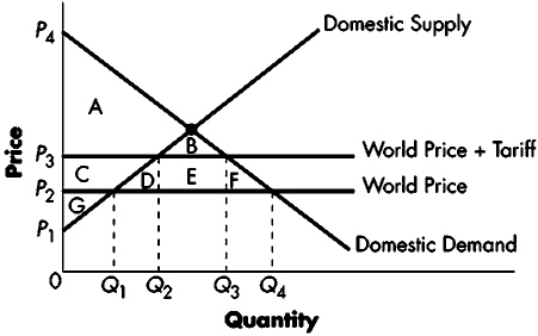 Refer to Exhibit 28-6.The amount of government revenue from the tariff is equal to area:
 (Multiple Choice)
4.8/5 (73)
(73) The intended gains from U.S.tariffs and other trade restrictions can backfire if foreign governments retaliate by imposing additional trade restrictions on U.S.goods sold in their countries.
(True/False)
4.9/5 (75)
(75) Which of the following is not a short-run impact of increasing tariffs on the American industries they seek to protect?
(Multiple Choice)
4.9/5 (73)
(73) Exhibit 28-1 Alpha can produce either 18 tons of oranges or 9 tons of apples in a year,while Omega can produce either 16 tons of oranges or 4 tons of apples.
Refer to Exhibit 28-1.Which of the following exchange rates between apples and oranges would allow both Alpha and Omega to gain by specialization and exchange?
(Multiple Choice)
4.8/5 (85)
(85) What is the law of comparative advantage,and why is it important in international trade?
(Essay)
4.7/5 (72)
(72) What benefits are to be gained from countries producing according to the law of comparative advantage? What if a country is absolutely more productive in all goods?
(Essay)
4.7/5 (84)
(84) Exhibit 28-5 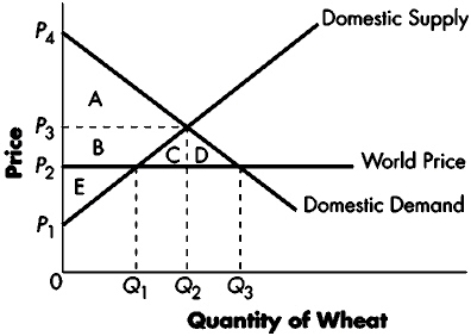 Refer to Exhibit 28-5.The change in consumer surplus from free trade is area:
 (Multiple Choice)
4.9/5 (70)
(70) Columbia produces coffee with less labor and land than any other country; it therefore necessarily has
(Multiple Choice)
4.8/5 (79)
(79) The inevitable cost of protecting domestic industries from foreign competition will be higher prices for domestic consumers.
(True/False)
5.0/5 (89)
(89) If a country begins allowing free international trade in a good,and as a result,it increases imports of that good.
(Multiple Choice)
4.8/5 (72)
(72) The difference between the price the consumer is willing to pay for a good or service and what he would have to pay for that unit is called:
(Multiple Choice)
4.9/5 (78)
(78) If Japan does not have a comparative advantage in producing rice,the consequences of adopting a Japanese policy of reducing or eliminating imports of rice into their country would include:
(Multiple Choice)
4.8/5 (73)
(73) 
Filters
- Essay(0)
- Multiple Choice(0)
- Short Answer(0)
- True False(0)
- Matching(0)