



 Chat with AI
Exam 28: International Trade

Exam 1: The Role and Method of Economics198 Questions
Exam 2: Economics: Eight Powerful Ideas197 Questions
Exam 3: Scarcity, Trade-Offs, and Production Possibilities189 Questions
Exam 4: Demand, Supply, and Market Equilibrium240 Questions
Exam 5: Markets in Motion and Price Controls228 Questions
Exam 6: Elasticities206 Questions
Exam 7: Market Efficiency and Welfare136 Questions
Exam 8: Market Failure215 Questions
Exam 9: Public Finance and Public Choice64 Questions
Exam 10: Consumer Choice Theory149 Questions
Exam 11: The Firm: Production and Costs198 Questions
Exam 12: Firms in Perfectly Competitive Markets207 Questions
Exam 13: Monopoly and Antitrust189 Questions
Exam 14: Monopolistic Competition and Product Differentiation159 Questions
Exam 15: Oligopoly and Strategic Behavior146 Questions
Exam 16: The Markets for Labor, Capital, and Land177 Questions
Exam 17: Income, Poverty, and Health Care138 Questions
Exam 18: Introduction to Macroeconomics: Unemployment, Inflation, and Economic Fluctuations171 Questions
Exam 19: Measuring Economic Performance147 Questions
Exam 20: Economic Growth in the Global Economy127 Questions
Exam 21: Financial Markets, Saving, and Investment65 Questions
Exam 22: Aggregate Demand and Aggregate Supply163 Questions
Exam 23: The Aggregate Expenditure Model69 Questions
Exam 25: Monetary Institutions182 Questions
Exam 26: The Federal Reserve System and Monetary Policy147 Questions
Exam 27: Issues in Macroeconomic Theory and Policy130 Questions
Exam 28: International Trade182 Questions
Exam 29: International Finance138 Questions
Select questions type


If the United States could produce 1/2 ton of potatoes or 1 ton of wheat per worker per year,while Ireland could produce 3 tons of potatoes or 2 tons of wheat per worker per year,the country with the comparative advantage in producing wheat is ____ and the country with the absolute advantage in producing potatoes is ____.
(Multiple Choice)
4.9/5  (66)
(66) When a country allows trade and becomes an exporter of goods consumers gain more than producers lose.
(True/False)
4.9/5 (87)
(87) Which of the following might lead a nation to engage in international trade?
(Multiple Choice)
4.9/5 (61)
(61) Iceland can produce 32 units of food per person per year or 16 units of clothing per person per year,but Lavaland can produce 36 units of food per year or 18 units of clothing.Which of the following is true?
(Multiple Choice)
4.8/5 (89)
(89) Import tariffs in the United States are likely to reduce U.S.exports,both because of the resulting decrease in foreign earnings of dollars from exports to the United States and because of the likelihood of increases in other countries' import restrictions against U.S.goods.
(True/False)
4.9/5 (83)
(83) If nations begin to expand their specialization in production for the purpose of trade,
(Multiple Choice)
4.9/5 (67)
(67) The infant industry argument for protectionism suggest that an industry must be protected in the early stages of its development so that:
(Multiple Choice)
4.9/5 (81)
(81) A country with relatively abundant supplies of labor is unlikely to have a comparative advantage in the production of labor intensive goods.
(True/False)
4.8/5 (76)
(76) A U.S.tariff on French wine will likely benefit U.S.wine producers and the U.S.government (by increasing tax revenue),but harm U.S.wine drinkers and French wine producers.
(True/False)
5.0/5 (79)
(79) The United States is the world's leading grain-producing nation.Exporting grain causes the:
(Multiple Choice)
4.9/5 (83)
(83) Exhibit 28-5 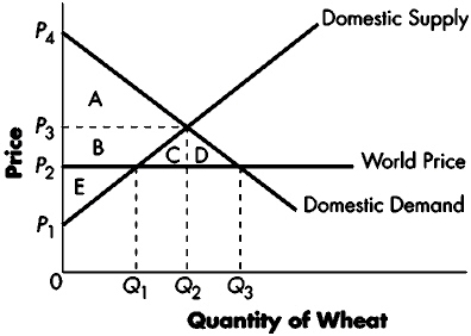 Refer to Exhibit 28-5.The change in total surplus from free trade is area:
 (Multiple Choice)
4.9/5 (85)
(85) Assume that the U.S.can produce either 10 million cell phones or 20 million picture frames and that Canada can produce either 2 million cell phones or 6 million picture frames.Based on this information,which of the following is true?
(Multiple Choice)
4.7/5 (83)
(83) Which of the following is one reason why trade makes all parties better off?
(Multiple Choice)
4.9/5 (71)
(71) Exhibit 28-1 Alpha can produce either 18 tons of oranges or 9 tons of apples in a year,while Omega can produce either 16 tons of oranges or 4 tons of apples.
Refer to Exhibit 28-1.The opportunity costs of producing 1 ton of oranges for Alpha and Omega,respectively,are:
(Multiple Choice)
4.8/5 (86)
(86) When a country allows trade and becomes an importer of goods,producers gain more than consumers lose.
(True/False)
4.8/5 (83)
(83) The net loss in welfare from a quota is proportionately larger than for a tariff because:
(Multiple Choice)
4.8/5 (71)
(71) 
Filters
- Essay(0)
- Multiple Choice(0)
- Short Answer(0)
- True False(0)
- Matching(0)