



 Chat with AI
Exam 7: Market Efficiency and Welfare

Exam 1: The Role and Method of Economics198 Questions
Exam 2: Economics: Eight Powerful Ideas197 Questions
Exam 3: Scarcity, Trade-Offs, and Production Possibilities189 Questions
Exam 4: Demand, Supply, and Market Equilibrium240 Questions
Exam 5: Markets in Motion and Price Controls228 Questions
Exam 6: Elasticities206 Questions
Exam 7: Market Efficiency and Welfare136 Questions
Exam 8: Market Failure215 Questions
Exam 9: Public Finance and Public Choice64 Questions
Exam 10: Consumer Choice Theory149 Questions
Exam 11: The Firm: Production and Costs198 Questions
Exam 12: Firms in Perfectly Competitive Markets207 Questions
Exam 13: Monopoly and Antitrust189 Questions
Exam 14: Monopolistic Competition and Product Differentiation159 Questions
Exam 15: Oligopoly and Strategic Behavior146 Questions
Exam 16: The Markets for Labor, Capital, and Land177 Questions
Exam 17: Income, Poverty, and Health Care138 Questions
Exam 18: Introduction to Macroeconomics: Unemployment, Inflation, and Economic Fluctuations171 Questions
Exam 19: Measuring Economic Performance147 Questions
Exam 20: Economic Growth in the Global Economy127 Questions
Exam 21: Financial Markets, Saving, and Investment65 Questions
Exam 22: Aggregate Demand and Aggregate Supply163 Questions
Exam 23: The Aggregate Expenditure Model69 Questions
Exam 25: Monetary Institutions182 Questions
Exam 26: The Federal Reserve System and Monetary Policy147 Questions
Exam 27: Issues in Macroeconomic Theory and Policy130 Questions
Exam 28: International Trade182 Questions
Exam 29: International Finance138 Questions
Select questions type


Phil and Lasca have always wanted to take a cruise.Although willing to pay $5,000 for a Caribbean cruise for two,they were able to purchase a cruise vacation for two for $3,500.Their total consumer surplus amounted to:
(Multiple Choice)
4.8/5  (81)
(81) Exhibit 7-8 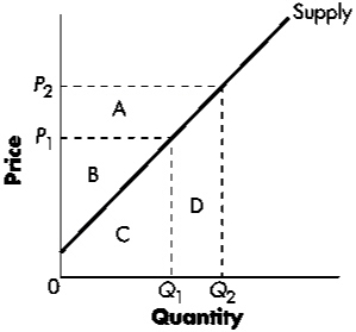 Refer to Exhibit 7-8.When the price falls from P2 to P1,producer surplus:
 (Multiple Choice)
4.8/5 (69)
(69) Exhibit 7-10 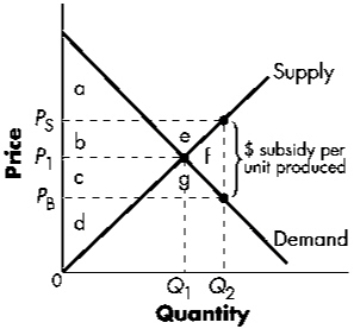 Refer to Exhibit 7-10.The producer surplus before the subsidy is area
 (Multiple Choice)
4.9/5 (66)
(66) Exhibit 7-6  Refer to Exhibit 7-6.If the market is in equilibrium and then the government imposes a price floor equal to P1,sellers lose producer surplus equal to area ____,but gain producer surplus equal to area ____.
 (Multiple Choice)
4.9/5 (79)
(79) The more elastic the supply curve,the ____ will be the effect of a tax on the quantity exchanged and the ____ will be the welfare cost.
(Multiple Choice)
4.8/5 (80)
(80) The more elastic the demand curve,the ____ will be the effect of a tax on the quantity exchanged and the ____ will be the welfare cost.
(Multiple Choice)
4.8/5 (73)
(73) Exhibit 7-12 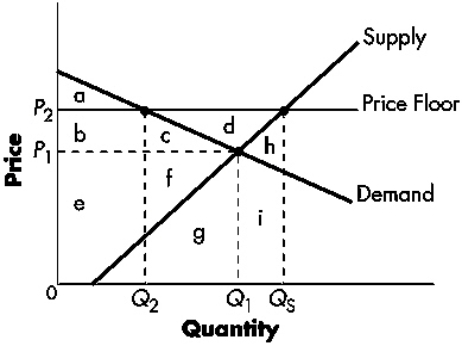 Refer to Exhibit 7-12.Producer surplus before the price floor is area:
 (Multiple Choice)
4.8/5 (85)
(85) How does the size of the deadweight loss from a tax depend on the price elasticities of supply and demand?
(Essay)
4.7/5 (80)
(80) Exhibit 7-2  Refer to Exhibit 7-2.What is the consumer surplus of the 2nd unit consumed assuming this market reaches equilibrium?
 (Multiple Choice)
4.9/5 (67)
(67) Exhibit 7-11 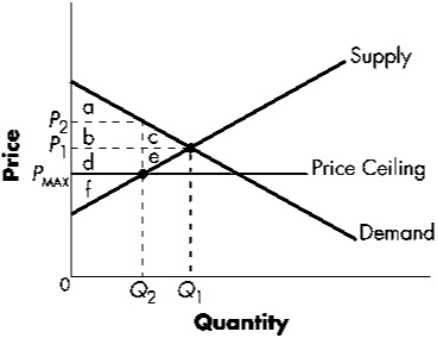 Refer to Exhibit 7-11.The consumer surplus after the price ceiling is area
 (Multiple Choice)
4.9/5 (86)
(86) Goods that are heavily taxed,such as alcohol and cigarettes,often have:
(Multiple Choice)
5.0/5 (69)
(69) Exhibit 7-6  Refer to Exhibit 7-6.If the market price equals P2,consumer surplus can be identified in the diagram as area:
 (Multiple Choice)
4.8/5 (83)
(83) As the market price of a good falls due to an increase in supply,consumer surplus:
(Multiple Choice)
4.9/5 (68)
(68) Ceteris paribus,a decrease in the price of a good will cause the:
(Multiple Choice)
4.7/5 (78)
(78) 
Filters
- Essay(0)
- Multiple Choice(0)
- Short Answer(0)
- True False(0)
- Matching(0)