



 Chat with AI
Exam 7: Market Efficiency and Welfare

Exam 1: The Role and Method of Economics198 Questions
Exam 2: Economics: Eight Powerful Ideas197 Questions
Exam 3: Scarcity, Trade-Offs, and Production Possibilities189 Questions
Exam 4: Demand, Supply, and Market Equilibrium240 Questions
Exam 5: Markets in Motion and Price Controls228 Questions
Exam 6: Elasticities206 Questions
Exam 7: Market Efficiency and Welfare136 Questions
Exam 8: Market Failure215 Questions
Exam 9: Public Finance and Public Choice64 Questions
Exam 10: Consumer Choice Theory149 Questions
Exam 11: The Firm: Production and Costs198 Questions
Exam 12: Firms in Perfectly Competitive Markets207 Questions
Exam 13: Monopoly and Antitrust189 Questions
Exam 14: Monopolistic Competition and Product Differentiation159 Questions
Exam 15: Oligopoly and Strategic Behavior146 Questions
Exam 16: The Markets for Labor, Capital, and Land177 Questions
Exam 17: Income, Poverty, and Health Care138 Questions
Exam 18: Introduction to Macroeconomics: Unemployment, Inflation, and Economic Fluctuations171 Questions
Exam 19: Measuring Economic Performance147 Questions
Exam 20: Economic Growth in the Global Economy127 Questions
Exam 21: Financial Markets, Saving, and Investment65 Questions
Exam 22: Aggregate Demand and Aggregate Supply163 Questions
Exam 23: The Aggregate Expenditure Model69 Questions
Exam 25: Monetary Institutions182 Questions
Exam 26: The Federal Reserve System and Monetary Policy147 Questions
Exam 27: Issues in Macroeconomic Theory and Policy130 Questions
Exam 28: International Trade182 Questions
Exam 29: International Finance138 Questions
Select questions type


Exhibit 7-8 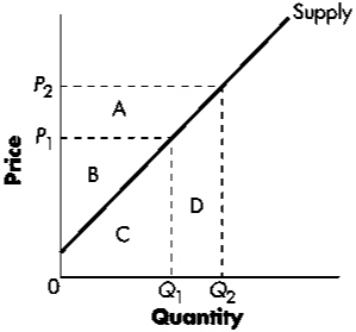 Refer to Exhibit 7-8.When the price is P2,the producer surplus is equal to area:
 (Multiple Choice)
4.9/5  (82)
(82) If the world supply of diamonds decreases,diamonds become more valuable,and therefore,the consumer surplus derived from diamonds increases.
(True/False)
4.7/5 (80)
(80) Exhibit 7-9 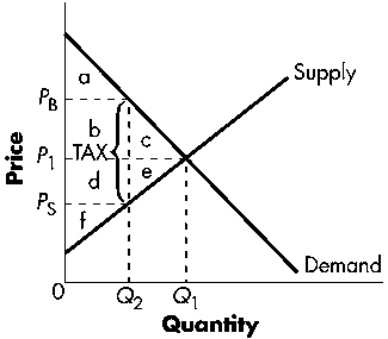 Refer to Exhibit 7-9.The total welfare after the tax is the area:
 (Multiple Choice)
4.7/5 (87)
(87) Exhibit 7-8 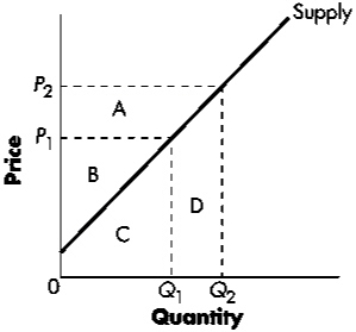 Refer to Exhibit 7-8.When the price is P1,the producer surplus is equal to area:
 (Multiple Choice)
4.9/5 (85)
(85) Ceteris paribus,an increase in the price of a good will cause the:
(Multiple Choice)
4.9/5 (81)
(81) Exhibit 7-11 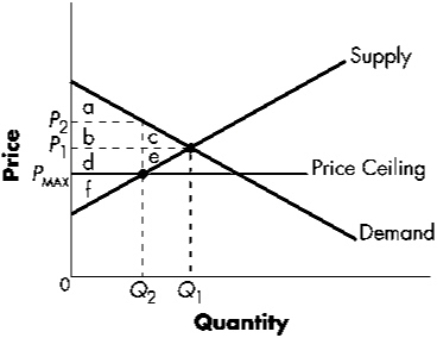 Refer to Exhibit 7-11.The consumer surplus before the price ceiling is area:
 (Multiple Choice)
4.8/5 (66)
(66) Exhibit 7-10 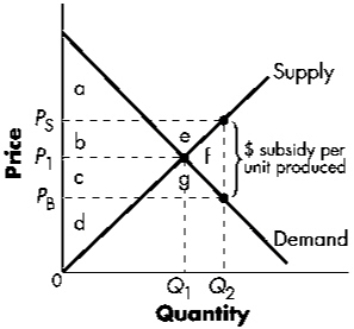 Refer to Exhibit 7-10.The producer surplus after the subsidy is area
 (Multiple Choice)
4.9/5 (70)
(70) A government payment to producers for the difference between a target price and the price at which producers were able to sell their goods is known as a:
(Multiple Choice)
4.8/5 (96)
(96) Exhibit 7-5 The schedule below represents the willingness of a typical consumer to pay for wine in a year.Suppose there are 10,000 identical consumers in the community.
 Refer to Exhibit 7-5.If the market price of wine is $20,the total consumer surplus for the community equals:
 (Multiple Choice)
5.0/5 (76)
(76) Exhibit 7-3  Refer to Exhibit 7-3.What is the producer surplus of the 10th unit bought/sold?
 (Multiple Choice)
4.7/5 (65)
(65) Welfare effects are the gains and losses associated with ____ in markets.
(Multiple Choice)
4.7/5 (75)
(75) Exhibit 7-7 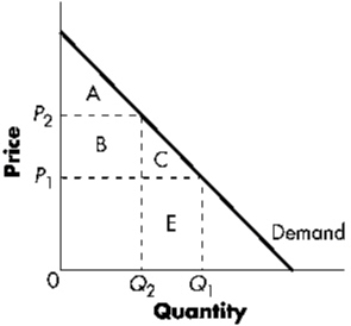 Refer to Exhibit 7-7.When the price falls from P2 to P1,consumer surplus
 (Multiple Choice)
4.8/5 (78)
(78) Exhibit 7-1 Miles demands jazz CDs according to the following demand schedule:
 Refer to Exhibit 7-1.If the price of the jazz CDs equals $15,the total consumer surplus Miles receives from purchasing jazz CDs is:
 (Multiple Choice)
4.8/5 (93)
(93) Exhibit 7-2  Refer to Exhibit 7-2.What is the producer surplus of the 1st unit sold assuming this market reaches equilibrium?
 (Multiple Choice)
4.9/5 (70)
(70) Exhibit 7-12 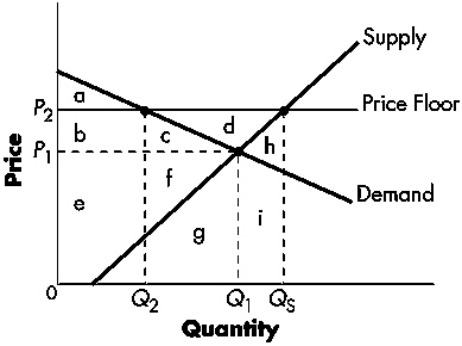 Refer to Exhibit 7-12.When the price floor is implemented,the price changes to ____ and the output bought by consumers changes to ____.
 (Multiple Choice)
4.8/5 (74)
(74) 
Filters
- Essay(0)
- Multiple Choice(0)
- Short Answer(0)
- True False(0)
- Matching(0)