



 Chat with AI
Exam 7: Market Efficiency and Welfare

Exam 1: The Role and Method of Economics198 Questions
Exam 2: Economics: Eight Powerful Ideas197 Questions
Exam 3: Scarcity, Trade-Offs, and Production Possibilities189 Questions
Exam 4: Demand, Supply, and Market Equilibrium240 Questions
Exam 5: Markets in Motion and Price Controls228 Questions
Exam 6: Elasticities206 Questions
Exam 7: Market Efficiency and Welfare136 Questions
Exam 8: Market Failure215 Questions
Exam 9: Public Finance and Public Choice64 Questions
Exam 10: Consumer Choice Theory149 Questions
Exam 11: The Firm: Production and Costs198 Questions
Exam 12: Firms in Perfectly Competitive Markets207 Questions
Exam 13: Monopoly and Antitrust189 Questions
Exam 14: Monopolistic Competition and Product Differentiation159 Questions
Exam 15: Oligopoly and Strategic Behavior146 Questions
Exam 16: The Markets for Labor, Capital, and Land177 Questions
Exam 17: Income, Poverty, and Health Care138 Questions
Exam 18: Introduction to Macroeconomics: Unemployment, Inflation, and Economic Fluctuations171 Questions
Exam 19: Measuring Economic Performance147 Questions
Exam 20: Economic Growth in the Global Economy127 Questions
Exam 21: Financial Markets, Saving, and Investment65 Questions
Exam 22: Aggregate Demand and Aggregate Supply163 Questions
Exam 23: The Aggregate Expenditure Model69 Questions
Exam 25: Monetary Institutions182 Questions
Exam 26: The Federal Reserve System and Monetary Policy147 Questions
Exam 27: Issues in Macroeconomic Theory and Policy130 Questions
Exam 28: International Trade182 Questions
Exam 29: International Finance138 Questions
Select questions type


Fred's demand schedule for movie DVDs is as follows: At $60,he would buy 1; at $50,he would buy two; at $30,he would buy 3; and at $20,he would buy 4.If the price of movie DVDs equals $40,the consumer surplus Fred receives from purchasing movie DVDs would be:
(Multiple Choice)
4.9/5  (76)
(76) Consumer surplus increases whenever the price of a good increases due to a leftward shift of the supply curve.
(True/False)
4.7/5 (80)
(80) Exhibit 7-4 The schedule below shows the prices that a consumer is willing to pay for pounds of shrimp:
 Refer to Exhibit 7-4.If the price of shrimp is $12 per pound,according to the schedule total consumer surplus equals:
 (Multiple Choice)
4.8/5 (79)
(79) Exhibit 7-7 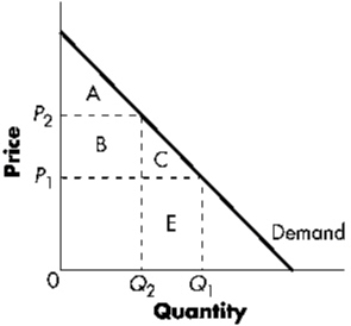 Refer to Exhibit 7-7.When the price is P1,the consumer surplus is equal to the area:
 (Multiple Choice)
4.9/5 (92)
(92) Exhibit 7-7 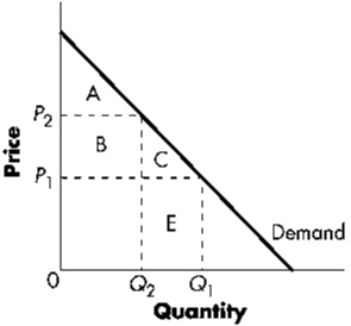 Refer to Exhibit 7-7.When the price is P2,the consumer surplus is equal to area:
 (Multiple Choice)
4.9/5 (74)
(74) Exhibit 7-14
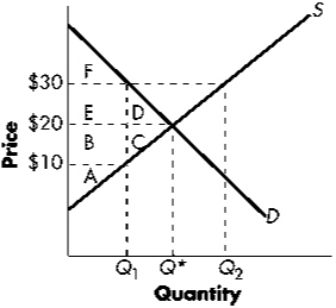 Refer to Exhibit 7-14.Identify the areas of consumer and producer surplus when the market price equals $20.
 (Essay)
4.9/5 (81)
(81) If Ming is willing to pay $75 to attend the Broadway production of The Lion King but actually pays $40,she receives a consumer surplus of $35.
(True/False)
4.9/5 (78)
(78) Other things equal,a price floor will reduce consumer surplus,but it will increase producer surplus if the government buys up any surplus at the price floor.
(True/False)
4.9/5 (73)
(73) How do taxes distort the incentives of buyers and sellers in a market?
(Essay)
4.8/5 (82)
(82) Exhibit 7-2  Refer to Exhibit 7-2.What is the total amount of producer surplus assuming this market reaches equilibrium?
 (Multiple Choice)
4.9/5 (82)
(82) The difference between the amount a consumer is willing to pay and the amount they actually must pay for a good is called the:
(Multiple Choice)
4.8/5 (78)
(78) Exhibit 7-13 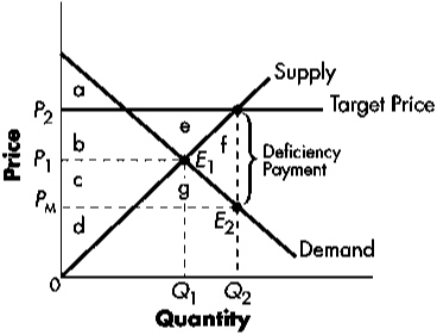 Refer to Exhibit 7-13.With the deficiency payment program,producers will supply ____ output.
 (Multiple Choice)
4.9/5 (75)
(75) Exhibit 7-11 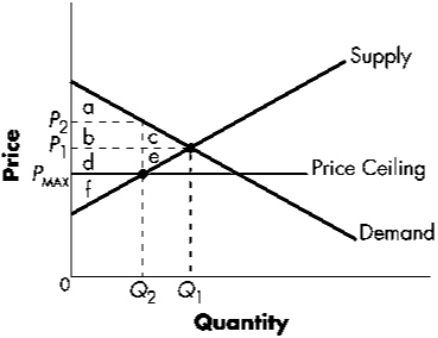 Refer to Exhibit 7-11.If area d is larger than area ____,the consumer is better off from the price ceiling.
 (Multiple Choice)
4.8/5 (78)
(78) Consumer surplus increases whenever the price of a good decreases due to a rightward shift of the supply curve.
(True/False)
4.9/5 (87)
(87) Exhibit 7-11 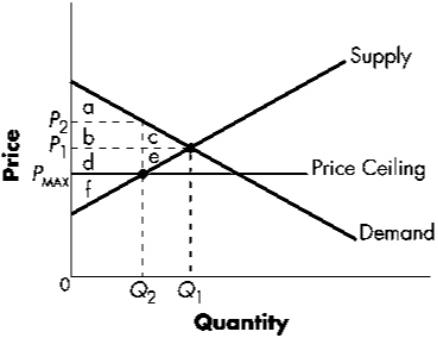 Refer to Exhibit 7-11.The producer surplus after the price ceiling is area
 (Multiple Choice)
4.9/5 (79)
(79) 
Filters
- Essay(0)
- Multiple Choice(0)
- Short Answer(0)
- True False(0)
- Matching(0)