



 Chat with AI
Exam 14: Government Intervention in the Market

Exam 1: Economics: Foundations and Models159 Questions
Exam 2: Choices and Trade-Offs in the Market192 Questions
Exam 3: Where Prices Come From: The Interaction of Demand and Supply202 Questions
Exam 4: Elasticity: The Responsiveness of Demand and Supply224 Questions
Exam 5: Economic Efficiency, Government Price Setting and Taxes187 Questions
Exam 6: Consumer Choice and Behavioural Economics254 Questions
Exam 7: Technology Production and Costs301 Questions
Exam 8: Firms in Perfectly Competitive Markets269 Questions
Exam 9: Monopoly Markets281 Questions
Exam 10: Monopolistic Competition: The Competitive Model in a More Realistic255 Questions
Exam 11: Oligopoly: Markets With Few Competitors186 Questions
Exam 12: The Markets for Labour and Other Factors of Production250 Questions
Exam 13: Comparative Advantage and the Gains From International Trade131 Questions
Exam 14: Government Intervention in the Market113 Questions
Exam 15: Externalities, Environmental Policy and Public Goods212 Questions
Exam 16: The Distribution of Income and Social Policy121 Questions
Select questions type


Figure 14.1 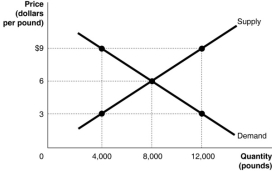 -Refer to Figure 14.1.The figure above represents the market for pecans.Assume that this is a competitive market.Which of the following is true?
 (Multiple Choice)
5.0/5  (69)
(69) Consider a used car market in which half the cars are good and half are bad (lemons).A rational buyer in this market should
(Multiple Choice)
4.8/5 (69)
(69) When people who buy insurance change their behaviour after the purchase because they are protected from loss by the insurance, the insurance market is said to face the problem of
(Multiple Choice)
4.9/5 (77)
(77) What do economists call the price of a factor of production that is in fixed supply?
(Multiple Choice)
5.0/5 (85)
(85) Will equilibrium in a market always result in an outcome that is economically efficient? Explain.
(Essay)
4.8/5 (92)
(92) Consider a used car market in which half the cars are good and half are bad (lemons).Suppose the average price of a good car is $9000 and the average price of a lemon is $3000.If rational buyers are willing to pay $6000 for a used car, then sellers will agree to sell mostly the lemons at this price.What is the term used to describe this situation?
(Multiple Choice)
4.8/5 (81)
(81) Suppose that in a market for used cars, there are good used cars and bad used cars (lemons).Consumers are willing to pay as much as $6000 for a good used car but only $1000 for a lemon.Sellers of good used cars value their cars at $5000 each and sellers of lemons value their cars at $800 each.Buyers cannot tell if a used car is reliable or is a lemon.Based on this information, what is the likely outcome in the market for used cars?
(Multiple Choice)
4.9/5 (74)
(74) If marginal benefit is greater than marginal cost, output is inefficiently high.
(True/False)
4.9/5 (72)
(72) One reason why adverse selection problems arise in health insurance markets is that
(Multiple Choice)
4.8/5 (74)
(74) The situation in which one party to a transaction takes advantage of knowing more than the other party to the transaction is known as asymmetric information.
(True/False)
4.8/5 (75)
(75) 'When it comes to public goods, individuals do not reveal their true preferences because it is not in their self-interest to do so.' Evaluate this statement.
(Essay)
4.7/5 (75)
(75) Public goods are distinguished by two primary characteristics.What are they?
(Multiple Choice)
4.8/5 (79)
(79) Figure 14.2 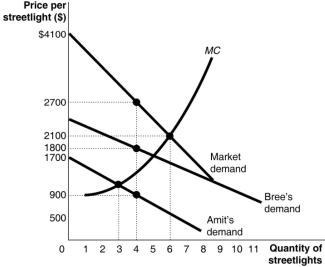 Amit and Bree are the only two homeowners on an isolated private road.Both agree that installing street lights along the road would be beneficial and want to do so.Figure 14.2 shows their willingness to pay for different quantities of street lights, the market demand for street lights and the marginal cost of installing the street lights.
-Refer to Figure 14.2.How much is Bree willing to pay to have 4 street lights installed?
Amit and Bree are the only two homeowners on an isolated private road.Both agree that installing street lights along the road would be beneficial and want to do so.Figure 14.2 shows their willingness to pay for different quantities of street lights, the market demand for street lights and the marginal cost of installing the street lights.
-Refer to Figure 14.2.How much is Bree willing to pay to have 4 street lights installed? (Multiple Choice)
4.9/5 (83)
(83) What is one difference between the demand for a private good and that for a public good?
(Multiple Choice)
4.9/5 (88)
(88) 
Filters
- Essay(0)
- Multiple Choice(0)
- Short Answer(0)
- True False(0)
- Matching(0)