



 Chat with AI
Exam 20: Electric Potential and Electric

Exam 1: Introduction to Physics98 Questions
Exam 2: One-Dimensional Kinematics138 Questions
Exam 3: Vectors in Physics69 Questions
Exam 4: Two-Dimensional Kinematics51 Questions
Exam 5: Newtons Laws of Motion54 Questions
Exam 6: Applications of Newtons Laws104 Questions
Exam 7: Work and Kinetic Energy55 Questions
Exam 8: Potential Energy and Conservation of Energy62 Questions
Exam 9: Linear Momentum and Collisions114 Questions
Exam 10: Rotational Kinematics and Energy60 Questions
Exam 11: Rotational Dynamics and Static Equilibrium69 Questions
Exam 12: Gravity53 Questions
Exam 13: Oscillations About Equilibrium79 Questions
Exam 14: Waves and Sound142 Questions
Exam 15: Fluids103 Questions
Exam 16: Temperature and Heat110 Questions
Exam 17: Phases and Phase Changes93 Questions
Exam 18: The Laws of Thermodynamics90 Questions
Exam 19: Electric Charges, Forces, and Fields75 Questions
Exam 20: Electric Potential and Electric124 Questions
Exam 21: Electric Current and Direct-Current Circuits228 Questions
Exam 22: Magnetism147 Questions
Exam 23: Magnetic Flux and Faradays Law of Induction98 Questions
Exam 24: Alternating-Current Circuits72 Questions
Exam 25: Electromagnetic Waves63 Questions
Exam 26: Geometrical Optics133 Questions
Exam 27: Optical Instruments103 Questions
Exam 28: Physical Optics: Interference and Diffraction119 Questions
Exam 29: Relativity98 Questions
Exam 30: Quantum Physics88 Questions
Exam 31: Atomic Physics97 Questions
Exam 32: Nuclear Physics and Nuclear Radiation137 Questions
Select questions type


How much work is needed to carry an electron from the positive terminal to the negative terminal of a 9.0-V battery.(e = 1.60 × 10⁻¹⁹ C ,melectron = 9.11 × 10⁻³¹ kg)
(Multiple Choice)
5.0/5  (86)
(86) An air-filled capacitor carries enough charge to store  Of potential energy.It is then accidentally filled with water in such a way as not to discharge its plates.How much energy does it continue to store after it is filled? The dielectric constant for water is 78 and for air it is 1.0006.
 (Multiple Choice)
4.7/5 (63)
(63) Which of the following changes will increase the capacitance of a parallel-plate capacitor? (There could be more than one correct choice. )
(Multiple Choice)
4.8/5 (72)
(72) An air-filled capacitor has a potential difference between the plates of 80 V.If the charge on each of the plates of the capacitor has magnitude 8.0 μC,what is the electrical energy stored by this capacitor?
(Multiple Choice)
4.7/5 (76)
(76) Which of the following will increase the capacitance of a parallel-plate capacitor? (There could be more than one correct choice. )
(Multiple Choice)
4.8/5 (68)
(68) A 4.0-g bead carries a charge of 20 μC.The bead is accelerated from rest through a potential difference V,and afterward the bead is moving at 2.0 m/s.What is the magnitude of the potential difference V?
(Multiple Choice)
4.9/5 (82)
(82) As a proton moves in the direction the electric field lines
(Multiple Choice)
5.0/5 (76)
(76) Point charges +4.00 μC and +2.00 μC are placed at the opposite corners of a rectangle as shown in the figure.What is the potential difference VA - VB? (k = 1/4πε0 = 8.99 × 10⁹ N ∙ m2/C2) 
(Multiple Choice)
4.9/5 (87)
(87) Two isolated copper plates,each of area 0.40 m2,carry opposite charges of magnitude 7.08 × 10⁻¹⁰ C.They are placed opposite each other in parallel alignment,with a spacing of 4.0 cm between them.What is the potential difference between the plates? (ε0 = 8.85 × 10⁻¹² C2/N ∙ m2)
(Multiple Choice)
4.8/5 (65)
(65) If a Cu2+ ion that is initially at rest accelerates through a potential difference of 12 V without friction,how much kinetic energy will it gain? (e = 1.60 × 10⁻¹⁹ C)
(Multiple Choice)
4.8/5 (82)
(82) An electron is released from rest at a distance of 9.00 cm from a fixed proton.How fast will the electron be moving when it is 3.00 cm from the proton?,(k = 1/4πε0 = 8.99 × 10⁹ N ∙ m2/C2,
 ,

, (Multiple Choice)
4.9/5 (82)
(82) The figure shows an arrangement of two particles each having charge Q = -6.8 nC and each separated by 5.0 mm from a proton.If the two particles are held fixed at their locations and the proton is set into motion as shown,what is the minimum speed the proton needs to totally escape from these particles? (mproton = 1.67 × 10⁻²⁷ kg,e = 1.60 × 10⁻¹⁹ C,k = 1/4πε0 = 9.0 × 10⁹ N ∙ m2/C2) 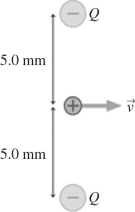
(Multiple Choice)
5.0/5 (77)
(77) A proton is accelerated from rest through a potential difference V0 and gains a speed v0.If it were accelerated instead through a potential difference of 2V0,what speed would it gain?
(Multiple Choice)
4.9/5 (82)
(82) The square plates of a 3000-pF parallel-plate capacitor measure 40 mm by 40 mm and are separated by a dielectric that is 0.29 mm thick and completely fills the region between the plates.What is the dielectric constant of the dielectric? (ε0 = 8.85 × 10⁻¹² C2/N ∙ m2)
(Multiple Choice)
4.7/5 (87)
(87) When the potential difference between the plates of an ideal air-filled parallel plate capacitor is 35 V,the electric field between the plates has a strength of 750 V/m.If the plate area is 4.0 × 10⁻² m2,what is the capacitance of this capacitor? (ε0 = 8.85 × 10⁻¹² C2/N ∙ m2)
(Multiple Choice)
4.8/5 (88)
(88) Two point charges of +2.00 μC and +4.00 μC are at the origin and at the point x = 0.000 m,y = -0.300 m,as shown in the figure.What is the electric potential due to these charges,relative to infinity,at the point P at x = 0.400 m on the x-axis? (k = 1/4πε0 = 8.99 × 10⁹ N ∙ m2/C2) 
(Multiple Choice)
4.8/5 (87)
(87) A 6.0-μF air-filled capacitor is connected across a 100-V potential source (a battery).After the battery fully charges the capacitor,it is left connected and the capacitor is immersed in transformer oil,which has a dielectric constant of 4.5.How much additional charge flows from the battery onto the capacitor during this process?
(Multiple Choice)
5.0/5 (86)
(86) The potential difference between the plates of an ideal air-filled parallel-plate capacitor with a plate separation of 6.0 cm is 60 V.What is the strength of the electric field between the plates of this capacitor?
(Multiple Choice)
4.9/5 (81)
(81) Two 5.0-µC point charges are 12 cm apart.What is the electric potential (relative to infinity)of this combination at the point where the electric field due to these charges is zero? 
(Multiple Choice)
4.8/5 (74)
(74) At a distance d from a point charge Q,the energy density in its electric field is u.If we double the charge,what is the energy density at the same point?
(Multiple Choice)
4.8/5 (83)
(83) 
Filters
- Essay(0)
- Multiple Choice(0)
- Short Answer(0)
- True False(0)
- Matching(0)