



 Chat with AI
Exam 20: Electric Potential and Electric

Exam 1: Introduction to Physics98 Questions
Exam 2: One-Dimensional Kinematics138 Questions
Exam 3: Vectors in Physics69 Questions
Exam 4: Two-Dimensional Kinematics51 Questions
Exam 5: Newtons Laws of Motion54 Questions
Exam 6: Applications of Newtons Laws104 Questions
Exam 7: Work and Kinetic Energy55 Questions
Exam 8: Potential Energy and Conservation of Energy62 Questions
Exam 9: Linear Momentum and Collisions114 Questions
Exam 10: Rotational Kinematics and Energy60 Questions
Exam 11: Rotational Dynamics and Static Equilibrium69 Questions
Exam 12: Gravity53 Questions
Exam 13: Oscillations About Equilibrium79 Questions
Exam 14: Waves and Sound142 Questions
Exam 15: Fluids103 Questions
Exam 16: Temperature and Heat110 Questions
Exam 17: Phases and Phase Changes93 Questions
Exam 18: The Laws of Thermodynamics90 Questions
Exam 19: Electric Charges, Forces, and Fields75 Questions
Exam 20: Electric Potential and Electric124 Questions
Exam 21: Electric Current and Direct-Current Circuits228 Questions
Exam 22: Magnetism147 Questions
Exam 23: Magnetic Flux and Faradays Law of Induction98 Questions
Exam 24: Alternating-Current Circuits72 Questions
Exam 25: Electromagnetic Waves63 Questions
Exam 26: Geometrical Optics133 Questions
Exam 27: Optical Instruments103 Questions
Exam 28: Physical Optics: Interference and Diffraction119 Questions
Exam 29: Relativity98 Questions
Exam 30: Quantum Physics88 Questions
Exam 31: Atomic Physics97 Questions
Exam 32: Nuclear Physics and Nuclear Radiation137 Questions
Select questions type


A proton that is initially at rest is accelerated through an electric potential difference of magnitude 500 V.How much kinetic energy does it gain? (e = 1.60 × 10⁻¹⁹C)
(Multiple Choice)
4.8/5  (89)
(89) A region of space contains a uniform electric field,directed toward the right,as shown in the figure.Which statement about this situation is correct? 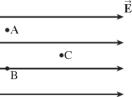
(Multiple Choice)
4.9/5 (81)
(81) Each plate of an ideal air-filled parallel-plate capacitor has an area of 0.0010  ,and the separation of the plates is
 An electric field of
 Is present between the plates.What is the capacitance of this capacitor? (ε0 = 8.85 × 10⁻¹² C2/N ∙ m2)
,and the separation of the plates is
An electric field of
Is present between the plates.What is the capacitance of this capacitor? (ε0 = 8.85 × 10⁻¹² C2/N ∙ m2) (Multiple Choice)
4.9/5 (92)
(92) What charge accumulates on the plates of a 2.0-μF air-filled capacitor when it is charged until the potential difference across its plates is 100 V?
(Multiple Choice)
4.9/5 (82)
(82) An ideal parallel-plate capacitor consists of two parallel plates of area A separated by a distance d.This capacitor is connected across a battery that maintains a constant potential difference between the plates.If the separation between the plates is now doubled,the magnitude of the charge on the plates will
(Multiple Choice)
4.7/5 (82)
(82) If the result of your calculation of a quantity has SI units of kg ∙ m/(s2 ∙C),that quantity could be
(Multiple Choice)
4.8/5 (68)
(68) Two ideal parallel-plate capacitors are identical in every respect except that one has twice the plate area of the other.If the smaller capacitor has capacitance C,the larger one has capacitance
(Multiple Choice)
4.7/5 (81)
(81) As an electron moves in the direction the electric field lines
(Multiple Choice)
5.0/5 (78)
(78) After a proton with an initial speed of 1.50 × 10⁵ m/s has increased its speed by accelerating through a potential difference of 0.100 kV,what is its final speed? (e = 1.60 × 10⁻¹⁹ C ,mproton = 1.67 × 10⁻²⁷ kg)
(Multiple Choice)
4.7/5 (87)
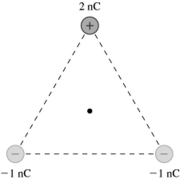
(87) The three point charges shown in the figure form an equilateral triangle with sides 4.9 cm long.What is the electric potential (relative to infinity)at the point indicated with the dot,which is equidistant from all three charges? Assume that the numbers in the figure are all accurate to two significant figures. 
(Multiple Choice)
4.7/5 (84)
(84) A +5.0-nC charge is at the point (0.00 m,0.00 m)and a -2.0-nC charge is at (3.0 m,0.00 m).What work is required to bring a 1.0-nC charge from very far away to point (0.00 m,4.0 m)? (k = 1/4πε0 = 9.0 × 10⁹ N ∙ m2/C2)
(Multiple Choice)
4.8/5 (88)
(88) A dielectric material such as paper is inserted between the plates of a capacitor as the capacitor holds a fixed charge on its plates.What happens to the electric field between the plates as the dielectric is inserted?
(Multiple Choice)
4.9/5 (82)
(82) A parallel-plate capacitor consists of two parallel,square plates having dimensions 1.0 cm by 1.0 cm.The plates are separated by  And the space between them is filled with Teflon,which has a dielectric constant of 2.1.What is the capacitance of this capacitor? (ε0 = 8.85 × 10⁻¹² C2/N ∙ m2)
 (Multiple Choice)
4.9/5 (76)
(76) Doubling the potential across a given capacitor causes the energy stored in that capacitor to
(Multiple Choice)
4.8/5 (76)
(76) In the figure,+4.0-μC and -4.0-μC point charges are located as shown.Now an additional +2.00-µC point charge is placed at point A.What is the electric potential energy of this system of three charges,relative to infinity? (k = 1/4πε0 = 8.99 × 10⁹ N ∙ m2/C2) 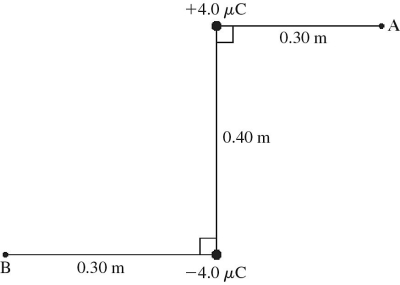
(Multiple Choice)
4.9/5 (79)
(79) An electric dipole with ±5.0 μC point charges is positioned so that the positive charge is  To the right of the origin and the negative charge is at the origin.How much work does it take to bring a
 Point charge from very far away to the point x = 3.0 mm,y = 0.0 mm? (k = 1/4πε0 = 9.0 × 10⁹ N ∙ m2/C2)
To the right of the origin and the negative charge is at the origin.How much work does it take to bring a
Point charge from very far away to the point x = 3.0 mm,y = 0.0 mm? (k = 1/4πε0 = 9.0 × 10⁹ N ∙ m2/C2) (Multiple Choice)
4.9/5 (75)
(75) Two protons are fired toward each other in a particle accelerator,with only the electrostatic force acting.Which of the following statements must be true about them as they move closer together? (There could be more than one correct choice. )
(Multiple Choice)
4.8/5 (81)
(81) How much kinetic energy does a proton gain if it is accelerated,with no friction,through a potential difference of 1.00 V? The proton is 1836 times heavier than an electron,and e = 1.60 × 10⁻¹⁹ C.
(Multiple Choice)
4.7/5 (87)
(87) Two parallel circular plates,each with a radius of  And carrying equal-magnitude surface charge densities of
 Are separated by a distance of
 With only air between them.How much energy is stored in these plates? (ε0 = 8.85 × 10⁻¹² C2/N ∙ m2)
And carrying equal-magnitude surface charge densities of
Are separated by a distance of
With only air between them.How much energy is stored in these plates? (ε0 = 8.85 × 10⁻¹² C2/N ∙ m2) (Multiple Choice)
4.7/5 (83)
(83) Four +6.00-µC point charges are at the corners of a square 2.00 m on each side.What is the electric potential of these charges,relative to infinity,at the center of this square? 
(Multiple Choice)
4.9/5 (83)
(83) 
Filters
- Essay(0)
- Multiple Choice(0)
- Short Answer(0)
- True False(0)
- Matching(0)