



 Chat with AI
Exam 20: Electric Potential and Electric

Exam 1: Introduction to Physics98 Questions
Exam 2: One-Dimensional Kinematics138 Questions
Exam 3: Vectors in Physics69 Questions
Exam 4: Two-Dimensional Kinematics51 Questions
Exam 5: Newtons Laws of Motion54 Questions
Exam 6: Applications of Newtons Laws104 Questions
Exam 7: Work and Kinetic Energy55 Questions
Exam 8: Potential Energy and Conservation of Energy62 Questions
Exam 9: Linear Momentum and Collisions114 Questions
Exam 10: Rotational Kinematics and Energy60 Questions
Exam 11: Rotational Dynamics and Static Equilibrium69 Questions
Exam 12: Gravity53 Questions
Exam 13: Oscillations About Equilibrium79 Questions
Exam 14: Waves and Sound142 Questions
Exam 15: Fluids103 Questions
Exam 16: Temperature and Heat110 Questions
Exam 17: Phases and Phase Changes93 Questions
Exam 18: The Laws of Thermodynamics90 Questions
Exam 19: Electric Charges, Forces, and Fields75 Questions
Exam 20: Electric Potential and Electric124 Questions
Exam 21: Electric Current and Direct-Current Circuits228 Questions
Exam 22: Magnetism147 Questions
Exam 23: Magnetic Flux and Faradays Law of Induction98 Questions
Exam 24: Alternating-Current Circuits72 Questions
Exam 25: Electromagnetic Waves63 Questions
Exam 26: Geometrical Optics133 Questions
Exam 27: Optical Instruments103 Questions
Exam 28: Physical Optics: Interference and Diffraction119 Questions
Exam 29: Relativity98 Questions
Exam 30: Quantum Physics88 Questions
Exam 31: Atomic Physics97 Questions
Exam 32: Nuclear Physics and Nuclear Radiation137 Questions
Select questions type


A sphere with radius 2.0 mm carries a  Charge.What is the potential difference,
 Between point B,which is
 From the center of the sphere,and point A,which is
 From the center of the sphere? (k = 1/4πε0 = 9.0 × 10⁹ N ∙ m2/C2)
Charge.What is the potential difference,
Between point B,which is
From the center of the sphere,and point A,which is
From the center of the sphere? (k = 1/4πε0 = 9.0 × 10⁹ N ∙ m2/C2) (Multiple Choice)
4.7/5  (68)
(68) Each plate of an ideal air-filled parallel-plate capacitor has an area of 0.0020  ,and the separation of the plates is
 An electric field of
 Is present between the plates.What is the surface charge density on the plates? (ε0 = 8.85 × 10⁻¹² C2/N ∙ m2)
,and the separation of the plates is
An electric field of
Is present between the plates.What is the surface charge density on the plates? (ε0 = 8.85 × 10⁻¹² C2/N ∙ m2) (Multiple Choice)
4.8/5 (77)
(77) Two large parallel plates are separated by 1.0 mm of air.If the potential difference between them is 3.0 V,what is the magnitude of their surface charge densities? (ε0 = 8.85 × 10⁻¹² C2/N ∙ m2)
(Multiple Choice)
4.9/5 (84)
(84) The plates of a parallel-plate capacitor are maintained with constant potential by a battery as they are pulled apart.During this process,the amount of charge on the plates
(Multiple Choice)
4.9/5 (76)
(76) Consider a uniform horizontal electric field of 50 N/C directed toward the east.If the electric potential at a given point in the field is 80 V,what is the potential at a point 1.0 m directly south of that point?
(Multiple Choice)
4.8/5 (67)
(67) A space probe approaches a planet,taking measurements as it goes.If it detects a potential difference of 6000 MV between the altitudes of 253,000 km and 276,000 km above the planet's surface,what is the approximate electric field strength produced by the planet at 264,500 km above the surface? Assume the electric field strength is approximately constant at these altitudes.
(Multiple Choice)
4.9/5 (79)
(79) The figure shows a group of three particles,all of which have charge Q = 8.8 nC.How much work did it take to assemble this group of charges if they all started out extremely far from each other? (k = 1/4πε0 
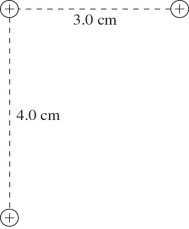
(Multiple Choice)
4.7/5 (80)
(80) Two tiny grains of sand having charges of 4.0 μC and -4.0 μC are situated along the x-axis at x1 = 2.0 m and x2 = -2.0 m.What is electric potential energy of these grains relative to infinity? (k = 1/4πε0 = 9.0 × 10⁹ N ∙ m2/C2)
(Multiple Choice)
4.9/5 (90)
(90) A parallel-plate capacitor consists of a set of two parallel plates of area A separated by a distance d.This capacitor is connected to a battery that maintains a constant potential difference across the plates.A slab of a dielectric material is inserted in the region between the plates and completely fills it.What changes would you observe as the dielectric is inserted? (There could be more than one correct choice. )
(Multiple Choice)
4.9/5 (84)
(84) Two very large parallel metal plates,separated by 0.20 m,are connected across a 12-V source of potential.An electron is released from rest at a location 0.10 m from the negative plate.When the electron arrives at a distance 0.050 m from the positive plate,how much kinetic energy has the electron gained? 
(Multiple Choice)
4.8/5 (78)
(78) When a dielectric material is introduced between the plates of a parallel-plate capacitor and completely fills the space,the capacitance increases by a factor of 4.What is the dielectric constant of the material that was introduced?
(Multiple Choice)
4.7/5 (89)
(89) When a 6.00-μF air-filled capacitor has a charge of ±40.0 μC on its plates,how much potential energy is stored in this capacitor?
(Multiple Choice)
4.9/5 (99)
(99) The square plates of a 5,000-pF parallel-plate capacitor measure 50 mm by 50 mm and are separated by a dielectric that is  Thick and totally fills the region between the plates.The voltage rating (the maximum safe voltage)of the capacitor is
 What is the maximum energy that can be stored in this capacitor without damaging it? (ε0 = 8.85 × 10⁻¹² C2/N ∙ m2)
Thick and totally fills the region between the plates.The voltage rating (the maximum safe voltage)of the capacitor is
What is the maximum energy that can be stored in this capacitor without damaging it? (ε0 = 8.85 × 10⁻¹² C2/N ∙ m2) (Multiple Choice)
4.8/5 (75)
(75) If the result of your calculations for a quantity has SI units of C2 ∙ s2/(kg ∙ m2),that quantity could be
(Multiple Choice)
4.8/5 (79)
(79) Two parallel plates that are initially uncharged are separated by 1.7 mm,have only air between them,and each have surface areas of 16 cm2.How much charge must be transferred from one plate to the other if 1.9 J of energy are to be stored in the plates? (ε0 = 8.85 × 10⁻¹² C2/N ∙ m2)
(Multiple Choice)
4.9/5 (79)
(79) An ideal parallel-plate capacitor consists of two parallel plates of area A separated by a distance d.This capacitor is connected to a battery that maintains a constant potential difference across the plates.If the separation between the plates is now doubled,the amount of electrical energy stored on the capacitor will
(Multiple Choice)
4.8/5 (80)
(80) When a 12.0-V battery causes 2.00 μC of charge to flow onto the plates of an air-filled capacitor,how much work did the battery do?
(Multiple Choice)
4.9/5 (76)
(76) A hydrogen atom consists of a proton and an electron.If the orbital radius of the electron increases,the electric potential energy of the electron due to the proton
(Multiple Choice)
5.0/5 (78)
(78) If the result of your calculation of a quantity has SI units kg ∙ m2/(s2 ∙C),that quantity could be
(Multiple Choice)
4.8/5 (70)
(70) A tiny particle carries a charge of  What is the energy density in the electric field at a distance of
 From this charge? (ε0 = 8.85 × 10⁻¹² C2/N ∙ m2,k = 1/4πε0 = 9.0 × 10⁹ N ∙ m2/C2)
What is the energy density in the electric field at a distance of
From this charge? (ε0 = 8.85 × 10⁻¹² C2/N ∙ m2,k = 1/4πε0 = 9.0 × 10⁹ N ∙ m2/C2) (Multiple Choice)
4.9/5 (88)
(88) 
Filters
- Essay(0)
- Multiple Choice(0)
- Short Answer(0)
- True False(0)
- Matching(0)