



 Chat with AI
Exam 20: Electric Potential and Electric

Exam 1: Introduction to Physics98 Questions
Exam 2: One-Dimensional Kinematics138 Questions
Exam 3: Vectors in Physics69 Questions
Exam 4: Two-Dimensional Kinematics51 Questions
Exam 5: Newtons Laws of Motion54 Questions
Exam 6: Applications of Newtons Laws104 Questions
Exam 7: Work and Kinetic Energy55 Questions
Exam 8: Potential Energy and Conservation of Energy62 Questions
Exam 9: Linear Momentum and Collisions114 Questions
Exam 10: Rotational Kinematics and Energy60 Questions
Exam 11: Rotational Dynamics and Static Equilibrium69 Questions
Exam 12: Gravity53 Questions
Exam 13: Oscillations About Equilibrium79 Questions
Exam 14: Waves and Sound142 Questions
Exam 15: Fluids103 Questions
Exam 16: Temperature and Heat110 Questions
Exam 17: Phases and Phase Changes93 Questions
Exam 18: The Laws of Thermodynamics90 Questions
Exam 19: Electric Charges, Forces, and Fields75 Questions
Exam 20: Electric Potential and Electric124 Questions
Exam 21: Electric Current and Direct-Current Circuits228 Questions
Exam 22: Magnetism147 Questions
Exam 23: Magnetic Flux and Faradays Law of Induction98 Questions
Exam 24: Alternating-Current Circuits72 Questions
Exam 25: Electromagnetic Waves63 Questions
Exam 26: Geometrical Optics133 Questions
Exam 27: Optical Instruments103 Questions
Exam 28: Physical Optics: Interference and Diffraction119 Questions
Exam 29: Relativity98 Questions
Exam 30: Quantum Physics88 Questions
Exam 31: Atomic Physics97 Questions
Exam 32: Nuclear Physics and Nuclear Radiation137 Questions
Select questions type


Each plate of a parallel-plate air-filled capacitor has an area of 0.0040  ,and the separation of the plates is
 An electric field of
 Is present between the plates.What is the energy density in the region between the plates? (ε0 = 8.85 × 10⁻¹² C2/N ∙ m2)
,and the separation of the plates is
An electric field of
Is present between the plates.What is the energy density in the region between the plates? (ε0 = 8.85 × 10⁻¹² C2/N ∙ m2) (Multiple Choice)
4.9/5  (72)
(72) An alpha particle (a helium nucleus,having charge +2e and mass 6.64 × 10⁻²⁷ kg)moves head-on at a fixed gold nucleus (having charge +79e).If the distance of closest approach is 2.0 × 10⁻¹⁰ m,what was the speed of the alpha particle when it was very far away from the gold? (k = 1/4πε0  ,

, (Multiple Choice)
4.8/5 (85)
(85) Four point charges of magnitude 6.00 μC and are at the corners of a square 2.00 m on each side.Two of the charges are positive,and two are negative.What is the electric potential at the center of this square,relative to infinity,due to these charges? (k = 1/4πε0 = 8.99 × 10⁹ N ∙ m2/C2)
(Multiple Choice)
4.8/5 (66)
(66) Which statements must be true about the surface of a charged conductor in which no charge is moving? (There could be more than one correct choice. )
(Multiple Choice)
4.9/5 (71)
(71) An ideal air-filled parallel-plate capacitor with horizontal plates has a plate separation of 5.0 cm.If the potential difference between the plates is 2000 V,with the top plate at the higher potential,what are the magnitude and direction of the electric field between the plates?
(Multiple Choice)
4.7/5 (84)
(84) An ideal parallel-plate capacitor has a capacitance of C.If the area of the plates is doubled and the distance between the plates is halved,what is the new capacitance?
(Multiple Choice)
4.8/5 (82)
(82) A small 4.0-µC charge and a small 1.5-µC charge are initially very far apart.How much work does it take to bring them to a final configuration in which the 4.0-µC charge is at the point x = 1.0 mm,y = 1.0 mm,and the 1.5-µC charge is at the point x = 1.0 mm,y = 3.0 mm? (k = 1/4πε0 = 8.99 × 10⁹ N ∙ m2/C2)
(Multiple Choice)
4.7/5 (79)
(79) If the electric potential at a point in space is zero,then the electric field at that point must be
(Multiple Choice)
4.8/5 (66)
(66) A +4.0-μC and a -4.0-μC point charge are placed as shown in the figure.What is the potential difference between points A and B? (k = 1/4πε0 = 9.0 × 10⁹ N ∙ m2/C2) 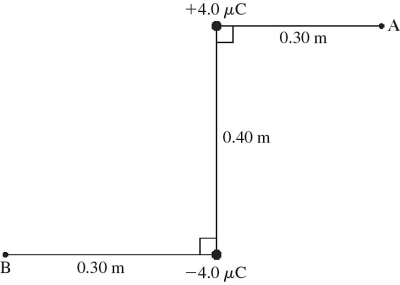
(Multiple Choice)
4.8/5 (68)
(68) A point charge of +3.00 μC and a second charge Q are initially very far apart.If it takes  Of work to bring them to a final configuration in which the
 Charge is at the point x = 1.00 mm,y = 1.00 mm,and the second charge Q is at the point x = 1.00 mm,y = 3.00 mm,find the magnitude of the charge Q.

Of work to bring them to a final configuration in which the
Charge is at the point x = 1.00 mm,y = 1.00 mm,and the second charge Q is at the point x = 1.00 mm,y = 3.00 mm,find the magnitude of the charge Q. (Multiple Choice)
4.9/5 (76)
(76) A proton that is initially at rest is accelerated through an electric potential difference of magnitude 500 V.What speed does the proton gain? (e = 1.60 × 10⁻¹⁹ C,mproton = 1.67 × 10⁻²⁷ kg)
(Multiple Choice)
4.8/5 (72)
(72) An ideal air-filled parallel-plate capacitor consists of two circular plates,each of radius  How far apart should the plates be for the capacitance to be 300.0-pF? (ε0 = 8.85 × 10⁻¹² C2/N ∙ m2)
 (Multiple Choice)
4.8/5 (63)
(63) A +5.0-µC point charge is 12 cm from a -5.0-µC point charge.What is the magnitude of the electric field they produce at the point on the line connecting them where their electric potential (relative to infinity)is zero? (k = 1/4πε0 = 9.0 × 10⁹ N ∙ m2/C2)
(Multiple Choice)
4.9/5 (71)
(71) How much energy is necessary to place three +2.0-µC point charges at the vertices of an equilateral triangle of side 2.0 cm if they started out extremely far away? (k = 1/4πε0 = 9.0 × 10⁹ N ∙ m2/C2)
(Multiple Choice)
4.8/5 (75)
(75) An ideal parallel-plate capacitor consists of two parallel plates of area A separated by a distance d.This capacitor is connected to a battery and charged until its plates carry charges +Q and -Q,and the battery is then disconnected.If the separation between the plates is now doubled,the electrical energy stored in the capacitor will
(Multiple Choice)
4.7/5 (72)
(72) A parallel-plate capacitor is connected to a battery and becomes fully charged.The capacitor is then disconnected,and the separation between the plates is increased in such a way that no charge leaks off.As the plates are being separated,the energy stored in this capacitor
(Multiple Choice)
4.9/5 (83)
(83) A 5.0 μF capacitor has a potential difference of 5.0 V. Applied across its plates.If the potential difference across its plates is increased to 8.0 V.
How much additional energy does the capacitor store?
(Multiple Choice)
4.9/5 (66)
(66) When the magnitude of the charge on each plate of an air-filled capacitor is 4 μC,the potential difference between the plates is 80 V.What is the capacitance of this capacitor?
(Multiple Choice)
4.9/5 (89)
(89) Two 3.0 μC charges lie on the x-axis,one at the origin and the other at  What is the potential (relative to infinity)due to these charges at a point at
 On the x-axis?

What is the potential (relative to infinity)due to these charges at a point at
On the x-axis? (Multiple Choice)
5.0/5 (83)
(83) In a region where the electric field is uniform and points in the +x direction,the electric potential is -2000 V at x = 8 m and is +400 V at x = 2 m.What is the magnitude of the electric field?
(Multiple Choice)
4.8/5 (81)
(81) 
Filters
- Essay(0)
- Multiple Choice(0)
- Short Answer(0)
- True False(0)
- Matching(0)