



 Chat with AI
Exam 13: Chemical Kinetics

Exam 1: Matter, Measurement, and Problem Solving120 Questions
Exam 2: Atoms and Elements116 Questions
Exam 3: Molecules, Compounds and Chemical Equations144 Questions
Exam 4: Chemical Quantities and Aqueous Reactions199 Questions
Exam 5: Gases157 Questions
Exam 6: Thermochemistry110 Questions
Exam 7: The Quantum-Mechanical Model of the Atom100 Questions
Exam 8: Periodic Properties of the Elements120 Questions
Exam 9: Chemical Bonding I: Lewis Theory125 Questions
Exam 10: Chemical Bonding II: Molecular Shapes, Valence Bond Theory, and109 Questions
Exam 11: Liquids, Solids, and Intermolecular Forces123 Questions
Exam 12: Solutions127 Questions
Exam 13: Chemical Kinetics125 Questions
Exam 14: Chemical Equilibrium112 Questions
Exam 15: Acids and Bases126 Questions
Exam 16: Aqueous Ionic Equilibrium148 Questions
Exam 17: Free Energy and Thermodynamics103 Questions
Exam 18: Electrochemistry115 Questions
Exam 19: Radioactivity and Nuclear Chemistry105 Questions
Select questions type


A reaction is followed and found to have a rate constant of 3.36 × 10⁴ M-1s-1 at 344 K and a rate constant of 7.69 M-1s-1 at 219 K.Determine the activation energy for this reaction.
(Multiple Choice)
4.9/5  (85)
(85) Derive an expression for a "1/3-life" for a first-order reaction.
(Multiple Choice)
4.8/5 (90)
(90) What data should be plotted to show that experimental concentration data fits a second-order reaction?
(Multiple Choice)
4.8/5 (75)
(75) Which of the following represents the integrated rate law for a zeroth-order reaction?
(Multiple Choice)
4.8/5 (67)
(67) Which of the following represents the integrated rate law for a first-order reaction?
(Multiple Choice)
4.8/5 (72)
(72) A particular first-order reaction has a rate constant of 1.35 × 10² s-1 at 25.0°C.What is the magnitude of k at 95.0°C if Ea = 55.5 kJ/mol?
(Multiple Choice)
4.8/5 (67)
(67) Which of the following reactions would you predict to have the smallest orientation factor?
(Multiple Choice)
4.8/5 (86)
(86) Given the following balanced equation,determine the rate of reaction with respect to [Cl2].If the rate of Cl2 loss is 4.24 × 10⁻² M/s,what is the rate of formation of NOCl?
2 NO(g)+ Cl2(g)→ 2 NOCl(g)
(Multiple Choice)
4.9/5 (82)
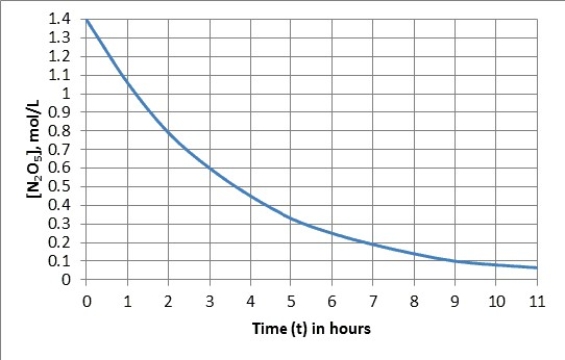
(82) The graph represents the first-order decomposition of N2O5(g)to form NO2(g)and O2(g).
N2O5(g)→ 2NO2(g)+1/2O2(g)
What is the estimated rate constant?
(Multiple Choice)
4.9/5 (86)
(86) How many half-lives are required for the concentration of reactant to decrease to 12.5% of its original value?
(Multiple Choice)
4.8/5 (92)
(92) Given the following rate law,how does the rate of reaction change if the concentration of Y is doubled?
Rate = k [X][Y]2
(Multiple Choice)
4.9/5 (88)
(88) The second-order decomposition of HI has a rate constant of 1.80 × 10⁻³ M-1s-1.How much HI remains after 27.3 s if the initial concentration of HI is 4.78 M?
(Multiple Choice)
4.8/5 (87)
(87) What is the overall reaction order for the reaction that has the rate law: Rate = k[O2] [NO ]2?
(Multiple Choice)
5.0/5 (75)
(75) The following reaction is first order,C2H6 → 2 CH3.If the rate constant is equal to 5.5 × 10⁻⁴ s-1 at 1000 K,how long will it take for 0.35 mol of C2H6 in a 1.00 L container to decrease to 0.20 mol in the same container?
(Multiple Choice)
4.8/5 (85)
(85) A first order reaction has a half-life of 30 min.If the initial concentration of the reactant is 0.50 M,what will the concentration of the reactant be after 2.00 hr?
(Multiple Choice)
4.9/5 (76)
(76) Determine the rate law and the value of k for the following reaction using the data provided.
CO(g)+ Cl2(g)→ COCl2(g)

(Multiple Choice)
4.7/5 (74)
(74) 
Filters
- Essay(0)
- Multiple Choice(0)
- Short Answer(0)
- True False(0)
- Matching(0)