



 Chat with AI
Exam 13: Chemical Kinetics

Exam 1: Matter, Measurement, and Problem Solving120 Questions
Exam 2: Atoms and Elements116 Questions
Exam 3: Molecules, Compounds and Chemical Equations144 Questions
Exam 4: Chemical Quantities and Aqueous Reactions199 Questions
Exam 5: Gases157 Questions
Exam 6: Thermochemistry110 Questions
Exam 7: The Quantum-Mechanical Model of the Atom100 Questions
Exam 8: Periodic Properties of the Elements120 Questions
Exam 9: Chemical Bonding I: Lewis Theory125 Questions
Exam 10: Chemical Bonding II: Molecular Shapes, Valence Bond Theory, and109 Questions
Exam 11: Liquids, Solids, and Intermolecular Forces123 Questions
Exam 12: Solutions127 Questions
Exam 13: Chemical Kinetics125 Questions
Exam 14: Chemical Equilibrium112 Questions
Exam 15: Acids and Bases126 Questions
Exam 16: Aqueous Ionic Equilibrium148 Questions
Exam 17: Free Energy and Thermodynamics103 Questions
Exam 18: Electrochemistry115 Questions
Exam 19: Radioactivity and Nuclear Chemistry105 Questions
Select questions type


For a reaction that follows the general rate law Rate = k[A][B]2,what will happen to the rate of reaction if the concentration of A is increased by a factor of 5.00? The rate will
(Multiple Choice)
4.8/5  (82)
(82) Which of the following conditions must be met for a chemical reaction to happen in gas phase?
(Multiple Choice)
4.8/5 (91)
(91) Carbon-14,which is present in all living tissue,radioactively decays via a first-order process.A one-gram sample of wood taken from a living tree gives a rate for carbon-14 decay of 13.6 counts per minute.If the half-life for carbon-14 is 5720 years,how old is a wood sample that gives a rate for carbon-14 decay of 11.9 counts per minute?
(Multiple Choice)
4.7/5 (77)
(77) Given the following balanced equation,determine the rate of reaction with respect to [O2].
2 O3(g)→ 3 O2(g)
(Multiple Choice)
4.9/5 (65)
(65) Determine the rate law and the value of k for the following reaction using the data provided.
2 N2O5(g)→ 4 NO2(g)+ O2(g)

(Multiple Choice)
4.8/5 (84)
(84) Given the following rate law,how does the rate of reaction change if the concentration of X is halved and the concentration of Y is doubled?
Rate = k [X][Y]2
(Multiple Choice)
4.8/5 (73)
(73) Which of the following represents the equation for a zeroth-order half-life?
(Multiple Choice)
4.8/5 (78)
(78) What are the units of k in the following rate law?
Rate = k[X][Y]
(Multiple Choice)
4.8/5 (79)
(79) The half-life for the decay of radium is 1620 years.What is the rate constant for this first-order process?
(Multiple Choice)
4.9/5 (78)
(78) Hydrogen iodide decomposes at 800 K via a second-order process to produce hydrogen and iodine according to the following chemical equation.
2HI(g)→ H2(g)+ I2(g)
At 800 K it takes 142 seconds for the initial concentration of HI to decrease from 6.75 × 10⁻² M to 3.50 × 10⁻² M.What is the rate constant for the reaction at this temperature?
(Multiple Choice)
4.8/5 (67)
(67) The first-order decay of radon has a half-life of 3.823 days.How many grams of radon remain after 7.22 days if the sample initially weighs 250.0 grams?
(Multiple Choice)
4.7/5 (93)
(93) The elementary reaction
2NO2(g)→ 2NO(g)+ O2(g)
Is second order in NO2 and the rate constant at 501 K is 7.93 × 10⁻³ M-1s-1.The reaction half-life at this temperature when [NO2]0 = 0.45 M is ________ s.
(Multiple Choice)
4.9/5 (64)
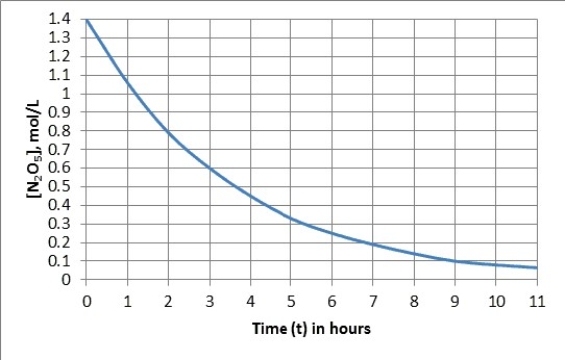
(64) The graph represents the first-order decomposition of N2O5(g)to form NO2(g)and O2(g).
N2O5(g)→ 2NO2(g)+1/2O2(g)
What will be the N2O5 concentration after 7.0 hours?
(Multiple Choice)
4.8/5 (77)
(77) A decomposition reaction has a half-life that does not depend on the initial concentration of the reactant.What is the order of the reaction?
(Multiple Choice)
4.7/5 (82)
(82) If the activation energy for a given compound is found to be 42.0 kJ/mol,with a frequency factor of
8.0 × 10¹⁰ s-1,what is the rate constant for this reaction at 298 K?
(Multiple Choice)
4.9/5 (73)
(73) Determine the rate law and the value of k for the following reaction using the data provided.
S2O82⁻(aq)+ 3 I⁻(aq)→ 2 SO42⁻(g)+ I3⁻(aq)

(Multiple Choice)
4.9/5 (81)
(81) What is the overall order of the following reaction,given the rate law?
NO(g)+ O3(g)→ NO2(g)+ O2(g)Rate = k[NO][O3]
(Multiple Choice)
4.9/5 (76)
(76) How many half-lives are required for the concentration of reactant to decrease to 3.1% of its original value?
(Multiple Choice)
4.8/5 (101)
(101) 
Filters
- Essay(0)
- Multiple Choice(0)
- Short Answer(0)
- True False(0)
- Matching(0)