



 Chat with AI
Exam 26: Oligopoly and Strategic Behavior

Exam 1: The Nature of Economics347 Questions
Exam 2: Scarcity and the World of Trade-Offs412 Questions
Exam 3: Demand and Supply448 Questions
Exam 4: Extensions of Demand and Supply Analysis399 Questions
Exam 5: Public Spending and Public Choice359 Questions
Exam 6: Funding the Public Sector202 Questions
Exam 7: The Macroeconomy: Unemployment, Inflation, and Deflation412 Questions
Exam 8: Measuring the Economys Performance413 Questions
Exam 9: Global Economic Growth and Development282 Questions
Exam 10: Real GDP and the Price Level in the Long Run290 Questions
Exam 11: Classical and Keynesian Macro Analyses365 Questions
Exam 12: Consumption, Real GDP, and the Multiplier445 Questions
Exam 13: Fiscal Policy273 Questions
Exam 14: Deficit Spending and the Public Debt145 Questions
Exam 15: Money, Banking, and Central Banking517 Questions
Exam 16: Domestic and International Dimensions of Monetary Policy357 Questions
Exam 17: Stabilization in an Integrated World Economy306 Questions
Exam 18: Policies and Prospects for Global Economic Growth216 Questions
Exam 19: Demand and Supply Elasticity413 Questions
Exam 20: Consumer Choice458 Questions
Exam 21: Rents, Profits, and the Financial Environment of Business445 Questions
Exam 22: The Firm: Cost and Output Determination387 Questions
Exam 23: Perfect Competition431 Questions
Exam 24: Monopoly386 Questions
Exam 25: Monopolistic Competition309 Questions
Exam 26: Oligopoly and Strategic Behavior306 Questions
Exam 27: Regulation and Antitrust Policy in a Globalized Economy309 Questions
Exam 28: The Labor Market: Demand, Supply and Outsourcing376 Questions
Exam 29: Unions and Labor Market Monopoly Power318 Questions
Exam 30: Income, Poverty, and Health Care302 Questions
Exam 31: Environmental Economics300 Questions
Exam 32: Comparative Advantage and the Open Economy314 Questions
Exam 33: Exchange Rates and the Balance of Payments300 Questions
Select questions type


People do not usually behave in a noncooperative fashion even when it is in their immediate interest to do so because
(Multiple Choice)
4.8/5  (88)
(88) There are 30 firms in an industry. What happens to that industry's four-firm concentration when the third- and fourth-largest firms merge?
(Multiple Choice)
4.7/5 (74)
(74) If Target were to merge with Wal-Mart, this would be referred to as a(n)
(Multiple Choice)
5.0/5 (78)
(78) An association of producers in an industry that agree to set common prices and output quotas to prevent competition is
(Multiple Choice)
4.8/5 (72)
(72) 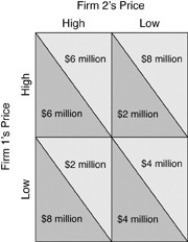
Explain how the prisoners' dilemma can be used to examine pricing strategies in an oligopoly.
(Essay)
4.8/5 (78)
(78) Which one of the following industries could be classified as an oligopoly?
(Multiple Choice)
4.8/5 (78)
(78) After participating members of a cartel form an agreement on common prices and output quotas, then an individual firm can increase its own profits by
(Multiple Choice)
4.8/5 (88)
(88) Which of the following is most likely to be sold in an oligopoly market?
(Multiple Choice)
4.9/5 (76)
(76) Straight Cut beauty salon merges with Clean-Cut beauty salon. This is an example of
(Multiple Choice)
4.8/5 (87)
(87)  -Refer to the above figure. The figure gives the payoff matrix for two individuals who are being accused of robbing a bank together. What is dominant strategy for Bob?
 (Multiple Choice)
4.9/5 (78)
(78) When a falloff in usage of a product by some consumers causes others to stop purchasing the item there is
(Multiple Choice)
4.9/5 (68)
(68) In an industry with network effects and differentiated products, it is possible for the industry to become an oligopoly if
(Multiple Choice)
4.7/5 (71)
(71) 
Filters
- Essay(0)
- Multiple Choice(0)
- Short Answer(0)
- True False(0)
- Matching(0)