



 Chat with AI
Exam 26: Oligopoly and Strategic Behavior

Exam 1: The Nature of Economics347 Questions
Exam 2: Scarcity and the World of Trade-Offs412 Questions
Exam 3: Demand and Supply448 Questions
Exam 4: Extensions of Demand and Supply Analysis399 Questions
Exam 5: Public Spending and Public Choice359 Questions
Exam 6: Funding the Public Sector202 Questions
Exam 7: The Macroeconomy: Unemployment, Inflation, and Deflation412 Questions
Exam 8: Measuring the Economys Performance413 Questions
Exam 9: Global Economic Growth and Development282 Questions
Exam 10: Real GDP and the Price Level in the Long Run290 Questions
Exam 11: Classical and Keynesian Macro Analyses365 Questions
Exam 12: Consumption, Real GDP, and the Multiplier445 Questions
Exam 13: Fiscal Policy273 Questions
Exam 14: Deficit Spending and the Public Debt145 Questions
Exam 15: Money, Banking, and Central Banking517 Questions
Exam 16: Domestic and International Dimensions of Monetary Policy357 Questions
Exam 17: Stabilization in an Integrated World Economy306 Questions
Exam 18: Policies and Prospects for Global Economic Growth216 Questions
Exam 19: Demand and Supply Elasticity413 Questions
Exam 20: Consumer Choice458 Questions
Exam 21: Rents, Profits, and the Financial Environment of Business445 Questions
Exam 22: The Firm: Cost and Output Determination387 Questions
Exam 23: Perfect Competition431 Questions
Exam 24: Monopoly386 Questions
Exam 25: Monopolistic Competition309 Questions
Exam 26: Oligopoly and Strategic Behavior306 Questions
Exam 27: Regulation and Antitrust Policy in a Globalized Economy309 Questions
Exam 28: The Labor Market: Demand, Supply and Outsourcing376 Questions
Exam 29: Unions and Labor Market Monopoly Power318 Questions
Exam 30: Income, Poverty, and Health Care302 Questions
Exam 31: Environmental Economics300 Questions
Exam 32: Comparative Advantage and the Open Economy314 Questions
Exam 33: Exchange Rates and the Balance of Payments300 Questions
Select questions type


If industry sales are $2,000, and the top four firms have sales of $170, $140, $100, and $80, respectively, what will be the four-firm concentration ratio?
(Multiple Choice)
4.7/5  (67)
(67) Which of the following has the highest Herfindahl-Hirschman index?
(Multiple Choice)
4.7/5 (82)
(82) After participating members of a cartel form an agreement on common prices and output quotas, then an individual firm can increase its own profits by
(Multiple Choice)
4.9/5 (86)
(86) Which of the following is likely among the most concentrated industries in the United States?
(Multiple Choice)
4.7/5 (88)
(88) 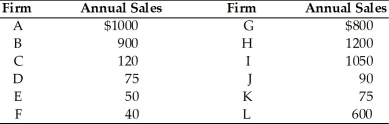 -According to the above table, the four-firm concentration ratio of this industry is
 (Multiple Choice)
4.9/5 (76)
(76) Cheating in a cartel is more likely to occur if the industry
(Multiple Choice)
4.8/5 (85)
(85) 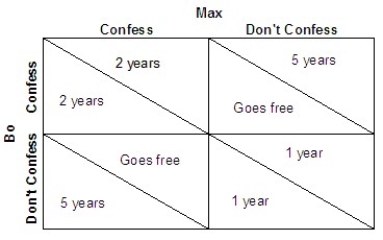 Refer to the above payoff matrix (in years of sentence) for two people (Bo and Max) charged for robbery. Which of the following is the outcome of the dominant strategy without cooperation?
 (Multiple Choice)
4.9/5 (83)
(83) Which of the following is NOT a necessary condition for oligopoly?
(Multiple Choice)
4.9/5 (86)
(86) Between World War II and the 1970s, three firms-General Motors, Chrysler, and Ford-produced and sold nearly all the output of the U.S. auto industry. These three firms had
(Multiple Choice)
4.8/5 (94)
(94) A merger between firms that are in the same industry is called a
(Multiple Choice)
5.0/5 (71)
(71) The higher the concentration ratio is in an industry, the more likely it is that
(Multiple Choice)
4.8/5 (91)
(91) Within a game theory model, if a change in decision-making raises corporation A's profits by $50 and lowers corporation B's profits by $60, the game is a
(Multiple Choice)
4.7/5 (69)
(69) If Ford Motor Company and General Motors Corporation were to merge, this would represent
(Multiple Choice)
4.9/5 (74)
(74) Suppose there are four firms in an industry. The market shares of the four firms are 5 percent, 20 percent, 35 percent, and 40 percent. The Herfindahl-Hirschman index for that industry is
(Multiple Choice)
4.8/5 (72)
(72) The joining of firms that are producing or selling a similar product is
(Multiple Choice)
4.8/5 (89)
(89) Which of the following is NOT a condition that helps enforce a cartel agreement?
(Multiple Choice)
4.7/5 (83)
(83) 
Filters
- Essay(0)
- Multiple Choice(0)
- Short Answer(0)
- True False(0)
- Matching(0)