



 Chat with AI
Exam 26: Oligopoly and Strategic Behavior

Exam 1: The Nature of Economics347 Questions
Exam 2: Scarcity and the World of Trade-Offs412 Questions
Exam 3: Demand and Supply448 Questions
Exam 4: Extensions of Demand and Supply Analysis399 Questions
Exam 5: Public Spending and Public Choice359 Questions
Exam 6: Funding the Public Sector202 Questions
Exam 7: The Macroeconomy: Unemployment, Inflation, and Deflation412 Questions
Exam 8: Measuring the Economys Performance413 Questions
Exam 9: Global Economic Growth and Development282 Questions
Exam 10: Real GDP and the Price Level in the Long Run290 Questions
Exam 11: Classical and Keynesian Macro Analyses365 Questions
Exam 12: Consumption, Real GDP, and the Multiplier445 Questions
Exam 13: Fiscal Policy273 Questions
Exam 14: Deficit Spending and the Public Debt145 Questions
Exam 15: Money, Banking, and Central Banking517 Questions
Exam 16: Domestic and International Dimensions of Monetary Policy357 Questions
Exam 17: Stabilization in an Integrated World Economy306 Questions
Exam 18: Policies and Prospects for Global Economic Growth216 Questions
Exam 19: Demand and Supply Elasticity413 Questions
Exam 20: Consumer Choice458 Questions
Exam 21: Rents, Profits, and the Financial Environment of Business445 Questions
Exam 22: The Firm: Cost and Output Determination387 Questions
Exam 23: Perfect Competition431 Questions
Exam 24: Monopoly386 Questions
Exam 25: Monopolistic Competition309 Questions
Exam 26: Oligopoly and Strategic Behavior306 Questions
Exam 27: Regulation and Antitrust Policy in a Globalized Economy309 Questions
Exam 28: The Labor Market: Demand, Supply and Outsourcing376 Questions
Exam 29: Unions and Labor Market Monopoly Power318 Questions
Exam 30: Income, Poverty, and Health Care302 Questions
Exam 31: Environmental Economics300 Questions
Exam 32: Comparative Advantage and the Open Economy314 Questions
Exam 33: Exchange Rates and the Balance of Payments300 Questions
Select questions type


If we observe firms earning zero economic profits in the short run, we know that
(Multiple Choice)
4.8/5  (76)
(76) Which of the following is NOT a common characteristic of oligopoly?
(Multiple Choice)
4.8/5 (89)
(89) Credit card companies that operate as intermediary firms between credit card holders and business vendors are best described as
(Multiple Choice)
4.9/5 (68)
(68)  -Refer to the above figure. Ajax and Greenco are oligopolists. Above you are given the payoff matrix for the two firms giving the payoff associated with different pricing strategies. What is the best strategy for Greenco if Ajax decides on charging a high price?
 (Multiple Choice)
4.9/5 (86)
(86) In which market structures is the firm able to earn long-run economic profits?
(Multiple Choice)
4.8/5 (75)
(75) The manner in which one oligopolist reacts to a change in price, output, or quality made by another oligopolist in the industry is
(Multiple Choice)
5.0/5 (81)
(81) Firms faced with prisoners' dilemma can always make more profits by engaging in opportunistic behavior. Why is this type of behavior NOT commonly found even in oligopolistic markets?
(Essay)
4.7/5 (73)
(73) What is oligopoly? How does oligopoly differ from the other kinds of market structure?
(Essay)
4.9/5 (82)
(82) Which of the following statements about concentration ratios is correct?
(Multiple Choice)
4.7/5 (91)
(91) 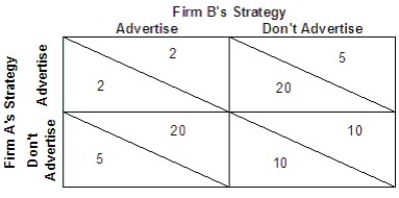 Refer to the above payoff matrix for the profits (in $ millions) of two firms (A and
 (Multiple Choice)
4.8/5 (65)
(65) Which of the following statements concerning the prisoner's dilemma is true?
(Multiple Choice)
4.8/5 (83)
(83) The combining of First Union National Bank and The National Bank of Memphis is an example of
(Multiple Choice)
4.9/5 (77)
(77) All of the following are reasons for an oligopoly to occur EXCEPT
(Multiple Choice)
5.0/5 (76)
(76) When decisions are guided strictly by short-run gains, this is known as
(Multiple Choice)
4.9/5 (75)
(75) The mutual interdependence of oligopolists ensures that each oligopolist has
(Multiple Choice)
4.8/5 (88)
(88)
-Refer to the above figure. Ajax and Greenco are oligopolists. Above you are given the payoff matrix for the two firms giving the payoff associated with different pricing strategies. What is the dominant strategy for Greenco?
-Refer to the above figure. Ajax and Greenco are oligopolists. Above you are given the payoff matrix for the two firms giving the payoff associated with different pricing strategies. What is the dominant strategy for Greenco? (Multiple Choice)
4.9/5 (79)
(79) 
Filters
- Essay(0)
- Multiple Choice(0)
- Short Answer(0)
- True False(0)
- Matching(0)