



 Chat with AI
Exam 23: Perfect Competition

Exam 1: The Nature of Economics347 Questions
Exam 2: Scarcity and the World of Trade-Offs412 Questions
Exam 3: Demand and Supply448 Questions
Exam 4: Extensions of Demand and Supply Analysis399 Questions
Exam 5: Public Spending and Public Choice359 Questions
Exam 6: Funding the Public Sector202 Questions
Exam 7: The Macroeconomy: Unemployment, Inflation, and Deflation412 Questions
Exam 8: Measuring the Economys Performance413 Questions
Exam 9: Global Economic Growth and Development282 Questions
Exam 10: Real GDP and the Price Level in the Long Run290 Questions
Exam 11: Classical and Keynesian Macro Analyses365 Questions
Exam 12: Consumption, Real GDP, and the Multiplier445 Questions
Exam 13: Fiscal Policy273 Questions
Exam 14: Deficit Spending and the Public Debt145 Questions
Exam 15: Money, Banking, and Central Banking517 Questions
Exam 16: Domestic and International Dimensions of Monetary Policy357 Questions
Exam 17: Stabilization in an Integrated World Economy306 Questions
Exam 18: Policies and Prospects for Global Economic Growth216 Questions
Exam 19: Demand and Supply Elasticity413 Questions
Exam 20: Consumer Choice458 Questions
Exam 21: Rents, Profits, and the Financial Environment of Business445 Questions
Exam 22: The Firm: Cost and Output Determination387 Questions
Exam 23: Perfect Competition431 Questions
Exam 24: Monopoly386 Questions
Exam 25: Monopolistic Competition309 Questions
Exam 26: Oligopoly and Strategic Behavior306 Questions
Exam 27: Regulation and Antitrust Policy in a Globalized Economy309 Questions
Exam 28: The Labor Market: Demand, Supply and Outsourcing376 Questions
Exam 29: Unions and Labor Market Monopoly Power318 Questions
Exam 30: Income, Poverty, and Health Care302 Questions
Exam 31: Environmental Economics300 Questions
Exam 32: Comparative Advantage and the Open Economy314 Questions
Exam 33: Exchange Rates and the Balance of Payments300 Questions
Select questions type


A perfectly competitive firm is maximizing profits in the short run. This implies that the firm is earning the most economic profits possible, which
(Multiple Choice)
4.7/5  (73)
(73) In a perfectly competitive industry, any restrictions that prevent new firms from entering
(Multiple Choice)
4.8/5 (82)
(82) The long-run supply curve in a constant-cost, perfectly competitive industry is
(Multiple Choice)
4.7/5 (81)
(81) If the long-run supply curve slopes downward, we know that this is
(Multiple Choice)
4.8/5 (75)
(75)  -Using the above figure, the short-run break-even price for the perfectly competitive firm will be
 (Multiple Choice)
5.0/5 (78)
(78) A firm earning economic losses should operate in the short run as long as
(Multiple Choice)
4.9/5 (75)
(75) A firm in a competitive industry faces the following short-run cost and revenue conditions: ATC = $16; AVC = $8; and MR = MC = $12. This firm should
(Multiple Choice)
4.9/5 (86)
(86) For a perfectly competitive firm facing the short-run break-even price,
(Multiple Choice)
4.7/5 (78)
(78) When price is greater than both marginal cost and average variable cost, the perfectly competitive firm
(Multiple Choice)
4.9/5 (87)
(87) The value of total output decreases when labor leaves one industry and goes to another and capital leaves the second industry and goes to the first. This indicates that
(Multiple Choice)
4.8/5 (77)
(77)  -Refer to the above figure. Profits will be positive
In the model of perfect competition, the market demand curve is found by
(Multiple Choice)
4.9/5 (79)
(79) 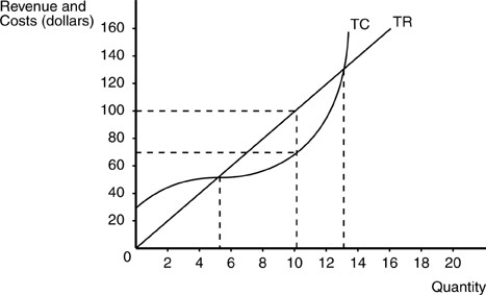 -In the above figure, at the profit-maximizing rate of production for the perfectly competitive firm total cost is
 (Multiple Choice)
4.7/5 (80)
(80) Assuming fixed factor prices, the short-run industry supply curve for a perfectly competitive industry is equal to the sum of the
(Multiple Choice)
4.9/5 (83)
(83) Suppose that at the current level of output, price = $10, MC = $14, AVC = $7, and ATC = $9. Which of the following is true?
(Multiple Choice)
4.7/5 (69)
(69) 
Filters
- Essay(0)
- Multiple Choice(0)
- Short Answer(0)
- True False(0)
- Matching(0)