



 Chat with AI
Exam 23: Perfect Competition

Exam 1: The Nature of Economics347 Questions
Exam 2: Scarcity and the World of Trade-Offs412 Questions
Exam 3: Demand and Supply448 Questions
Exam 4: Extensions of Demand and Supply Analysis399 Questions
Exam 5: Public Spending and Public Choice359 Questions
Exam 6: Funding the Public Sector202 Questions
Exam 7: The Macroeconomy: Unemployment, Inflation, and Deflation412 Questions
Exam 8: Measuring the Economys Performance413 Questions
Exam 9: Global Economic Growth and Development282 Questions
Exam 10: Real GDP and the Price Level in the Long Run290 Questions
Exam 11: Classical and Keynesian Macro Analyses365 Questions
Exam 12: Consumption, Real GDP, and the Multiplier445 Questions
Exam 13: Fiscal Policy273 Questions
Exam 14: Deficit Spending and the Public Debt145 Questions
Exam 15: Money, Banking, and Central Banking517 Questions
Exam 16: Domestic and International Dimensions of Monetary Policy357 Questions
Exam 17: Stabilization in an Integrated World Economy306 Questions
Exam 18: Policies and Prospects for Global Economic Growth216 Questions
Exam 19: Demand and Supply Elasticity413 Questions
Exam 20: Consumer Choice458 Questions
Exam 21: Rents, Profits, and the Financial Environment of Business445 Questions
Exam 22: The Firm: Cost and Output Determination387 Questions
Exam 23: Perfect Competition431 Questions
Exam 24: Monopoly386 Questions
Exam 25: Monopolistic Competition309 Questions
Exam 26: Oligopoly and Strategic Behavior306 Questions
Exam 27: Regulation and Antitrust Policy in a Globalized Economy309 Questions
Exam 28: The Labor Market: Demand, Supply and Outsourcing376 Questions
Exam 29: Unions and Labor Market Monopoly Power318 Questions
Exam 30: Income, Poverty, and Health Care302 Questions
Exam 31: Environmental Economics300 Questions
Exam 32: Comparative Advantage and the Open Economy314 Questions
Exam 33: Exchange Rates and the Balance of Payments300 Questions
Select questions type


The loss-minimizing output for the perfectly competitive firm occurs at the point at which
(Multiple Choice)
4.9/5  (86)
(86) The owner of a perfectly competitive firm is currently earning an economic profit of zero. This owner
(Multiple Choice)
4.8/5 (88)
(88) A company finds that at its present level of production, MR = MC at $14, MC = AVC at $15, and MC = ATC at $20. Your advice to the firm regarding its short-run operations is
(Multiple Choice)
4.9/5 (81)
(81) Describe and explain how a perfectly competitive firm's demand curve is found.
(Essay)
4.8/5 (84)
(84) A perfectly competitive firm faces a horizontal demand curve because it is
(Multiple Choice)
4.8/5 (84)
(84) Why should a perfect competitor produce at which price equals marginal cost?
(Essay)
4.8/5 (77)
(77) Malfeasance at Enron, a Houston-based energy firm, led to overstatement of revenues by almost $92 billion. As Enron closed its operations, U.S. energy prices remained stable. This may have been evidence that
(Multiple Choice)
4.7/5 (76)
(76) 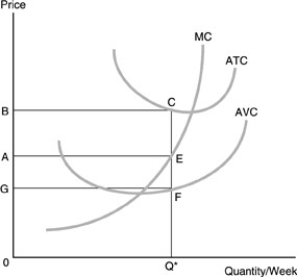 -Refer to the above figure. If the market price is equal to A, which statement can be made about profits?
 (Multiple Choice)
4.8/5 (80)
(80)  -Refer to the above table. If the price is $5, the perfectly competitive firm should produce
 (Multiple Choice)
4.8/5 (79)
(79) Which of the following is true for the perfectly competitive firm?
(Multiple Choice)
4.9/5 (70)
(70) 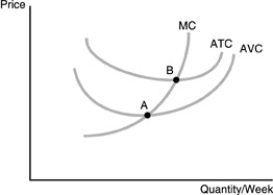 -Refer to the above figure. The competitive firm's short run supply curve
 (Multiple Choice)
4.9/5 (73)
(73)  -The firm in the above figure breaks even when market price is
 (Multiple Choice)
4.8/5 (80)
(80) Suppose a perfectly competitive asparagus farm can produce six containers of asparagus at an output at which marginal cost equals marginal revenue. The price per container of asparagus is $100 and the average total cost is $75. What is the profit or loss that this asparagus farm is earning?
(Multiple Choice)
4.9/5 (69)
(69) 
Filters
- Essay(0)
- Multiple Choice(0)
- Short Answer(0)
- True False(0)
- Matching(0)