



 Chat with AI
Exam 31: International Corporate Finance

Exam 1: Introduction to Corporate Finance67 Questions
Exam 2: Financial Statements and Cash Flow94 Questions
Exam 3: Financial Statements Analysis and Financial Models120 Questions
Exam 4: Discounted Cash Flow Valuation134 Questions
Exam 5: Net Present Value and Other Investment Rules105 Questions
Exam 6: Making Capital Investment Decisions101 Questions
Exam 7: Risk Analysis, Real Options, and Capital Budgeting99 Questions
Exam 8: Interest Rates and Bond Valuation69 Questions
Exam 9: Stock Valuation77 Questions
Exam 10: Risk and Return: Lessons From Market History84 Questions
Exam 11: Return and Risk: the Capital Asset Pricing Model Capm136 Questions
Exam 12: An Alternative View of Risk and Return: The Arbitrage Pricing Theory51 Questions
Exam 13: Risk, Cost of Capital, and Valuation59 Questions
Exam 14: Efficient Capital Markets and Behavioral Challenges65 Questions
Exam 15: Long-Term Financing46 Questions
Exam 16: Capital Structure: Basic Concepts91 Questions
Exam 17: Capital Structure: Limits to the Use of Debt74 Questions
Exam 18: Valuation and Capital Budgeting for the Levered Firm57 Questions
Exam 19: Dividends and Other Payouts90 Questions
Exam 20: Raising Capital73 Questions
Exam 21: Leasing55 Questions
Exam 22: Options and Corporate Finance95 Questions
Exam 23: Options and Corporate Finance: Extensions and Applications46 Questions
Exam 24: Warrants and Convertibles58 Questions
Exam 25: Derivatives and Hedging Risk66 Questions
Exam 26: Short-Term Finance and Planning124 Questions
Exam 27: Cash Management59 Questions
Exam 28: Credit and Inventory Management61 Questions
Exam 29: Mergers, Acquisitions, and Divestitures83 Questions
Exam 30: Financial Distress52 Questions
Exam 31: International Corporate Finance95 Questions
Select questions type


The implicit exchange rate between two currencies when both are quoted in some third currency is called a(n):
(Multiple Choice)
4.9/5  (70)
(70) Suppose the spot exchange rate is 2 U.S. dollars per British pound. The forward exchange rate is 1.9 dollars per pound. Which of the following is true?
(Multiple Choice)
4.7/5 (85)
(85) In international capital budgeting,there are two approaches- the home currency approach and the foreign currency approach. Describe both and explain the key difference from the aspect of capital budgeting for international firms.
(Essay)
4.9/5 (74)
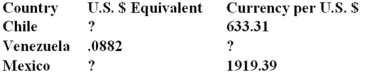
(74) You just returned from some extensive traveling throughout the Americas. You started your trip with $10,000 in your pocket. You spent 1.4 million pesos while in Chile. You spent another 40,000 bolivars in Venezuela. Then on the way home,you spent 34,000 pesos in Mexico. How many dollars did you have left by the time you returned to the U.S. given the following exchange rates?
(Multiple Choice)
4.9/5 (90)
(90) The current spot rate is C$1.362 and the one-year forward rate is C$1.371. The nominal risk-free rate in Canada is 6 percent while it is 3.5 percent in the U.S. Using covered interest arbitrage you can earn an extra _____ profit over that which you would earn if you invested $1 in the U.S.
(Multiple Choice)
4.9/5 (79)
(79) Are exchange rate changes between the U.S. dollar and the Japanese yen necessarily good or bad for Japanese automakers?
Explain your reasoning.
(Essay)
4.7/5 (82)
(82) The most important complication of international finance is the:
(Multiple Choice)
4.8/5 (81)
(81) Assume that you can buy 250 Canadian dollars with 100 British pounds. Which one of the following statements is correct given the following exchange rates? Assume that you start out with British pounds.

(Multiple Choice)
4.9/5 (82)
(82) Which one of the following statements is correct assuming that exchange rates are quoted as units of foreign currency per dollar?
(Multiple Choice)
4.9/5 (77)
(77) The condition stating that the expected percentage change in the exchange rate is equal to the difference in interest rates between the countries is called:
(Multiple Choice)
4.8/5 (93)
(93) You want to import $45,000 worth of rugs from India. How many rupees will you need to pay for this purchase if one rupee is worth $.0218?
(Multiple Choice)
4.7/5 (82)
(82) In the spot market,$1 is currently equal to A$1.42. The expected inflation rate is 3 percent in Australia and 2 percent in the U.S.. What is the expected exchange rate one year from now if relative purchasing power parity exists?
(Multiple Choice)
4.9/5 (84)
(84) When the German mark is quoted as 1.923 marks to the dollar,this quote is a(n):
(Multiple Choice)
4.9/5 (86)
(86) You are expecting a payment of C$100,000 four years from now. The risk-free rate of return is 3 percent in the U.S. and 4 percent in Canada. The inflation rate is 3 percent in the U.S. and 2 percent in Canada. The current exchange rate is C$1 = $.72. How much will the payment four years from now be worth in U.S. dollars?
(Multiple Choice)
4.9/5 (75)
(75) An agreement to exchange currencies at some point in the future using an agreed-upon exchange rate is called a _____ trade.
(Multiple Choice)
4.9/5 (82)
(82) A foreign bond issued in the United States and denominated in dollars is called a(n):
(Multiple Choice)
4.8/5 (88)
(88) 
Filters
- Essay(0)
- Multiple Choice(0)
- Short Answer(0)
- True False(0)
- Matching(0)