



 Chat with AI
Exam 31: International Corporate Finance

Exam 1: Introduction to Corporate Finance67 Questions
Exam 2: Financial Statements and Cash Flow94 Questions
Exam 3: Financial Statements Analysis and Financial Models120 Questions
Exam 4: Discounted Cash Flow Valuation134 Questions
Exam 5: Net Present Value and Other Investment Rules105 Questions
Exam 6: Making Capital Investment Decisions101 Questions
Exam 7: Risk Analysis, Real Options, and Capital Budgeting99 Questions
Exam 8: Interest Rates and Bond Valuation69 Questions
Exam 9: Stock Valuation77 Questions
Exam 10: Risk and Return: Lessons From Market History84 Questions
Exam 11: Return and Risk: the Capital Asset Pricing Model Capm136 Questions
Exam 12: An Alternative View of Risk and Return: The Arbitrage Pricing Theory51 Questions
Exam 13: Risk, Cost of Capital, and Valuation59 Questions
Exam 14: Efficient Capital Markets and Behavioral Challenges65 Questions
Exam 15: Long-Term Financing46 Questions
Exam 16: Capital Structure: Basic Concepts91 Questions
Exam 17: Capital Structure: Limits to the Use of Debt74 Questions
Exam 18: Valuation and Capital Budgeting for the Levered Firm57 Questions
Exam 19: Dividends and Other Payouts90 Questions
Exam 20: Raising Capital73 Questions
Exam 21: Leasing55 Questions
Exam 22: Options and Corporate Finance95 Questions
Exam 23: Options and Corporate Finance: Extensions and Applications46 Questions
Exam 24: Warrants and Convertibles58 Questions
Exam 25: Derivatives and Hedging Risk66 Questions
Exam 26: Short-Term Finance and Planning124 Questions
Exam 27: Cash Management59 Questions
Exam 28: Credit and Inventory Management61 Questions
Exam 29: Mergers, Acquisitions, and Divestitures83 Questions
Exam 30: Financial Distress52 Questions
Exam 31: International Corporate Finance95 Questions
Select questions type


Financial Accounting Standard Board Statement Number 52 requires that most assets and liabilities be translated at the current exchange rate. Gains and losses are recorded:
(Multiple Choice)
4.8/5  (59)
(59) The idea that commodities have the same value no matter where they are purchased or what currency is used is known as _____ parity.
(Multiple Choice)
4.8/5 (85)
(85) Assume that $1 can buy you either ¥107 or £.55. If a TV in London costs £500,what will that identical TV cost in Tokyo if absolute purchasing power parity exists?
(Multiple Choice)
4.9/5 (81)
(81) You want to invest in a riskless project in Sweden. The project has an initial cost of SKr2.1 million and is expected to produce cash inflows of SKr810,000 a year for 3 years. The project will be worthless after the first 3 years. The expected inflation rate in Sweden is 2 percent while it is 5 percent in the U.S. A risk-free security is paying 6 percent in the U.S. The current spot rate is $1 = SKr7.55. What is the net present value of this project in Swedish krona using the foreign currency approach? Assume that the international Fisher effect applies.
(Multiple Choice)
4.8/5 (86)
(86) Today,you can get either 140 Canadian dollars or 1,140 Mexican pesos for 100 U.S. dollars. Last year,100 U.S. dollars was worth 139 Canadian dollars and 1,160 Mexican pesos. Which one of the following statements is correct given this information?
(Multiple Choice)
4.8/5 (82)
(82) Assume that the Euro is selling in the spot market for $1.10. Simultaneously,in the 3-month forward market the Euro is selling for $1.12. Which one of the following statements correctly describes this situation?
(Multiple Choice)
4.7/5 (82)
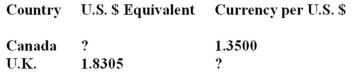
(82) Assume that you can buy 245 Canadian dollars with 100 British pounds. How much profit can you earn on a triangle arbitrage given the following rates if you start out with 100 U.S. dollars?
(Multiple Choice)
4.8/5 (67)
(67) Which of the following conditions must exist for absolute purchasing power parity to hold?
I. The goods are identical
II. The goods have equal economic values
III. Transaction costs are equal to zero
IV. There are no trade barriers
(Multiple Choice)
5.0/5 (89)
(89) You are planning a trip to Australia. Your hotel will cost you A$150 per night for five nights. You expect to spend another A$2,000 for meals,tours,souvenirs,and so forth. How much will this trip cost you in U.S. dollars given the following exchange rates?

(Multiple Choice)
4.8/5 (85)
(85) The changes in the relative economic conditions between countries are referred to as the:
(Multiple Choice)
4.7/5 (71)
(71) A security issued in the United States that represents shares of a foreign stock and allows that stock to be traded in the United States is called a(n):
(Multiple Choice)
4.9/5 (80)
(80) The spot rate for the British pound currently is £.55 per $1. The one-year forward rate is £.58 per $1. A risk-free asset in the U.S. is currently earning 3 percent. If interest rate parity holds,approximately what rate can you earn on a one-year risk-free British security?
(Multiple Choice)
4.9/5 (82)
(82) In the spot market,$1 is currently equal to £.55. The expected inflation rate in the U.K. is 4 percent and in the U.S. 3 percent. What is the expected exchange rate two years from now if relative purchasing power parity exists?
(Multiple Choice)
4.8/5 (90)
(90) Which of the following statements are correct concerning the foreign exchange market?
I. The trading floor of the foreign exchange market is located in London,England.
II. The foreign exchange market is the world's largest financial market.
III. The four primary currencies that are traded in the foreign exchange market are the U.S. dollar,the British pound,the Canadian dollar,and the euro.
IV. Importers and exporters are key players in the foreign exchange market.
(Multiple Choice)
4.8/5 (90)
(90) The price of one country's currency expressed in terms of another country's currency is:
(Multiple Choice)
4.8/5 (76)
(76) The camera you want to buy costs $399 in the U.S. If absolute purchasing power parity exists,the identical camera will cost _____ in Canada if the exchange rate is C$1 = $.7349.
(Multiple Choice)
4.9/5 (91)
(91) A foreign subsidiary can remit funds to a parent in the following form(s):
(Multiple Choice)
4.9/5 (75)
(75) The current spot rate for the Norwegian krone is $1 = NKr6.83. The expected inflation rate in Norway is 3 percent and in the U.S. 2 percent. A risk-free asset in the U.S. is yielding 4.5 percent. What real rate of return should you expect on a risk-free Norwegian security?
(Multiple Choice)
4.9/5 (83)
(83) Assume that ¥107.62 equal $1. Also assume that 7.5415Skr equal $1. How many Japanese yen can you acquire in exchange for 6,200 Swedish krona?
(Multiple Choice)
4.8/5 (84)
(84) 
Filters
- Essay(0)
- Multiple Choice(0)
- Short Answer(0)
- True False(0)
- Matching(0)