



 Chat with AI
Exam 7: Global Markets in Action

Exam 1: What Is Economics479 Questions
Exam 2: The Economic Problem440 Questions
Exam 3: Demand and Supply515 Questions
Exam 4: Elasticity533 Questions
Exam 5: Efficiency and Equity450 Questions
Exam 6: Government Actions in Markets412 Questions
Exam 7: Global Markets in Action200 Questions
Exam 8: Utility and Demand364 Questions
Exam 9: Possibilities, Preferences, and Choices459 Questions
Exam 10: Organizing Production385 Questions
Exam 11: Output and Costs493 Questions
Exam 12: Perfect Competition487 Questions
Exam 13: Monopoly599 Questions
Exam 14: Monopolistic Competition319 Questions
Exam 15: Oligopoly276 Questions
Exam 16: Public Choices, Public Goods, and Healthcare205 Questions
Exam 17: Externalities437 Questions
Exam 18: Markets for Factors of Production382 Questions
Exam 19: Economic Inequality353 Questions
Exam 20: Uncertainty and Information233 Questions
Select questions type


Suppose the country of Mooland imposes a tariff on imported beef from the country of Aqualand. As a result of the tariff, the
(Multiple Choice)
4.7/5  (84)
(84) 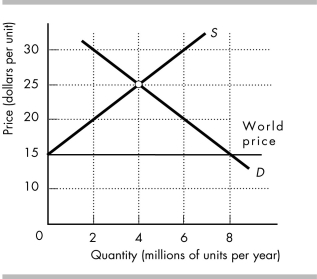 -The above figure shows the domestic supply of and domestic demand for an imported good. The world price is $15 per unit.
a) At the world price of $15 per unit, what is the domestic consumption and domestic production?
b) At the world price of $15 per unit, what is the quantity imported?
c) If the government imposes a tariff of $5 per unit, what is the domestic consumption and domestic production?
d) With the $5 per unit tariff, what is the quantity imported?
e) How much revenue does the government collect with a tariff of $5 per unit?
-The above figure shows the domestic supply of and domestic demand for an imported good. The world price is $15 per unit.
a) At the world price of $15 per unit, what is the domestic consumption and domestic production?
b) At the world price of $15 per unit, what is the quantity imported?
c) If the government imposes a tariff of $5 per unit, what is the domestic consumption and domestic production?
d) With the $5 per unit tariff, what is the quantity imported?
e) How much revenue does the government collect with a tariff of $5 per unit? (Essay)
4.8/5 (86)
(86) During the first 6 months of 2008, the United States imported more than 1.6 billion pounds of coffee. Suppose the United States is considering placing trade restrictions on the importation of coffee. What would be a potential consequence of such a trade restriction?
(Multiple Choice)
5.0/5 (87)
(87)  The figure shows the market for helicopters in the United States, where D is the domestic demand curve and S is the domestic supply curve. The United States trades helicopters with the rest of the world at a price of $36 million per helicopter.
-In the figure above, international trade ________ consumer surplus in the United States by ________.
The figure shows the market for helicopters in the United States, where D is the domestic demand curve and S is the domestic supply curve. The United States trades helicopters with the rest of the world at a price of $36 million per helicopter.
-In the figure above, international trade ________ consumer surplus in the United States by ________. (Multiple Choice)
4.9/5 (69)
(69) Trade war occurs when, after a tariff is imposed, other countries retaliate with their own tariff.
(True/False)
4.8/5 (90)
(90) Currently Belize, a country in Central America, has a small coffee industry but does not export any coffee. Suppose the government of Belize, in order to protect the new coffee industry to enable it to grow into a mature industry that can compete in world markets, places a tariff on the importation of coffee. What is the argument that has been used to support the tariff on coffee?
(Multiple Choice)
4.8/5 (71)
(71) A tariff is imposed on a good. This will ________ the domestic producer surplus, ________ the domestic consumer surplus, and ________ total surplus in the home country.
(Multiple Choice)
4.8/5 (73)
(73) A country opens up to trade and becomes an importer of a sugar. In the sugar market, consumer surplus will ________, producer surplus will ________, and total surplus will ________.
(Multiple Choice)
5.0/5 (76)
(76) The activities in which U.S. workers are relatively more productive
(Multiple Choice)
4.8/5 (69)
(69) "When countries specialize in producing the good in which they have a comparative advantage and then trade with each other, only the country with the absolute advantage gains." Is the previous statement correct or incorrect? Briefly explain your answer.
(Essay)
4.8/5 (94)
(94) How does a tariff affect the domestic price of the import, the domestic consumption, the domestic production, and the quantity imported?
(Essay)
4.9/5 (81)
(81) A tariff on imported peanuts ________ the quantity of peanuts imported and ________ the domestic price of peanuts.
(Multiple Choice)
4.8/5 (87)
(87) Increasing a tariff will ________ the domestic quantity consumed of the good, while ________ the domestic production of the good.
(Multiple Choice)
4.8/5 (59)
(59) Prior to international trade, the price of good X is lower in country A than in country B. This means that we know that
(Multiple Choice)
4.8/5 (70)
(70) 
Filters
- Essay(0)
- Multiple Choice(0)
- Short Answer(0)
- True False(0)
- Matching(0)