



 Chat with AI
Exam 7: Global Markets in Action

Exam 1: What Is Economics479 Questions
Exam 2: The Economic Problem440 Questions
Exam 3: Demand and Supply515 Questions
Exam 4: Elasticity533 Questions
Exam 5: Efficiency and Equity450 Questions
Exam 6: Government Actions in Markets412 Questions
Exam 7: Global Markets in Action200 Questions
Exam 8: Utility and Demand364 Questions
Exam 9: Possibilities, Preferences, and Choices459 Questions
Exam 10: Organizing Production385 Questions
Exam 11: Output and Costs493 Questions
Exam 12: Perfect Competition487 Questions
Exam 13: Monopoly599 Questions
Exam 14: Monopolistic Competition319 Questions
Exam 15: Oligopoly276 Questions
Exam 16: Public Choices, Public Goods, and Healthcare205 Questions
Exam 17: Externalities437 Questions
Exam 18: Markets for Factors of Production382 Questions
Exam 19: Economic Inequality353 Questions
Exam 20: Uncertainty and Information233 Questions
Select questions type


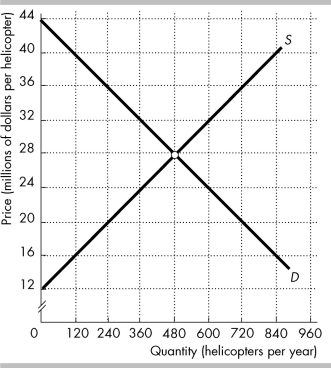 The figure shows the market for helicopters in the United States, where D is the domestic demand curve and S is the domestic supply curve. The United States trades helicopters with the rest of the world at a price of $36 million per helicopter.
-In the figure above, international trade ________ total surplus in the United States by ________.
The figure shows the market for helicopters in the United States, where D is the domestic demand curve and S is the domestic supply curve. The United States trades helicopters with the rest of the world at a price of $36 million per helicopter.
-In the figure above, international trade ________ total surplus in the United States by ________. (Multiple Choice)
4.9/5  (74)
(74) A country specializes in the production of goods for which it has a comparative advantage, so
(Multiple Choice)
4.7/5 (79)
(79) A tax that is imposed by the importing country when an imported good crosses its international boundary is called
(Multiple Choice)
4.8/5 (89)
(89) 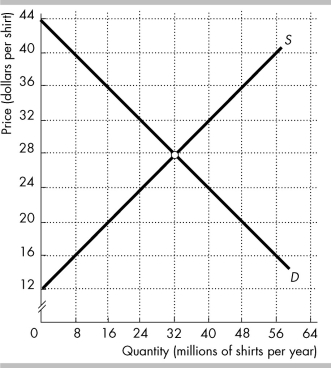 The figure shows the market for shirts in the United States, where D is the U.S demand curve and S is the U.S. supply curve. The world price is $20 per shirt. The United States imposes a tariff on imported shirts, $4 per shirt.
-In the figure above, U.S. producers' ________ from the tariff is ________.
The figure shows the market for shirts in the United States, where D is the U.S demand curve and S is the U.S. supply curve. The world price is $20 per shirt. The United States imposes a tariff on imported shirts, $4 per shirt.
-In the figure above, U.S. producers' ________ from the tariff is ________. (Multiple Choice)
4.7/5 (68)
(68) The figure shows the market for shirts in the United States, where D is the U.S demand curve and S is the U.S. supply curve. The world price is $20 per shirt. The United States imposes a tariff on imported shirts, $4 per shirt.
-In the figure above, the tariff ________ the domestic production of shirts in the United States by ________ per year.
The figure shows the market for shirts in the United States, where D is the U.S demand curve and S is the U.S. supply curve. The world price is $20 per shirt. The United States imposes a tariff on imported shirts, $4 per shirt.
-In the figure above, the tariff ________ the domestic production of shirts in the United States by ________ per year. (Multiple Choice)
4.8/5 (82)
(82) When the United States exports a good, U.S. consumer surplus ________ and U.S. total surplus ________.
(Multiple Choice)
4.8/5 (85)
(85) In 2006, the European Union (EU) threatened to ban imports of long-grain rice because traces of genetically modified rice were found mixed in to commercial supplies. Instead of a ban, suppose the EU placed a tariff on the import of long-grain rice. Which of the following would be an outcome of this tariff?
(Multiple Choice)
4.7/5 (78)
(78) In a market open to international trade, at the world price the quantity demanded is 150 and quantity supplied is 200. This country will
(Multiple Choice)
4.7/5 (61)
(61)  The figure shows the market for shirts in the United States, where D is the domestic demand curve and S is the domestic supply curve. The world price is $20 per shirt.
-In the figure above, with international trade American consumers buy ________ million shirts per year.
The figure shows the market for shirts in the United States, where D is the domestic demand curve and S is the domestic supply curve. The world price is $20 per shirt.
-In the figure above, with international trade American consumers buy ________ million shirts per year. (Multiple Choice)
4.9/5 (71)
(71) Consider a market in which there is an import tariff. Which of the following is TRUE?
(Multiple Choice)
4.7/5 (57)
(57) Which of the following is a reason why only limited attempts are made to compensate those who lose from free international trade?
(Multiple Choice)
5.0/5 (81)
(81) In 2007, European Union (EU) negotiators have offered to cut tariffs for Latin American bananas to avoid "banana wars". What are the effects of a cut in tariffs?
(Multiple Choice)
4.9/5 (81)
(81) Define comparative advantage and discuss its role in international trade.
(Essay)
4.9/5 (81)
(81) Which of the statements about the gains from international trade is CORRECT?
(Multiple Choice)
4.8/5 (83)
(83) The most efficient way to encourage the growth of an infant industry is through
(Multiple Choice)
4.9/5 (71)
(71) 
Filters
- Essay(0)
- Multiple Choice(0)
- Short Answer(0)
- True False(0)
- Matching(0)