



 Chat with AI
Exam 7: Global Markets in Action

Exam 1: What Is Economics479 Questions
Exam 2: The Economic Problem440 Questions
Exam 3: Demand and Supply515 Questions
Exam 4: Elasticity533 Questions
Exam 5: Efficiency and Equity450 Questions
Exam 6: Government Actions in Markets412 Questions
Exam 7: Global Markets in Action200 Questions
Exam 8: Utility and Demand364 Questions
Exam 9: Possibilities, Preferences, and Choices459 Questions
Exam 10: Organizing Production385 Questions
Exam 11: Output and Costs493 Questions
Exam 12: Perfect Competition487 Questions
Exam 13: Monopoly599 Questions
Exam 14: Monopolistic Competition319 Questions
Exam 15: Oligopoly276 Questions
Exam 16: Public Choices, Public Goods, and Healthcare205 Questions
Exam 17: Externalities437 Questions
Exam 18: Markets for Factors of Production382 Questions
Exam 19: Economic Inequality353 Questions
Exam 20: Uncertainty and Information233 Questions
Select questions type


Which of the following is an effective counter argument to the claim that protectionism saves domestic jobs?
(Multiple Choice)
4.7/5  (92)
(92) Which of the following is a valid reason for protecting an industry?
(Multiple Choice)
4.8/5 (84)
(84)  The figure shows the market for shirts in the United States, where D is the domestic demand curve and S is the domestic supply curve. The world price is $20 per shirt.
-In the figure above, international trade ________ total surplus in the United States by ________.
The figure shows the market for shirts in the United States, where D is the domestic demand curve and S is the domestic supply curve. The world price is $20 per shirt.
-In the figure above, international trade ________ total surplus in the United States by ________. (Multiple Choice)
4.7/5 (84)
(84) The gains from free trade are enjoyed by a ________ number of people and the costs of free trade are imposed by ________ number of people.
(Multiple Choice)
4.9/5 (86)
(86) When a group lobbies for the prevention of free trade, the most likely reason is
(Multiple Choice)
4.9/5 (85)
(85) If a country imposes a tariff on an imported good, the tariff ________ the price in the importing country and ________ the quantity of imports.
(Multiple Choice)
4.9/5 (69)
(69) 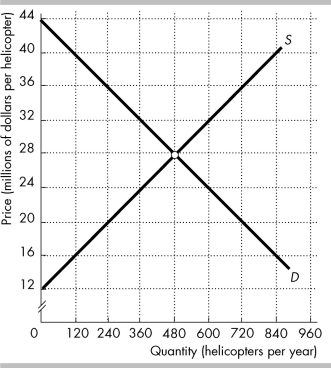 The figure shows the market for helicopters in the United States, where D is the domestic demand curve and S is the domestic supply curve. The United States trades helicopters with the rest of the world at a price of $36 million per helicopter.
-In the figure above, the United States ________ helicopters per year.
The figure shows the market for helicopters in the United States, where D is the domestic demand curve and S is the domestic supply curve. The United States trades helicopters with the rest of the world at a price of $36 million per helicopter.
-In the figure above, the United States ________ helicopters per year. (Multiple Choice)
4.9/5 (83)
(83) Most economists would agree that "saving jobs" is a valid reason for restricting trade.
(True/False)
4.7/5 (80)
(80) A tariff imposed by the United States on Japanese cars ________ the price of cars in the United States and ________ the quantity of Japanese cars imported into the United States.
(Multiple Choice)
4.8/5 (79)
(79) Some observers opposing free trade argue that when we buy shoes from Brazil, U.S. workers lose their jobs. The fact of the matter is that
(Multiple Choice)
4.8/5 (73)
(73) In 2008, Agriculture Secretary Ed Schafer announced that Chile's Livestock and Agricultural Service approved the U.S. inspection, control and certification systems for poultry, allowing these products to enter the Chilean market. The effect of this change in Chilean policy in the Chilean poultry market is to
(Multiple Choice)
4.8/5 (87)
(87) When considering rent seeking, which of the following is TRUE?
(Multiple Choice)
4.8/5 (77)
(77) In developing countries, there is more reliance on ________ as opposed to ________ for government revenue.
(Multiple Choice)
4.9/5 (87)
(87) Which of the following statements concerning tariffs is NOT true?
(Multiple Choice)
5.0/5 (70)
(70) Most economists agree that valid reasons for protecting trade include which of the following? I. The economies of scale argument
II) The saving jobs argument
III) The protection of high wages argument
(Multiple Choice)
4.9/5 (79)
(79) 
Filters
- Essay(0)
- Multiple Choice(0)
- Short Answer(0)
- True False(0)
- Matching(0)