



 Chat with AI
Exam 7: Global Markets in Action

Exam 1: What Is Economics479 Questions
Exam 2: The Economic Problem440 Questions
Exam 3: Demand and Supply515 Questions
Exam 4: Elasticity533 Questions
Exam 5: Efficiency and Equity450 Questions
Exam 6: Government Actions in Markets412 Questions
Exam 7: Global Markets in Action200 Questions
Exam 8: Utility and Demand364 Questions
Exam 9: Possibilities, Preferences, and Choices459 Questions
Exam 10: Organizing Production385 Questions
Exam 11: Output and Costs493 Questions
Exam 12: Perfect Competition487 Questions
Exam 13: Monopoly599 Questions
Exam 14: Monopolistic Competition319 Questions
Exam 15: Oligopoly276 Questions
Exam 16: Public Choices, Public Goods, and Healthcare205 Questions
Exam 17: Externalities437 Questions
Exam 18: Markets for Factors of Production382 Questions
Exam 19: Economic Inequality353 Questions
Exam 20: Uncertainty and Information233 Questions
Select questions type


The gains from trade that are possible when two countries have different opportunity costs for wheat and coffee are realized when
(Multiple Choice)
4.8/5  (80)
(80) Suppose that the country of Pacifica sold its cars in Atlantica for less than it costs to produce the cars. Pacifica could be accused of
(Multiple Choice)
4.9/5 (92)
(92) Suppose the world price of a good is $4. Based on the table below, the country would 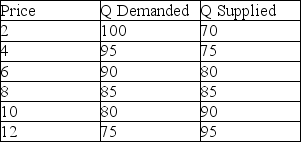
(Multiple Choice)
4.8/5 (88)
(88) Which of the following are reasons economists consider valid for trade protection? I. Protection penalizes countries that have weak environmental standards.
II) Protection limits dumping of low-wage jobs into the domestic economy.
III) Protection prevents low-wage jobs in foreign countries from lowering wages in the United States.
(Multiple Choice)
4.8/5 (79)
(79) Japan imposes a tariff on imported rice. In Japan, surplus will be redistributed from
(Multiple Choice)
4.9/5 (83)
(83)  The figure shows the market for shirts in the United States, where D is the domestic demand curve and S is the domestic supply curve. The world price is $20 per shirt.
-In the figure above, with international trade ________ million shirts per year are produced in the United States.
The figure shows the market for shirts in the United States, where D is the domestic demand curve and S is the domestic supply curve. The world price is $20 per shirt.
-In the figure above, with international trade ________ million shirts per year are produced in the United States. (Multiple Choice)
4.8/5 (74)
(74)  The figure shows the market for shirts in the United States, where D is the U.S demand curve and S is the U.S. supply curve. The world price is $20 per shirt. The United States imposes a tariff on imported shirts, $4 per shirt.
-In the figure above, the U.S. government's revenue from the tariff is ________.
The figure shows the market for shirts in the United States, where D is the U.S demand curve and S is the U.S. supply curve. The world price is $20 per shirt. The United States imposes a tariff on imported shirts, $4 per shirt.
-In the figure above, the U.S. government's revenue from the tariff is ________. (Multiple Choice)
4.8/5 (77)
(77) How does an import quota affect the domestic price of the import, the domestic consumption, the domestic production, and the quantity imported?
(Essay)
5.0/5 (71)
(71) During 2005-2006 Europe imported more than $70 million worth of U.S. long-grain rice. Who gains from this trade?
(Multiple Choice)
4.9/5 (87)
(87) Belize, a country in Central America, has a small coffee industry. Suppose Belize does not have free trade but it has comparative advantage in coffee production. If Belize allowed international trade, what would be the gains from trade?
(Multiple Choice)
4.8/5 (82)
(82) Using calculations of the cost to Americans per job saved in protected industries, it can be concluded that
(Multiple Choice)
4.7/5 (77)
(77) The infant-industry argument is the only perfectly valid argument for protection.
(True/False)
4.9/5 (80)
(80) Almost all economists support protectionist policies because protection
(Multiple Choice)
4.8/5 (78)
(78) An assumption behind the infant-industry argument for tariff protection is that
(Multiple Choice)
4.9/5 (94)
(94) Which of the following is an explanation for the existence of trade restrictions?
(Multiple Choice)
4.9/5 (68)
(68) A U.S. tariff on textiles would ________ U.S. clothing prices and ________ jobs in the U.S. textile industry.
(Multiple Choice)
4.7/5 (88)
(88) 
Filters
- Essay(0)
- Multiple Choice(0)
- Short Answer(0)
- True False(0)
- Matching(0)