



 Chat with AI
Exam 19: The Citric Acid Cycle

Exam 1: Biochemistry and the Organization of Cells69 Questions
Exam 2: Water: The Solvent for Biochemical Reactions79 Questions
Exam 3: Amino Acids and Peptides77 Questions
Exam 4: The Three-Dimensional Structure of Proteins77 Questions
Exam 5: Protein Purification and Characterization Techniques58 Questions
Exam 6: The Behavior of Proteins: Enzymes78 Questions
Exam 7: The Behavior of Proteins: Enzymes, Mechanisms, and Control77 Questions
Exam 8: Lipids and Proteins Are Associated in Biological Membranes90 Questions
Exam 9: Nucleic Acids: How Structure Conveys Information60 Questions
Exam 10: Biosynthesis of Nucleic Acids: Replication79 Questions
Exam 11: Transcription of the Genetic Code: Biosynthesis of Rna93 Questions
Exam 12: Protein Synthesis: Translation of the Genetic Message80 Questions
Exam 13: Nucleic Acid Biotechnology Techniques89 Questions
Exam 14: Viruses, Cancer, and Immunology35 Questions
Exam 15: The Importance of Energy Changes and Electron Transfer in Metabolism56 Questions
Exam 16: Carbohydrates88 Questions
Exam 17: Glycolysis63 Questions
Exam 18: Storage Mechanisms and Control in Carbohydrate Metabolism79 Questions
Exam 19: The Citric Acid Cycle77 Questions
Exam 20: Electron Transport and Oxidative Phosphorylation70 Questions
Exam 21: Lipid Metabolism86 Questions
Exam 22: Photosynthesis74 Questions
Exam 23: The Metabolism of Nitrogen78 Questions
Exam 24: Integration of Metabolism: Cellular Signaling60 Questions
Select questions type


The reactions in which succinate is converted to oxaloacetate are,in order
(Multiple Choice)
4.9/5  (75)
(75) Exhibit 19A 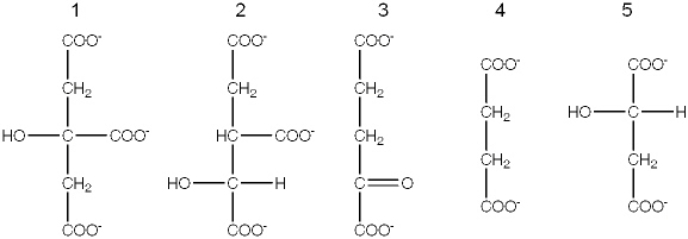 The following compounds are all intermediates in the citric acid cycle.
Refer to Exhibit 19A.Which intermediate becomes bonded to Coenzyme A during the cycle?
The following compounds are all intermediates in the citric acid cycle.
Refer to Exhibit 19A.Which intermediate becomes bonded to Coenzyme A during the cycle? (Multiple Choice)
4.9/5 (67)
(67) Which of the following describes a use for acetyl-CoA as an important intermediate in metabolism?
(Multiple Choice)
4.8/5 (84)
(84) Which of these enzymes is most similar to pyruvate dehydrogenase?
(Multiple Choice)
4.8/5 (72)
(72) In the conversion of succinyl-CoA to succinate,GTP is produced from GDP in a reaction in which the source of the added phosphate is
(Multiple Choice)
4.8/5 (81)
(81) The citric acid cycle is the only metabolic pathway that can be used both as an anabolic and as a catabolic pathway.
(True/False)
4.9/5 (75)
(75) Which of the following vitamins and enzyme cofactors are used by the pyruvate dehydrogenase complex during oxidative decarboxylation?
(Multiple Choice)
4.8/5 (76)
(76) The only difference between succinate and fumarate is the geometry around their double bonds,one contains a cis double bond and the other contains a trans double bond.
(True/False)
4.9/5 (77)
(77) Which of the following enzymes is not a control point of the citric acid cycle?
(Multiple Choice)
4.9/5 (90)
(90) Which of the following is true regarding the control of pyruvate dehydrogenase?
(Multiple Choice)
4.8/5 (80)
(80) The production of malate in the glyoxylate pathway is important,since it can be readily converted to phosphoenolpyruvate and then to sugars.
(True/False)
4.8/5 (85)
(85) Which of the following enzymes does not use NAD+ for oxidation?
(Multiple Choice)
4.9/5 (86)
(86) Which of the following statements concerning the citric acid cycle as the central metabolic pathway is true?
(Multiple Choice)
4.9/5 (67)
(67) 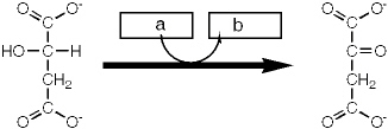
Which of the following enzymes is allosterically activated by NAD+?
(Multiple Choice)
4.9/5 (94)
(94) Weight loss in humans can be difficult to achieve,since we lack the ability to convert our fats to sugars,and it is difficult to change our metabolism to using fats as a primary energy source.
(True/False)
4.9/5 (86)
(86) Which of the following statements concerning the glyoxylate pathway is false?
(Multiple Choice)
4.8/5 (96)
(96) The conversion of citrate to isocitrate is remarkable because
(Multiple Choice)
4.8/5 (64)
(64) Which of the following is not a component of the pyruvate dehydrogenase complex?
(Multiple Choice)
4.9/5 (79)
(79) 
Filters
- Essay(0)
- Multiple Choice(0)
- Short Answer(0)
- True False(0)
- Matching(0)