



 Chat with AI
Exam 19: The Citric Acid Cycle

Exam 1: Biochemistry and the Organization of Cells69 Questions
Exam 2: Water: The Solvent for Biochemical Reactions79 Questions
Exam 3: Amino Acids and Peptides77 Questions
Exam 4: The Three-Dimensional Structure of Proteins77 Questions
Exam 5: Protein Purification and Characterization Techniques58 Questions
Exam 6: The Behavior of Proteins: Enzymes78 Questions
Exam 7: The Behavior of Proteins: Enzymes, Mechanisms, and Control77 Questions
Exam 8: Lipids and Proteins Are Associated in Biological Membranes90 Questions
Exam 9: Nucleic Acids: How Structure Conveys Information60 Questions
Exam 10: Biosynthesis of Nucleic Acids: Replication79 Questions
Exam 11: Transcription of the Genetic Code: Biosynthesis of Rna93 Questions
Exam 12: Protein Synthesis: Translation of the Genetic Message80 Questions
Exam 13: Nucleic Acid Biotechnology Techniques89 Questions
Exam 14: Viruses, Cancer, and Immunology35 Questions
Exam 15: The Importance of Energy Changes and Electron Transfer in Metabolism56 Questions
Exam 16: Carbohydrates88 Questions
Exam 17: Glycolysis63 Questions
Exam 18: Storage Mechanisms and Control in Carbohydrate Metabolism79 Questions
Exam 19: The Citric Acid Cycle77 Questions
Exam 20: Electron Transport and Oxidative Phosphorylation70 Questions
Exam 21: Lipid Metabolism86 Questions
Exam 22: Photosynthesis74 Questions
Exam 23: The Metabolism of Nitrogen78 Questions
Exam 24: Integration of Metabolism: Cellular Signaling60 Questions
Select questions type


The reaction in which malate is oxidized to oxaloacetate is not thermodynamically favored.It takes place because
(Multiple Choice)
4.7/5  (77)
(77) The "energy charge" in a cell is important in the control of metabolism.
(True/False)
4.8/5 (71)
(71) Which of the following is not a reaction occurring during oxidative decarboxylation of pyruvate?
(Multiple Choice)
4.7/5 (64)
(64) When the citric acid cycle is not functioning,the most common fate of acetyl-CoA from sugar metabolism in humans is the formation of fatty acids or cholesterol.
(True/False)
4.7/5 (93)
(93) There is a cyclic reaction in which pyruvate becomes oxaloacetate.The oxaloacetate is converted to malate and then back to pyruvate.This cycle is important because:
(Multiple Choice)
4.9/5 (84)
(84) Most of the products of the catabolism of sugars,fats and amino acids enter the citric acid cycle as:
(Multiple Choice)
4.9/5 (80)
(80) The reaction of the citric acid cycle that does not take place in the mitochondrial matrix is the one catalyzed by:
(Multiple Choice)
4.9/5 (88)
(88) Exhibit 19A 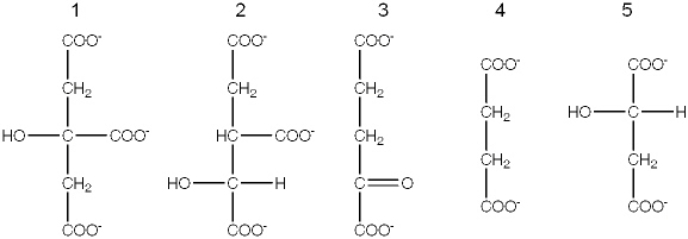 The following compounds are all intermediates in the citric acid cycle.
Refer to Exhibit 19A.Which intermediate is formed from acetyl-CoA and oxaloacetate.
The following compounds are all intermediates in the citric acid cycle.
Refer to Exhibit 19A.Which intermediate is formed from acetyl-CoA and oxaloacetate. (Multiple Choice)
4.8/5 (76)
(76) Which of the following cannot cross the inner mitochondrial membrane?
(Multiple Choice)
4.8/5 (84)
(84) Exhibit 19A 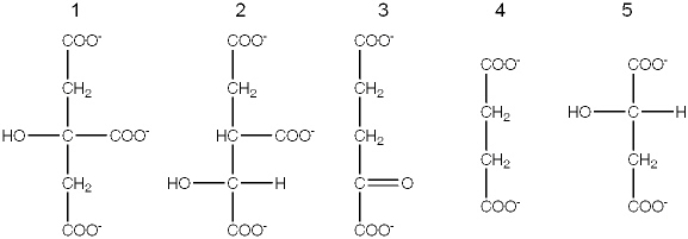 The following compounds are all intermediates in the citric acid cycle.
Refer to Exhibit 19A.Which intermediate releases CO2 concurrent with oxidation?
The following compounds are all intermediates in the citric acid cycle.
Refer to Exhibit 19A.Which intermediate releases CO2 concurrent with oxidation? (Multiple Choice)
5.0/5 (89)
(89) Which of the following enzymes is the only membrane-bound enzyme in the citric acid cycle?
(Multiple Choice)
4.9/5 (68)
(68) The glyoxylate pathway bypasses part of the citric acid cycle by converting isocitrate to glyoxylate and
(Multiple Choice)
5.0/5 (76)
(76) In the glyoxylate cycle,acetyl-CoA reacts with glyoxylate to produce
(Multiple Choice)
4.9/5 (91)
(91) Glyoxysomes are named for the fact that they contain the glyoxylate pathway.
(True/False)
4.8/5 (83)
(83) Exhibit 19A 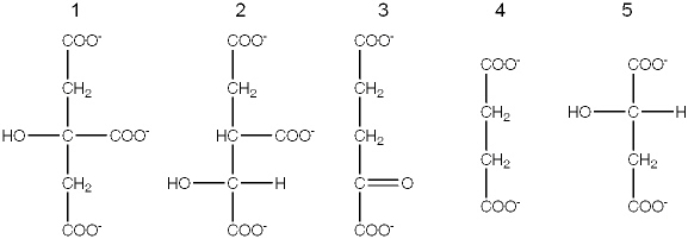 The following compounds are all intermediates in the citric acid cycle.
Refer to Exhibit 19A.Which intermediate does FAD oxidize?
The following compounds are all intermediates in the citric acid cycle.
Refer to Exhibit 19A.Which intermediate does FAD oxidize? (Multiple Choice)
4.9/5 (90)
(90) 
Filters
- Essay(0)
- Multiple Choice(0)
- Short Answer(0)
- True False(0)
- Matching(0)