



 Chat with AI
Exam 7: Long-Run Economic Growth: Sources and Policies

Exam 1: Economics: Foundations and Models148 Questions
Exam 2: Trade-Offs, Comparative Advantage, and the Market System314 Questions
Exam 3: Where Prices Come From: The Interaction of Supply and Demand314 Questions
Exam 4: GDP: Measuring Total Production and Income277 Questions
Exam 5: Unemployment and Inflation300 Questions
Exam 6: Economic Growth, The Financial System, and Business Cycles262 Questions
Exam 7: Long-Run Economic Growth: Sources and Policies280 Questions
Exam 8: Aggregate Expenditure and Output in the Short Run315 Questions
Exam 9: Aggregate Demand and Aggregate Supply Analysis246 Questions
Exam 10: Money, Banks, and the Bank of Canada285 Questions
Exam 11: Monetary Policy281 Questions
Exam 12: Fiscal Policy303 Questions
Exam 13: Inflation, Unemployment, and Bank of Canada Policy265 Questions
Exam 14: Macroeconomics in an Open Economy280 Questions
Exam 15: The International Financial System228 Questions
Select questions type


When firms benefit from the results of research and development they didn't pay for, we say firms are
(Multiple Choice)
4.8/5  (95)
(95) Robert Lucas, a Nobel Laureate in economics, argues that there are increasing returns to
(Multiple Choice)
4.7/5 (72)
(72) List four types of government policies that can aid economic growth.
(Essay)
4.8/5 (93)
(93) Which of the following is an example of foreign direct investment?
(Multiple Choice)
4.9/5 (87)
(87) Would you expect to see higher or lower growth rates for countries that start out with a relatively low level of real GDP per capita? Explain using the concept of "catch-up" and support your answer with a graph.
(Essay)
4.8/5 (72)
(72) In Canada, the annual growth rate of real GDP per person between 1995 and 2014 averaged
(Multiple Choice)
4.9/5 (88)
(88) In 2014, South America had a lower average GDP per capita than any other continent.
(True/False)
4.9/5 (87)
(87) Which of the following is a true statement regarding the economic growth model's predictions and how it actually affects the real world?
(Multiple Choice)
4.9/5 (78)
(78) Table 7.4 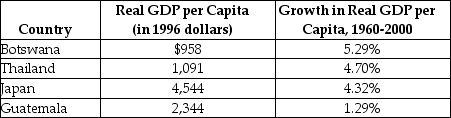 -Refer to Table 7.4.In the table above, which countries are consistent with the predictions of the economic growth model?
 (Multiple Choice)
4.9/5 (73)
(73) Firms free ride on the research and development of other firms when they
(Multiple Choice)
5.0/5 (74)
(74) Which of the following countries had the highest GDP per capita in 2014?
(Multiple Choice)
4.7/5 (90)
(90) The labour productivity slowdown in Canada in the 1970s was due to declining quality of education in, because no other industrialized country experienced the same labour productivity slowdown at the same time.
(True/False)
4.8/5 (74)
(74) The easiest way for a country to obtain access to technology is through
(Multiple Choice)
4.9/5 (82)
(82) Suggest two policies the federal government could pursue to help increase the accumulation of knowledge.
(Essay)
4.8/5 (89)
(89) If the slope of the per-worker production function is 1/2 in a given range, how will a $10,000 increase in capital per hour worked affect real GDP per hour worked in the same given range?
(Multiple Choice)
4.7/5 (75)
(75) According to the World Bank, in 2013 China's GDP was approximately $9.24 trillion (in U.S.dollars). That same year, India's GDP was approximately $3.88 trillion (also in U.S.dollars).With which of the following populations would China's standard of living have been considered higher than India's that year?
(Multiple Choice)
4.8/5 (93)
(93) Recent rapid economic growth in India and China has reduced the amount of "brain drain" in those countries.
(True/False)
4.9/5 (71)
(71) Which of the following countries actually experienced negative economic growth from 1960 to 2011?
(Multiple Choice)
4.8/5 (80)
(80) 
Filters
- Essay(0)
- Multiple Choice(0)
- Short Answer(0)
- True False(0)
- Matching(0)