



 Chat with AI
Exam 7: Long-Run Economic Growth: Sources and Policies

Exam 1: Economics: Foundations and Models148 Questions
Exam 2: Trade-Offs, Comparative Advantage, and the Market System314 Questions
Exam 3: Where Prices Come From: The Interaction of Supply and Demand314 Questions
Exam 4: GDP: Measuring Total Production and Income277 Questions
Exam 5: Unemployment and Inflation300 Questions
Exam 6: Economic Growth, The Financial System, and Business Cycles262 Questions
Exam 7: Long-Run Economic Growth: Sources and Policies280 Questions
Exam 8: Aggregate Expenditure and Output in the Short Run315 Questions
Exam 9: Aggregate Demand and Aggregate Supply Analysis246 Questions
Exam 10: Money, Banks, and the Bank of Canada285 Questions
Exam 11: Monetary Policy281 Questions
Exam 12: Fiscal Policy303 Questions
Exam 13: Inflation, Unemployment, and Bank of Canada Policy265 Questions
Exam 14: Macroeconomics in an Open Economy280 Questions
Exam 15: The International Financial System228 Questions
Select questions type


Empirical evidence from 1960 to 2011 shows that convergence in economic growth is occurring in which of the following cases?
(Multiple Choice)
4.8/5  (88)
(88) Which of the following policies would not help promote economic growth?
(Multiple Choice)
4.8/5 (83)
(83) According to Joseph Schumpeter, the theory of creative destruction describes a process by which
(Multiple Choice)
4.8/5 (77)
(77) According to new growth theory, the accumulation of ________ capital is subject to diminishing returns at the ________ level, but not at the level of the economy as a whole.
(Multiple Choice)
4.7/5 (73)
(73) Which of the following is not one of the three sources of technological change?
(Multiple Choice)
4.8/5 (83)
(83) The former Soviet Union consistently increased the amount of capital available to its workers, but found that increases in capital resulted in progressively smaller and smaller increases in GDP per worker.This phenomenon is referred to as
(Multiple Choice)
4.9/5 (83)
(83) Some of the policies used by the Chinese government result in investment being 50 percent of GDP. As a result
(Multiple Choice)
5.0/5 (86)
(86) Most of the countries of Africa are considered newly industrializing countries.
(True/False)
4.9/5 (74)
(74) Some economists argue that the productivity slowdown from mid-1970s to mid-1990s actually didn't happen, but just "appeared" to happen because
(Multiple Choice)
4.8/5 (90)
(90) Figure 7.3  Alt text for Figure 7.3: In figure 7.3, a graph, comparing capital per hour worked and real GDP per hour worked.
Long description for Figure 7.3: The x-axis is labelled, capital per hour worked, K/L.The y-axis is labelled, real GDP per hour worked, Y/L.2 concave curves originating from 0 at the vertex are shown.5 points A ($50000, $15000), B ($60000, $16000), C ($70000, $16400), D ($80000, $16500), and E ($60000, $17000)are plotted.The curve labelled Production function 1, passes through points A, B, C, and D.The curve labelled Production function 2, passes through point E.These 5 points are connected to their respective coordinates on the x and y-axis with dotted lines.
-Refer to Figure 7.3.Which of the following would cause an economy to move from a point like A in the figure above to a point like B?
Alt text for Figure 7.3: In figure 7.3, a graph, comparing capital per hour worked and real GDP per hour worked.
Long description for Figure 7.3: The x-axis is labelled, capital per hour worked, K/L.The y-axis is labelled, real GDP per hour worked, Y/L.2 concave curves originating from 0 at the vertex are shown.5 points A ($50000, $15000), B ($60000, $16000), C ($70000, $16400), D ($80000, $16500), and E ($60000, $17000)are plotted.The curve labelled Production function 1, passes through points A, B, C, and D.The curve labelled Production function 2, passes through point E.These 5 points are connected to their respective coordinates on the x and y-axis with dotted lines.
-Refer to Figure 7.3.Which of the following would cause an economy to move from a point like A in the figure above to a point like B? (Multiple Choice)
4.9/5 (71)
(71) According to Nobel Laureate Douglass North, one reason why the Industrial Revolution occurred in England before many other countries was because the King of England consistently maintained control over the court system and the government.
(True/False)
4.9/5 (73)
(73) Significant economic growth did not begin in the world until
(Multiple Choice)
4.9/5 (91)
(91) In the long run, a country will experience an increasing standard of living only if it experiences
(Multiple Choice)
4.9/5 (81)
(81) Figure 7.4 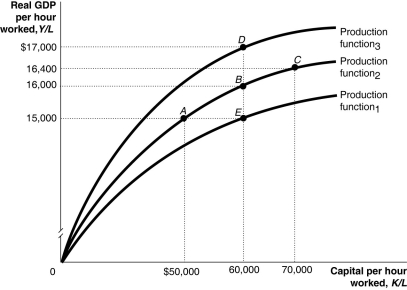 Alt text for Figure 7.4: In figure 7.4, a graph representing per-worker production functions.
Long description for Figure 7.4: The x-axis is labelled, capital per hour worked, K/L.The y-axis is labelled, real GDP per hour worked, Y/L.3 concave curves originating from 0 at the vertex are shown.5 points A ($50000, $15000), B ($60000, $16000), C ($70000, $16400), D ($60000, $17000), and E ($60000, $15000)are plotted.The curve labelled, Production function 1, passes through point E.The curve labelled, Production function 2, passes through points A, B, and C.The curve labelled, Production function 3, passes through point D.These 5 points are connected to their respective coordinates on the x-axis and y-axis with dotted lines.
-Refer to Figure 7.4.Suppose the economy gains more capital per hour worked and experiences technological change.This is shown in the figure above by the movement from
Alt text for Figure 7.4: In figure 7.4, a graph representing per-worker production functions.
Long description for Figure 7.4: The x-axis is labelled, capital per hour worked, K/L.The y-axis is labelled, real GDP per hour worked, Y/L.3 concave curves originating from 0 at the vertex are shown.5 points A ($50000, $15000), B ($60000, $16000), C ($70000, $16400), D ($60000, $17000), and E ($60000, $15000)are plotted.The curve labelled, Production function 1, passes through point E.The curve labelled, Production function 2, passes through points A, B, and C.The curve labelled, Production function 3, passes through point D.These 5 points are connected to their respective coordinates on the x-axis and y-axis with dotted lines.
-Refer to Figure 7.4.Suppose the economy gains more capital per hour worked and experiences technological change.This is shown in the figure above by the movement from (Multiple Choice)
4.9/5 (92)
(92) Figure 7.1 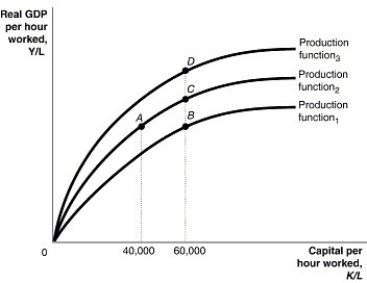 Alt text for Figure 7.1: In figure 7.1, a graph comparing capital per hour worked and real GDP per hour worked.
Long description for Figure 7.1: The x-axis is labelled, capital per hour worked, K/L, with values 40,000 and 60,000 marked.The y-axis is labelled, real GDP per hour worked, Y/L, with 0 at the vertex.3 concave curves, each originating from the vertex are shown.4 points A, B, C, and D are plotted such that point A has 40,000 as the x coordinate, and points B, C, and D have 60,000 as the x coordinate.The 3 curves pass through these points.The curve labelled, Production function 1, passes through point B.The curve labelled, Production function 2, passes through points A and C.The curve labelled, Production function 3, passes through point D.
-Refer to Figure 7.1.Diminishing marginal returns is illustrated in the per-worker production function in the figure above by a movement from
Alt text for Figure 7.1: In figure 7.1, a graph comparing capital per hour worked and real GDP per hour worked.
Long description for Figure 7.1: The x-axis is labelled, capital per hour worked, K/L, with values 40,000 and 60,000 marked.The y-axis is labelled, real GDP per hour worked, Y/L, with 0 at the vertex.3 concave curves, each originating from the vertex are shown.4 points A, B, C, and D are plotted such that point A has 40,000 as the x coordinate, and points B, C, and D have 60,000 as the x coordinate.The 3 curves pass through these points.The curve labelled, Production function 1, passes through point B.The curve labelled, Production function 2, passes through points A and C.The curve labelled, Production function 3, passes through point D.
-Refer to Figure 7.1.Diminishing marginal returns is illustrated in the per-worker production function in the figure above by a movement from (Multiple Choice)
4.9/5 (71)
(71) A small economy increased its capital per hour worked (K/L)from $40,000 to $50,000.As a result, real GDP per worker (Y/L)grew from $20,000 to $25,000.If the economy increases its capital per hour worked by another $10,000 to $60,000, but there is no change in technology, by how much more and in what direction will output per worker change?
(Multiple Choice)
4.8/5 (79)
(79) Table 7.2 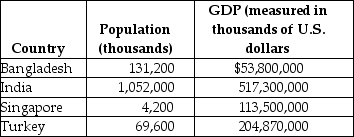 -Refer to Table 7.2.Calculate the GDP per capita for each country in the table.Which country has the highest standard of living? Why?
 (Essay)
4.8/5 (74)
(74) 
Filters
- Essay(0)
- Multiple Choice(0)
- Short Answer(0)
- True False(0)
- Matching(0)