



 Chat with AI
Exam 7: Long-Run Economic Growth: Sources and Policies

Exam 1: Economics: Foundations and Models148 Questions
Exam 2: Trade-Offs, Comparative Advantage, and the Market System314 Questions
Exam 3: Where Prices Come From: The Interaction of Supply and Demand314 Questions
Exam 4: GDP: Measuring Total Production and Income277 Questions
Exam 5: Unemployment and Inflation300 Questions
Exam 6: Economic Growth, The Financial System, and Business Cycles262 Questions
Exam 7: Long-Run Economic Growth: Sources and Policies280 Questions
Exam 8: Aggregate Expenditure and Output in the Short Run315 Questions
Exam 9: Aggregate Demand and Aggregate Supply Analysis246 Questions
Exam 10: Money, Banks, and the Bank of Canada285 Questions
Exam 11: Monetary Policy281 Questions
Exam 12: Fiscal Policy303 Questions
Exam 13: Inflation, Unemployment, and Bank of Canada Policy265 Questions
Exam 14: Macroeconomics in an Open Economy280 Questions
Exam 15: The International Financial System228 Questions
Select questions type


The purchase of stocks and bonds issued in another country is known as foreign direct investment.
(True/False)
4.8/5  (76)
(76) Use production functions from the economic growth model to explain why Canada grew at a much faster rate than the former Soviet Union in the latter half of the 20th century.
(Essay)
4.9/5 (80)
(80) How might Canada's educational system have contributed to the productivity slowdown of the mid-1970s to the mid-1990s?
(Essay)
4.7/5 (74)
(74) One reason why many low-income countries experience low rates of growth is because of low rates of saving and investment in those countries.
(True/False)
4.7/5 (83)
(83) Does globalization promote economic growth, and how does globalization affect the welfare of a given country's citizens?
(Essay)
4.8/5 (82)
(82) The "new economy" which some economists believe can lead to higher productivity growth in the future is based on
(Multiple Choice)
4.9/5 (78)
(78) Which of the following is not a reason why the Industrial Revolution occurred when and where it did?
(Multiple Choice)
4.9/5 (63)
(63) The Soviet Union's economy grew rapidly in terms of GDP per hour worked in the 1950s, but eventually this growth slowed.Why did this occur?
(Multiple Choice)
4.7/5 (82)
(82) One of the results of Paul Romer's new growth theory is that investment in research and development will be too low in an economy.Explain how he comes to this conclusion.
(Essay)
4.8/5 (69)
(69) By offering more generous unemployment insurance programs than the United States, Canada can expect
(Multiple Choice)
4.9/5 (89)
(89) Because knowledge capital is nonexcludable and nonrival, firms have an incentive to ________ the research and development of other firms.
(Multiple Choice)
4.9/5 (89)
(89) How can economic growth help a country combat "brain drain"?
(Multiple Choice)
4.8/5 (68)
(68) In 2014, GDP per capita was ________ in Canada than in China, and since 1980 the growth rate of real GDP per capita has been ________ in Canada than in China.
(Multiple Choice)
5.0/5 (80)
(80) Table 7.5 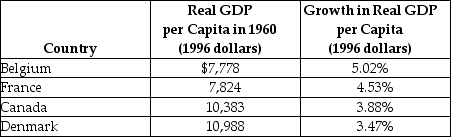 -Refer to Table 7.5.Consider the statistics in the table above in describing the industrialized countries.Are these consistent with the economic growth model? Briefly explain.
 (Essay)
4.7/5 (71)
(71) 
Filters
- Essay(0)
- Multiple Choice(0)
- Short Answer(0)
- True False(0)
- Matching(0)