



 Chat with AI
Exam 7: Long-Run Economic Growth: Sources and Policies

Exam 1: Economics: Foundations and Models148 Questions
Exam 2: Trade-Offs, Comparative Advantage, and the Market System314 Questions
Exam 3: Where Prices Come From: The Interaction of Supply and Demand314 Questions
Exam 4: GDP: Measuring Total Production and Income277 Questions
Exam 5: Unemployment and Inflation300 Questions
Exam 6: Economic Growth, The Financial System, and Business Cycles262 Questions
Exam 7: Long-Run Economic Growth: Sources and Policies280 Questions
Exam 8: Aggregate Expenditure and Output in the Short Run315 Questions
Exam 9: Aggregate Demand and Aggregate Supply Analysis246 Questions
Exam 10: Money, Banks, and the Bank of Canada285 Questions
Exam 11: Monetary Policy281 Questions
Exam 12: Fiscal Policy303 Questions
Exam 13: Inflation, Unemployment, and Bank of Canada Policy265 Questions
Exam 14: Macroeconomics in an Open Economy280 Questions
Exam 15: The International Financial System228 Questions
Select questions type


Knowledge capital is ________ in production and ________.As a result, firms ________ free ride.
(Multiple Choice)
4.7/5  (79)
(79) Which of the following is not an implication of secular stagnation?
(Multiple Choice)
4.9/5 (78)
(78) The opportunity cost of being unemployed tends to be the highest in which of the following countries?
(Multiple Choice)
4.8/5 (76)
(76) Growth in real GDP per person in Canada began to slow down during what period of time?
(Multiple Choice)
4.8/5 (78)
(78) Table 7.7 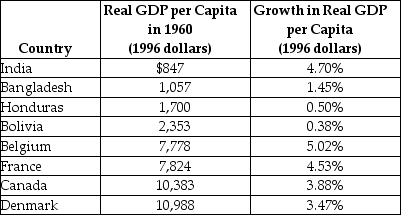 -Refer to Table 7.7.Consider the statistics in the table above in describing the following industrialized and developing countries.Are these consistent with the economic growth model? Briefly explain.
 (Essay)
4.8/5 (74)
(74) If an outflow of workers leaves a country with a smaller but more productive workforce and the capital per hour worked does not change, there will be ________ the per-worker production function in that country.
(Multiple Choice)
4.9/5 (79)
(79) In 1973, the Club of Rome published a book titled The Limits to Growth, which predicted that economic growth would likely end in high-income countries because of
(Multiple Choice)
4.8/5 (78)
(78) There has been catch-up among the ________ countries, but there has not been catch-up among ________.
(Multiple Choice)
4.9/5 (82)
(82) Figure 7.5 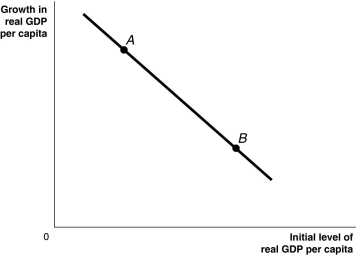 Alt text for Figure 7.5: In figure 7.5, a graph depicting the "catch-up line."
Long description for Figure 7.5: The x-axis is labelled, initial level of real GDP per capita.The y-axis is labelled, growth in real GDP per capita.A line slopes down from the top left corner to the end of the x-axis.2 points, A and B, are plotted on this line such that point A is on the top part of the line, and point B is on the bottom part of the line.
-Refer to Figure 7.5.Based on the "catch-up line" drawn above, poorer countries are more likely to be at a point like ________, where growth in GDP is relatively ________, while richer countries are more likely to be at a point like ________, where growth in GDP is relatively ________.
Alt text for Figure 7.5: In figure 7.5, a graph depicting the "catch-up line."
Long description for Figure 7.5: The x-axis is labelled, initial level of real GDP per capita.The y-axis is labelled, growth in real GDP per capita.A line slopes down from the top left corner to the end of the x-axis.2 points, A and B, are plotted on this line such that point A is on the top part of the line, and point B is on the bottom part of the line.
-Refer to Figure 7.5.Based on the "catch-up line" drawn above, poorer countries are more likely to be at a point like ________, where growth in GDP is relatively ________, while richer countries are more likely to be at a point like ________, where growth in GDP is relatively ________. (Multiple Choice)
4.9/5 (81)
(81) Which of the following best explains why productivity growth in the United States has been faster than in other leading industrialized nations?
(Multiple Choice)
4.9/5 (74)
(74) Disease, poor nutrition, and substandard health care in developing nations can reduce growth in an economy by
(Multiple Choice)
4.9/5 (88)
(88) Why would knowledge capital exhibit increasing returns for an entire economy, but not for an individual firm?
(Multiple Choice)
4.9/5 (74)
(74) Foreign direct investment in Canada increased 3.8 percent in 2011.This means that
(Multiple Choice)
4.9/5 (85)
(85) Which of the following does not contribute to the explanation why some countries have not experienced relatively high growth rates in real GDP per capita despite relatively low initial levels of real GDP per capita?
(Multiple Choice)
4.8/5 (91)
(91) The developing countries have been catching up to the lower-income industrial countries in terms of economic growth.
(True/False)
4.7/5 (87)
(87) In a small European country, it is estimated that changing the level of capital from $8 million to $10 million will increase real GDP from $2 million to $3 million.What level of GDP would you expect the economy to be able to reach if spending on capital continued to rise to $12 million, assuming no technological change and no change in the hours of work?
(Multiple Choice)
4.8/5 (70)
(70) If there is a change in the ability of a firm to produce a given level of output with a given level of inputs, we say there is
(Multiple Choice)
4.9/5 (84)
(84) 
Filters
- Essay(0)
- Multiple Choice(0)
- Short Answer(0)
- True False(0)
- Matching(0)