



 Chat with AI
Exam 11: Monopolistic Competition and Oligopoly

Exam 1: Economics: The World Around You90 Questions
Exam 2: Choice, opportunity Costs, and Specialization95 Questions
Exam 3: Markets, Demand and Supply, and the Price System98 Questions
Exam 4: The Market System and the Private and Public Sector100 Questions
Exam 5: Elasticity: Demand and Supply132 Questions
Exam 6: Consumer Choice142 Questions
Exam 7: Supply: The Costs of Doing Business106 Questions
Exam 8: Profit Maximization122 Questions
Exam 9: Perfect Competition135 Questions
Exam 10: Monopoly118 Questions
Exam 11: Monopolistic Competition and Oligopoly114 Questions
Exam 12: Antitrust and Regulation100 Questions
Exam 13: Market Failures, Government Failures, and Rent Seeking121 Questions
Exam 14: Resource Markets112 Questions
Exam 15: The Labor Market117 Questions
Exam 16: Capital Markets100 Questions
Exam 17: The Land Market and Natural Resources55 Questions
Exam 18: Aging, Social Security and Health Care88 Questions
Exam 19: Income Distribution,Poverty and Government Policy115 Questions
Exam 20: World Trade Equilibrium112 Questions
Exam 21: International Trade Restrictions109 Questions
Exam 22: Exchange Rates and Financial Links Between Countries132 Questions
Select questions type


Often the best way for a firm to convey information to consumers about the quality of a product is to spend money on creating well-known brand names and the provision of guarantees.
(True/False)
4.7/5  (65)
(65) The following table shows the payoff matrix of the two firms (Firm X and Firm Y) in dollars when they advertise and when they do not advertise. Table 11.1 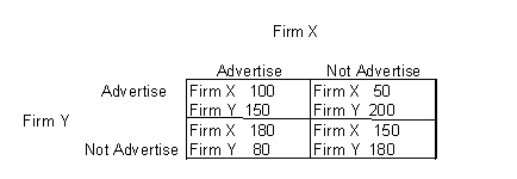 -According to Table 11.1,if firm X advertises and Y does not advertise:
 (Multiple Choice)
4.8/5 (80)
(80) As a firm in a monopolistically competitive market successfully differentiates its products and earns a positive economic profit,it is soon imitated by its rivals and profit of the firm falls to zero.
(True/False)
4.8/5 (80)
(80) A monopolistically competitive firm faces a relatively less elastic demand curve than a monopolist.
(True/False)
4.8/5 (82)
(82) The market structure called monopolistic competition is named using both monopoly and perfect competition.Why?
(Multiple Choice)
4.9/5 (93)
(93) Martin is in the market for a new television set.He is deciding between two sets: one is rather expensive but offers a guarantee; the other has a lower price but offers no guarantee.Martin's decision to buy the more expensive set would indicate that:
(Multiple Choice)
4.9/5 (89)
(89) The figure given below shows revenue and cost curves of a monopolistically competitive firm. Figure: 11.1 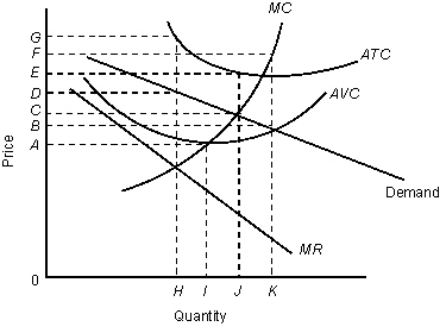 In the figure,
MR: Marginal revenue curve
ATC: Average total cost curve
AVC: Average variable cost curve
MC: Marginal cost curve
-Consider the monopolistically competitive firm described in the Figure 11.1.The profit-maximizing output level and price are,respectively:
In the figure,
MR: Marginal revenue curve
ATC: Average total cost curve
AVC: Average variable cost curve
MC: Marginal cost curve
-Consider the monopolistically competitive firm described in the Figure 11.1.The profit-maximizing output level and price are,respectively: (Multiple Choice)
4.8/5 (73)
(73) Oligopolies can arise as a result of both natural barriers and governmentally created barriers.
(True/False)
4.9/5 (80)
(80) According to Figure 11.1,the profit-maximizing firm is making an average:
(Multiple Choice)
4.8/5 (84)
(84) A monopolistically competitive firm maximizes profit at the point at which price is equal to marginal cost.
(True/False)
4.8/5 (84)
(84) One reason that monopolistically competitive firms often use celebrity endorsements is that:
(Multiple Choice)
4.9/5 (70)
(70) Firms develop brand names in order to make the demand for their product more elastic.
(True/False)
4.8/5 (89)
(89) Both monopolistically and perfectly competitive firms earn only normal profits in the long run.
(True/False)
4.9/5 (80)
(80) In the context of market structure,the characteristic that best describes a monopolistically competitive market is that:
(Multiple Choice)
4.8/5 (77)
(77) A deadweight loss arises in a perfectly competitive market as each firm is a price taker.
(True/False)
4.8/5 (89)
(89) By forming a cartel the member firms can actually raise their profits.
(True/False)
4.9/5 (68)
(68) The figure below shows the revenue and cost curves of a monopolistically competitive firm. Figure: 11.2 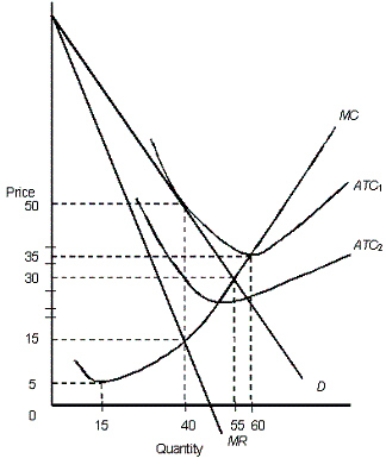 In the figure,
D: Demand curve
MR: Marginal revenue curve
ATC1 and ATC2: Average total cost curves
MC: Marginal cost curve
-In Figure 11.2,if the market is monopolistically competitive,which quantity represents long-run equilibrium for the firm?
In the figure,
D: Demand curve
MR: Marginal revenue curve
ATC1 and ATC2: Average total cost curves
MC: Marginal cost curve
-In Figure 11.2,if the market is monopolistically competitive,which quantity represents long-run equilibrium for the firm? (Multiple Choice)
5.0/5 (82)
(82) 
Filters
- Essay(0)
- Multiple Choice(0)
- Short Answer(0)
- True False(0)
- Matching(0)