



 Chat with AI
Exam 11: Monopolistic Competition and Oligopoly

Exam 1: Economics: The World Around You90 Questions
Exam 2: Choice, opportunity Costs, and Specialization95 Questions
Exam 3: Markets, Demand and Supply, and the Price System98 Questions
Exam 4: The Market System and the Private and Public Sector100 Questions
Exam 5: Elasticity: Demand and Supply132 Questions
Exam 6: Consumer Choice142 Questions
Exam 7: Supply: The Costs of Doing Business106 Questions
Exam 8: Profit Maximization122 Questions
Exam 9: Perfect Competition135 Questions
Exam 10: Monopoly118 Questions
Exam 11: Monopolistic Competition and Oligopoly114 Questions
Exam 12: Antitrust and Regulation100 Questions
Exam 13: Market Failures, Government Failures, and Rent Seeking121 Questions
Exam 14: Resource Markets112 Questions
Exam 15: The Labor Market117 Questions
Exam 16: Capital Markets100 Questions
Exam 17: The Land Market and Natural Resources55 Questions
Exam 18: Aging, Social Security and Health Care88 Questions
Exam 19: Income Distribution,Poverty and Government Policy115 Questions
Exam 20: World Trade Equilibrium112 Questions
Exam 21: International Trade Restrictions109 Questions
Exam 22: Exchange Rates and Financial Links Between Countries132 Questions
Select questions type


Which of the following is not an example of nonprice competition?
(Multiple Choice)
4.8/5  (73)
(73) If all the firms in a monopolistically competitive market are incurring losses,then eventually:
(Multiple Choice)
4.8/5 (80)
(80) Which of the following is a characteristic of an oligopoly market?
(Multiple Choice)
4.9/5 (94)
(94) The table below shows the payoff (profit) matrix of Firm A and Firm B indicating the profit outcome that corresponds to each firm's pricing strategy (where $500 and $200 are the pricing strategies of two firms). Table 11.2 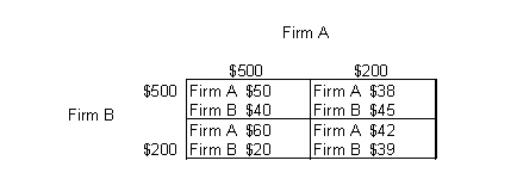 -According to Table 11.2,if firm A follows its dominant strategy but firm B does not,firm A earns a profit of:
 (Multiple Choice)
4.8/5 (90)
(90) If additional firms enter a monopolistically competitive industry,the demand facing a typical firm increases.
(True/False)
4.8/5 (90)
(90) The figure given below shows the revenue and cost curves of a monopolistically competitive firm. Figure 11.4 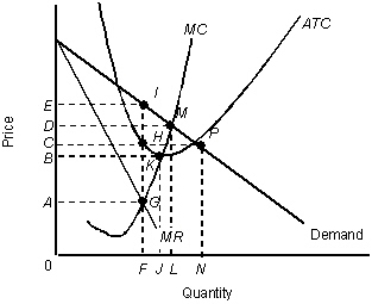 MR: Marginal revenue curve
ATC: Average total cost curve
MC: Marginal cost curve
-Refer to Figure 11.4.What is the profit earned by the firm at equilibrium?
MR: Marginal revenue curve
ATC: Average total cost curve
MC: Marginal cost curve
-Refer to Figure 11.4.What is the profit earned by the firm at equilibrium? (Multiple Choice)
4.7/5 (79)
(79) Celebrity endorsements are often used by monopolistically competitive firms to boost the reputation of the product that is being endorsed.
(True/False)
4.7/5 (71)
(71) The firms in an oligopoly market structure agree to collude because:
(Multiple Choice)
4.7/5 (69)
(69) The figure given below shows revenue and cost curves of a monopolistically competitive firm. Figure: 11.1 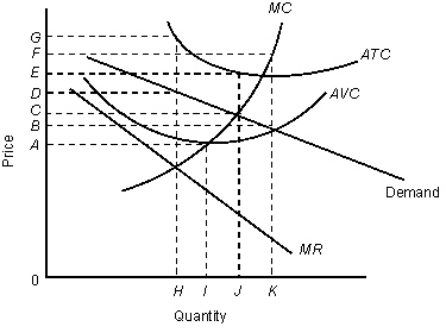 In the figure,
MR: Marginal revenue curve
ATC: Average total cost curve
AVC: Average variable cost curve
MC: Marginal cost curve
-According to Figure 11.1,the firm:
In the figure,
MR: Marginal revenue curve
ATC: Average total cost curve
AVC: Average variable cost curve
MC: Marginal cost curve
-According to Figure 11.1,the firm: (Multiple Choice)
4.9/5 (87)
(87) The following table shows the payoff matrix of the two firms (Firm X and Firm Y) in dollars when they advertise and when they do not advertise. Table 11.1 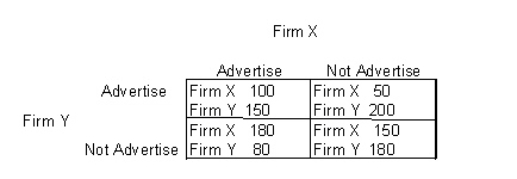 - According to Table 11.1,if both the firms follow their dominant strategies:
 (Multiple Choice)
4.9/5 (70)
(70) If economic losses exist in a monopolistically competitive market,
(Multiple Choice)
4.7/5 (72)
(72) The table below shows the payoff (profit) matrix of Firm A and Firm B indicating the profit outcome that corresponds to each firm's pricing strategy (where $500 and $200 are the pricing strategies of two firms). Table 11.2 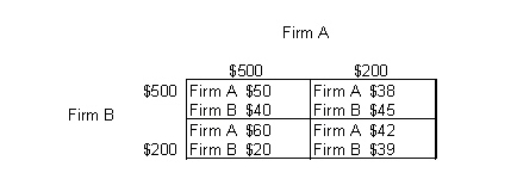 -Refer to Table 11.2.If firm both firm A and firm B choose their dominant strategies then:
 (Multiple Choice)
4.9/5 (88)
(88) Which of the following statements about the monopolistically competitive market in the long run is true?
(Multiple Choice)
4.9/5 (102)
(102) If a monopolistically competitive industry is in long-run equilibrium and suddenly the cost of resources increases,then:
(Multiple Choice)
4.8/5 (84)
(84) Firms in monopolistically competitive markets spend significant sums on product differentiation because:
(Multiple Choice)
4.8/5 (71)
(71) The short-run equilibrium position for a firm in monopolistic competition is the point at which the firm's marginal-cost curve intersects its marginal-revenue curve from above.
(True/False)
4.7/5 (70)
(70) A strategy that produces the best result no matter what strategy the opposing player follows is known as the dominated strategy.
(True/False)
4.9/5 (86)
(86) 
Filters
- Essay(0)
- Multiple Choice(0)
- Short Answer(0)
- True False(0)
- Matching(0)